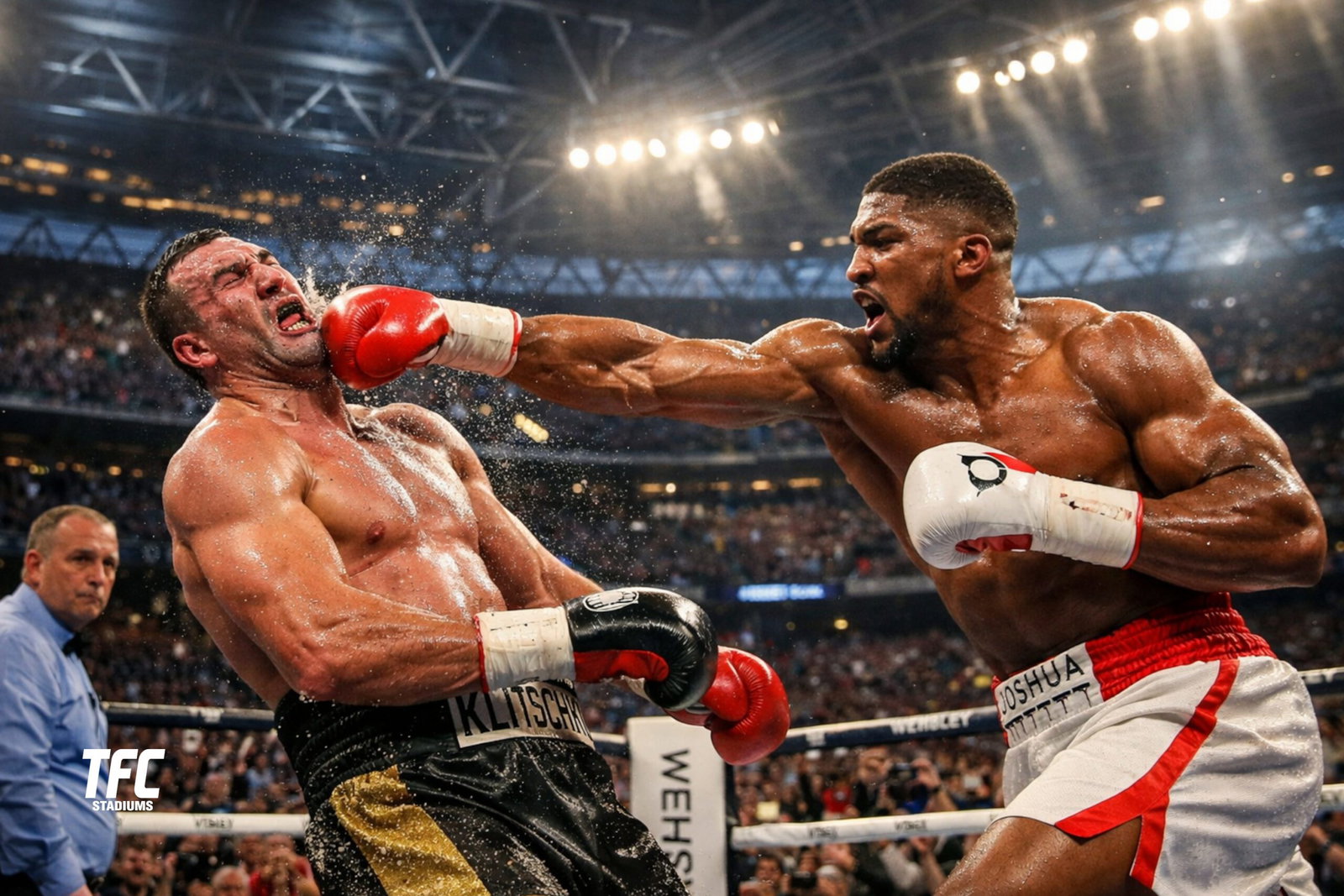
Wembley Stadium has seen plenty of drama, but boxing nights bring a different kind of electricity. Eighty thousand people holding their breath, a single punch changing everything, and a roar that hits you a half second before your brain catches up. This is where careers tilt, reputations harden, and sometimes, legends get knocked sideways.
Below are the knockouts that still get mentioned when Wembley comes up in boxing circles, usually with a pause and a grin.
Anthony Joshua vs Wladimir Klitschko (2017)
The fight that turned Wembley into a heavyweight cathedral.
Joshua knocking down Klitschko early was impressive. Klitschko dropping Joshua later made the place feel like it had lost oxygen. By the time Joshua landed that right hand in the eleventh round, the stadium sounded less like a sports venue and more like controlled demolition.
The stoppage itself was brutal but clean. Klitschko tried to rise, realised the legs were on a different schedule, and the referee did the sensible thing. This was not just a knockout, it was a passing of the torch in front of 90,000 witnesses. Even Klitschko looked like he knew it.
Carl Froch vs George Groves II (2014)
If Wembley had a signature punch, this might be it.
The first fight was all controversy and bad blood. The rematch was simpler. Froch waited. Groves pressed. And then came that right hand in the eighth round that shut the conversation down instantly.
Groves dropped hard, eyes unfocused, and the stadium erupted in the kind of noise usually reserved for cup finals and royal events. Froch never fought again, which feels fitting. If you are going to bow out, doing it with a highlight reel knockout at Wembley is strong form.
Tyson Fury vs Dillian Whyte (2022)
This was Fury in full control mode.
The knockout was not flashy in the cinematic sense. No wild exchange, no desperate scramble. Just a perfectly timed uppercut that landed like it had been measured with a ruler. Whyte fell forward, confused rather than unconscious, which is often worse.
What made this one memorable was the ease of it. Fury barely celebrated. Wembley barely believed it. When a heavyweight makes a knockout look routine, that tells you more than ten rounds of dominance.
Anthony Joshua vs Alexander Povetkin (2018)
Povetkin came to fight and for a few rounds, he made it uncomfortable.
Then Joshua adjusted. A right hand staggered Povetkin. Another followed. The final punch ended it and left Povetkin slumped against the ropes like a man who had just missed the last train home.
This knockout mattered because it showed Joshua learning on the job. Not panicking, not rushing, just taking what was there. Wembley likes growth arcs, and this one landed nicely.
Daniel Dubois vs Nathan Gorman (2019)
Not every Wembley knockout needs a global superstar.
Dubois was the prospect, Gorman the test, and the ending was swift. A left hook in the fifth round put Gorman down and out, the kind of knockout that makes promoters start talking a little louder.
It lacked the scale of the heavyweight blockbusters, but it showed how Wembley can turn a promising night into a career milestone in seconds.
Why Wembley Knockouts Hit Different
There are bigger arenas by capacity and louder ones pound for pound, but Wembley has scale and symbolism. A knockout there does not just end a fight, it echoes. Fighters talk about the sound first, not the punch. The noise arrives like weather.
For British boxers, it is validation. For visitors, it is pressure you cannot simulate. And for fans, it is a reminder that boxing, at its best, still does what it has always done. One moment, total chaos, and everyone knows they just saw something that will be replayed forever.
Final Bell
Wembley knockouts tend to age well. They look better in replays, sound louder in memory, and feel bigger every time someone brings them up in a pub debate. That is the magic of the place. When the lights are right and the punch lands clean, Wembley does the rest.
Written by Rick Dalton, a Los Angeles based sports writer who covers the NFL and NBA with opinions as bold as a Rams fourth down call. He mixes sharp analysis with humour that cuts through the noise and still believes the perfect sporting moment should leave you arguing about it for years.
About the Author