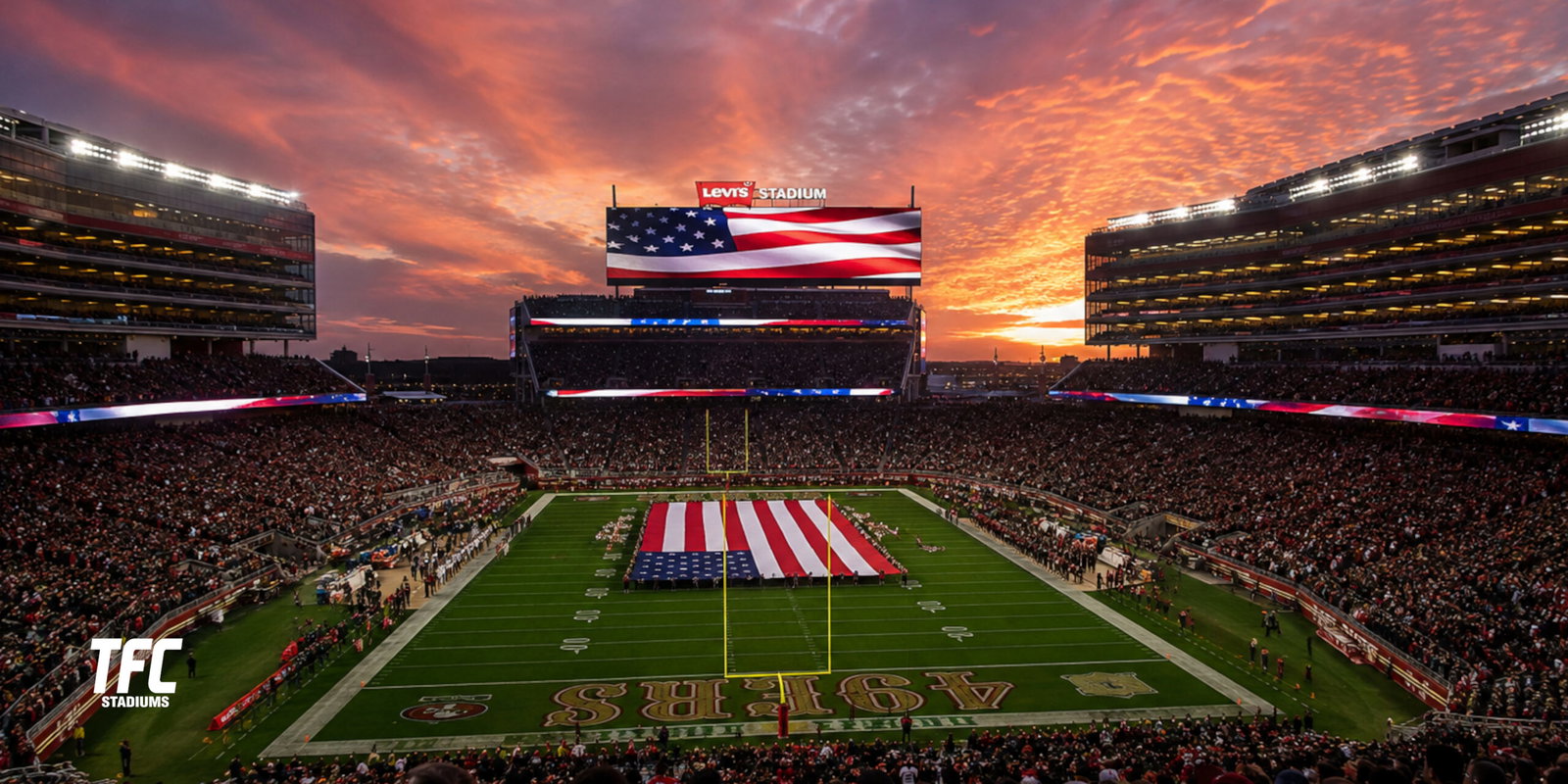
When Levi’s Stadium opened in 2014, it wasn’t simply another shiny new NFL venue. It arrived with a mission to prove that watching football in person could actually compete with sitting on your couch surrounded by three televisions, unlimited snacks and a remote control.
That was a bold challenge.
For decades, stadiums had fallen behind the home viewing experience. Fans tolerated slow queues, patchy phone signals and expensive food because live sport was worth it. Levi’s Stadium decided that wasn’t good enough.
Located in the heart of Silicon Valley, only a short drive from some of the world’s biggest technology companies, it would have been embarrassing if the stadium hadn’t embraced innovation. Fortunately, it leaned into it with enthusiasm.
More than a decade later, many of its ideas have become standard across professional sports.
Built in Silicon Valley
The location matters.
Santa Clara sits among companies that have shaped modern computing, networking and artificial intelligence. Engineers, software developers and entrepreneurs regularly fill the stadium alongside die-hard San Francisco 49ers supporters.
That environment encouraged the organisation to think differently.
Rather than adding technology as an afterthought, digital infrastructure became part of the stadium’s original design.
The result was one of the first true “smart stadiums” in professional sport.
Stadium Technology at a Glance
| Feature | Details |
|---|---|
| Opening Year | 2014 |
| Capacity | Approximately 68,500 for NFL games |
| WiFi Network | Stadium-wide high-density coverage |
| Mobile App | Tickets, parking, navigation, food ordering |
| Payments | Fully cashless concessions |
| Sustainability | Extensive solar power and energy monitoring |
| Video Boards | Massive 4K-capable LED displays with continual upgrades |
| Connectivity | Thousands of wireless access points supporting tens of thousands of simultaneous users |
WiFi That Actually Works
Anyone who attended sporting events before the 2010s remembers the frustration.
You scored the winning touchdown. You reached for your phone to celebrate. Then…nothing.
No signal.
No photos uploaded.
No messages sent.
Levi’s Stadium tackled this problem head-on.
Cisco partnered with the 49ers to install one of the largest high-density wireless networks ever deployed in a sports venue at the time. Hundreds of antennas and thousands of wireless access points were strategically placed beneath seats, inside handrails and throughout concourses to ensure coverage even when every fan reached for their phone simultaneously.
That may sound unremarkable today.
In 2014 it was revolutionary.
Large NFL crowds regularly generate multiple terabytes of wireless data during games, with fans uploading videos, streaming replays, checking fantasy football scores and arguing online about referees before the officials have even left the field.
The Levi’s Stadium App Changed Matchday
Before smartphones became central to the stadium experience, fans spent much of their visit wandering around looking for things.
Where’s my section?
Where’s the nearest bathroom?
Where can I buy garlic fries without standing in line for half the quarter?
Levi’s Stadium answered those questions through its mobile app.
Key features include:
- Digital ticket management
- Interactive stadium maps
- Real-time directions
- Mobile food ordering
- Parking information
- Instant replay access
- Team news and statistics
- Merchandise ordering
Instead of standing in lengthy concession queues, supporters can often order food directly from their seats before collecting it or having it delivered in selected seating areas.
The technology removes friction rather than trying to impress people with flashy gimmicks.
That’s usually the best kind of innovation.
Cashless Everything
Levi’s Stadium has steadily moved towards a completely cashless operation.
For most visitors this means:
- Faster transactions
- Shorter concession queues
- Improved security
- Better sales tracking
- Reduced staffing complexity
Average transaction times are significantly lower than traditional cash purchases, helping concession stands serve more customers during short breaks in play.
It may not sound exciting, but anyone who has spent an entire quarter waiting for nachos knows speed matters.
One of the Greenest Stadiums in America
Technology at Levi’s Stadium extends well beyond phones and giant screens.
The venue was designed as one of the most environmentally conscious stadiums in professional sport.
Key sustainability technology includes:
| Innovation | Purpose |
|---|---|
| Solar panels | Generate renewable electricity |
| Green roof | Reduces heat absorption and improves insulation |
| Smart irrigation | Conserves water |
| Energy monitoring systems | Optimise electricity use |
| LED lighting | Lower energy consumption |
| Water recycling | Reduces overall water demand |
Levi’s Stadium became the first NFL venue to achieve LEED Gold certification shortly after opening, demonstrating that sustainability and major sports venues could comfortably coexist.
As California continues pushing environmental innovation, the stadium remains a useful showcase for energy-efficient design.
Huge Screens, Better Replays
Every modern NFL stadium boasts enormous displays.
Levi’s Stadium made sure its video boards were among the best.
The high-definition screens provide:
- Multiple replay angles
- Live statistics
- Fantasy football information
- Interactive fan features
- Sponsor content
- Concert visuals
The displays have received continual upgrades over the years, ensuring image quality keeps pace with modern broadcasting standards.
When you’re sitting in the upper deck, those screens quickly become your second pair of eyes.
Data Drives Everything
One of the less visible technologies is data analytics.
Every interaction inside the stadium generates valuable information.
The organisation analyses:
- Crowd movement
- Food purchasing trends
- Queue lengths
- Network usage
- Entry gate performance
- Parking patterns
- Merchandise sales
- Fan engagement
This information helps staff deploy resources more efficiently during future events.
If one concession stand consistently develops huge queues while another remains quiet, adjustments can be made before the next game.
It sounds obvious, but only sophisticated data systems make those decisions possible in real time.
Security Has Become Smarter
Modern stadium security relies heavily on technology.
Levi’s Stadium employs systems that include:
- Advanced CCTV monitoring
- Digital credential management
- Electronic ticket validation
- AI-assisted video monitoring
- Modern bag screening equipment
- Integrated emergency communications
These technologies help improve safety while reducing bottlenecks at entrances.
Fans spend less time waiting outside and more time watching football.
That’s generally a win for everyone except perhaps the parking attendant trying to explain where Lot 6 actually is.
Hosting the Biggest Events
Technology has helped Levi’s Stadium become one of America’s premier event venues.
The stadium has hosted:
- NFL regular season games
- College Football Playoff events
- WrestleMania
- International football matches
- Major concerts
- Super Bowl 50
- FIFA World Cup matches
- Super Bowl LX in 2026
Each event places different demands on networking, broadcasting, security and crowd management.
The underlying digital infrastructure allows organisers to adapt without rebuilding the venue for every occasion.
How Levi’s Stadium Compares
| Stadium | Technology Reputation |
|---|---|
| Levi’s Stadium | Early smart stadium pioneer |
| SoFi Stadium | Immersive displays and digital infrastructure |
| Mercedes-Benz Stadium | Advanced connectivity and fan experience |
| Allegiant Stadium | Cashless operations and premium technology |
| AT&T Stadium | Giant displays and broadcast innovation |
While newer venues benefit from more recent hardware, Levi’s Stadium deserves considerable credit for proving that technology could fundamentally improve the live sports experience rather than simply adding novelty.
Many features now expected by fans first gained widespread attention here.
Has the Technology Lived Up to the Hype?
Not every experiment has been flawless.
Early versions of the stadium app occasionally struggled under heavy demand, particularly during major events. Like many ambitious technology projects, updates and refinements were necessary after opening.
Some fans also argue that too much emphasis on digital interaction risks distracting people from the actual game.
There is some truth in that.
No amount of bandwidth can improve a fourth-quarter interception or a missed field goal.
Yet the technology largely succeeds because it operates quietly in the background. Faster entry, reliable connectivity, shorter queues and easier navigation all make the day smoother without demanding attention.
The best technology is often the kind you barely notice.
The Future of Smart Stadiums
Levi’s Stadium continues evolving.
Future developments are likely to include deeper AI integration, more personalised fan experiences, improved augmented reality features, predictive crowd management and increasingly automated operations.
With Silicon Valley just beyond the stadium walls, there will never be a shortage of new ideas waiting to be tested.
Some will become industry standards.
Others will quietly disappear after a season, joining the long list of gadgets that seemed brilliant in a meeting but less convincing once 68,000 football fans arrived.
That is probably fitting.
Innovation has always involved a bit of trial and error, and Levi’s Stadium remains one of the places where the future of live sport is still being written.
About the Author