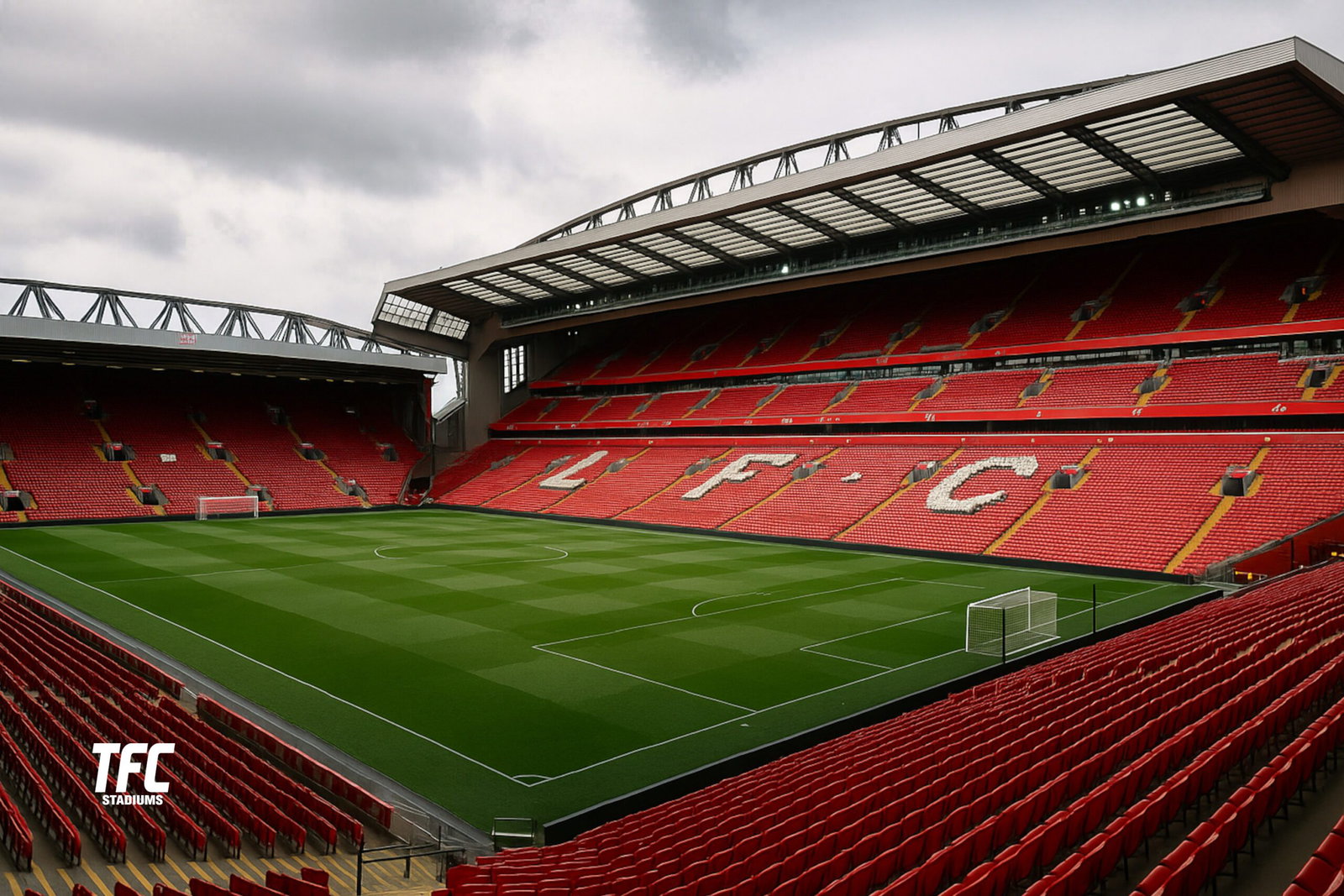
Anfield stands not just as the home of Liverpool FC but as one of football’s most iconic stadiums. From its origins in the 19th century to its present-day redevelopment, Anfield’s transformation tells a story of ambition, rivalry, resilience, and modernisation.
Early Years and Founding (1884–1892)
Anfield was originally built in 1884 for Everton FC. At that time, it was a modest ground with a single stand and an uncovered bank of terracing. The site was leased from John Orrell, a local brewer and friend of Everton board member John Houlding. In a dispute over rent and control, Everton moved to Goodison Park in 1892, prompting Houlding to form a new club: Liverpool FC.
Liverpool played their first match at Anfield in September 1892 in front of just over 200 people. The ground, then holding only 20,000, would soon become the epicentre of a footballing dynasty.
Twentieth-Century Developments
The Spion Kop
In 1906, following Liverpool’s second league title, the famous Spion Kop terrace was built. Named after a hill in South Africa where many local men had died during the Boer War, it quickly became the emotional heart of the stadium. The Kop was a single-tiered bank of terracing and, at its peak, held around 28,000 fans. Its reputation for passion, noise, and unrelenting support made it world-renowned.
Main Stand and Kemlyn Road
By the 1920s, the Main Stand was redeveloped and extended, while the Kemlyn Road Stand, originally a small structure, remained relatively unchanged until the latter half of the century.
In 1957, floodlights were installed for the first time, a sign of modernisation creeping into English football. The Anfield Road End was redeveloped in the 1960s to complete the four-sided bowl.
Post-Heysel and Taylor Report
The tragedy at Heysel in 1985 and the subsequent Hillsborough disaster in 1989 prompted sweeping changes in stadium design across the UK. The Taylor Report in 1990 mandated all-seater stadiums for top-flight clubs.
As a result, the standing Spion Kop was demolished in 1994 and replaced with an all-seater stand. While the new Kop retained the name and some of the spirit, the loss of its terrace form was deeply felt by many.
New Millennium and Modern Expansion
The Stanley Park Project and Shift in Strategy
In the early 2000s, Liverpool explored a complete relocation to a new stadium in Stanley Park, just a few hundred metres away. Several designs were proposed, but ownership instability under Tom Hicks and George Gillett stalled progress.
Under Fenway Sports Group (FSG), the relocation plans were scrapped in favour of expanding Anfield in phases, retaining the ground’s identity and spiritual home.
Main Stand Redevelopment (2016)
The first major phase under FSG was the Main Stand redevelopment. Completed in 2016, the new structure expanded capacity by 8,500 seats, taking the total above 54,000. The stand was built behind the existing one, allowing matches to continue during construction. It introduced:
- Three tiers with improved hospitality suites
- A significantly larger roof structure with cantilevered design
- Enhanced facilities for media, players, and fans
This redevelopment changed the skyline of the city and preserved the acoustic strength of the ground.
Anfield Road Stand Expansion (2021–2024)
The next phase was the Anfield Road End. Work began in 2021 and concluded in 2024, increasing capacity to around 61,000. This expansion followed the same approach: building behind the existing stand to maintain operations.
It included:
- A new upper tier
- Upgraded concourses and hospitality
- Improved accessibility and fan zones
This addition made Anfield the fourth-largest stadium in the Premier League and one of the most atmospheric in Europe.
Architectural Character
Despite the changes, Anfield retains distinct characteristics:
- The Kop remains one of the most imposing single ends in English football.
- The asymmetric layout, especially before the Main Stand rebuild, gave it a unique look.
- Recent work has kept the red-brick aesthetic and incorporated glass façades, respecting tradition while embracing modernity.
Transport, Infrastructure and Community Integration
As capacity increased, so did attention to access and local impact. Improvements included:
- Upgraded local rail stations and bus routes
- Pedestrianised fan zones around the stadium
- Community-led development of retail and public space
Efforts were made to ensure that expansion benefited the local Anfield area, which had long suffered from economic challenges.
Legacy and Cultural Role
Anfield’s evolution mirrors Liverpool’s broader story: forged in working-class roots, shaken by tragedy, driven by passion, and reborn through resilience. The stadium is not just a venue but a cultural institution, steeped in memory and defiance.
It remains a fortress where flags ripple to the sound of “You’ll Never Walk Alone”, where architecture serves both spectacle and soul.
Looking Ahead
Further upgrades may yet come, including potential improvements to the Kop’s facilities or digital connectivity enhancements throughout the stadium. Yet, there is a shared understanding among supporters and club officials that any changes must never compromise Anfield’s identity.
The ground stands as both a modern stadium and a living monument, shaped not by architects alone but by those who fill its stands week after week.
About the Author