For decades, attending a game at Hard Rock Stadium meant preparing for two things, football and Florida’s relentless weather. The Miami heat, heavy humidity and sudden tropical downpours were as much a part of the experience as the action on the field. While the stadium itself remained one of the NFL’s largest venues, many fans found themselves baking under the afternoon sun.
That changed dramatically in 2016.
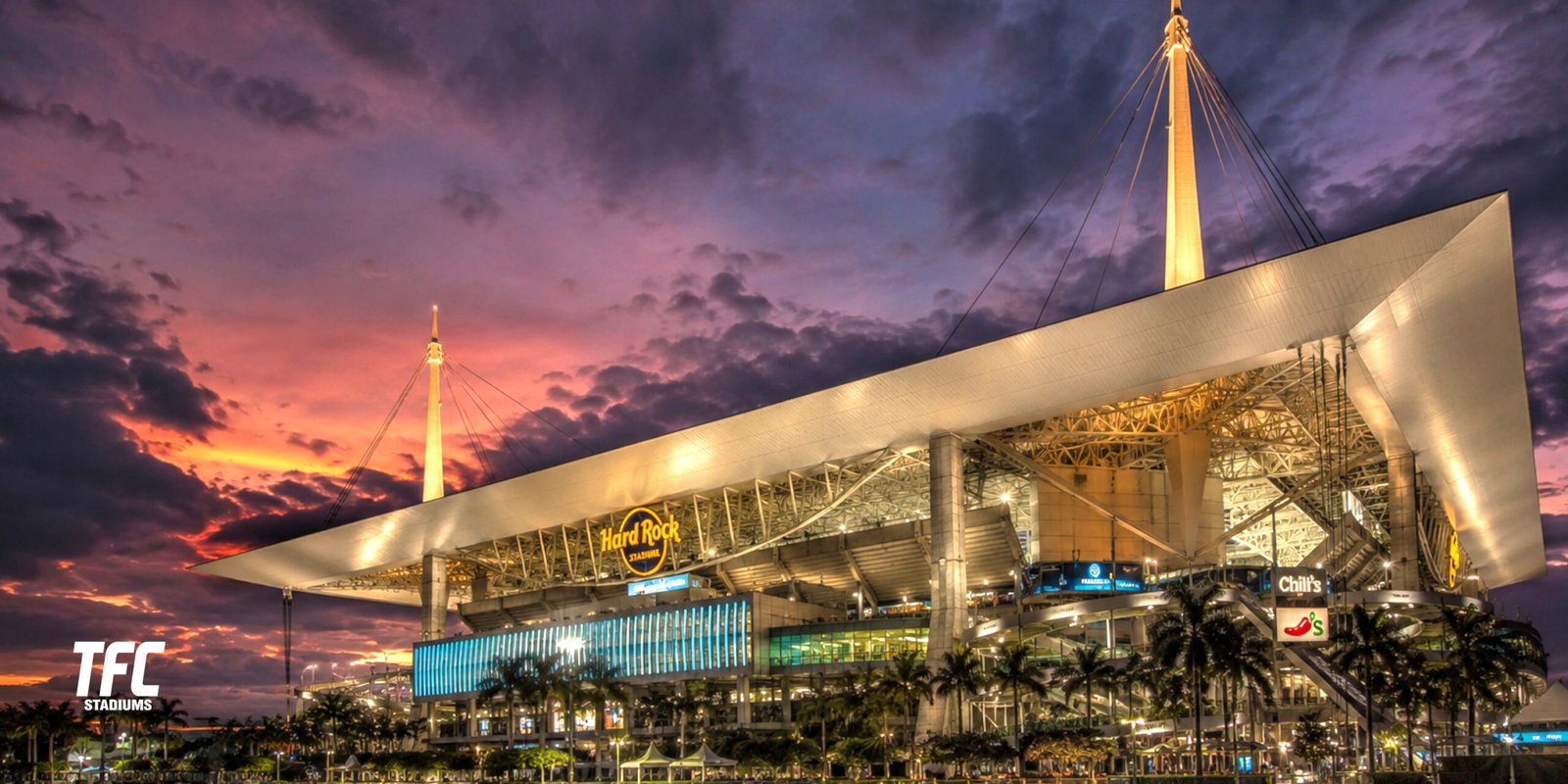
The addition of Hard Rock Stadium’s enormous canopy roof became one of the most successful stadium renovations in modern American sport. Rather than enclosing the venue completely, designers created a lightweight structure that protects spectators while leaving the field open to the elements. It was an elegant compromise that preserved football’s outdoor character while making the stadium significantly more comfortable.
Today, the canopy has become one of the defining features of Hard Rock Stadium and a major reason why the venue continues to attract the biggest events in world sport.
Why Hard Rock Stadium Needed a Roof
When the stadium opened in 1987, it reflected the design priorities of the era. Large concrete bowls maximised capacity, but weather protection received relatively little attention.
Miami presents unique challenges for stadium architects.
Summer temperatures regularly exceed 30°C, humidity often sits above 70 percent, and thunderstorms can appear with very little warning. Afternoon kick-offs frequently left thousands of spectators sitting in direct sunlight for several hours.
Unlike many northern NFL cities, heat was often a greater concern than rain.
By the early 2010s, the stadium’s owners recognised that improving fan comfort had become essential if the venue wanted to compete for premium events such as the Super Bowl, international football tournaments and major concerts.
Rather than building an entirely new stadium, they chose an ambitious redevelopment.
A Roof Without Closing the Stadium
The solution was surprisingly innovative.
Instead of installing a retractable roof or creating a fully enclosed venue, architects designed a massive canopy that sits above the seating bowl while leaving the playing surface completely open.
This approach delivered several important benefits.
The grass pitch still receives direct sunlight and natural rainfall.
The open-air atmosphere remains intact.
Wind can continue flowing across the field.
Fans gain extensive protection from both sun and rain.
It is a simple concept on paper, but the engineering required to achieve it was anything but simple.
Engineering on a Massive Scale
The canopy spans approximately 14 acres, making it one of the largest stadium roof structures in North America.
Rather than resting on the existing stadium, the roof is supported by four enormous corner columns positioned outside the original seating bowl. Massive steel trusses stretch between these supports, allowing the roof to appear as though it floats above the stadium.
This design was particularly important because engineers wanted to avoid placing excessive loads on a structure that had originally been built decades earlier.
The completed canopy contains thousands of tonnes of structural steel and required extraordinary precision during construction.
From many viewing angles, the roof almost disappears against the Miami sky, giving the illusion of a much lighter structure than its true size suggests.
Protecting Fans Without Blocking the Game
One of the roof’s greatest successes lies in how effectively it shades spectators.
Studies carried out during the design process examined the movement of the Florida sun throughout the year. The canopy was shaped specifically to maximise shade during afternoon events, when temperatures are typically highest.
Depending on the time of day, well over 90 percent of seats receive protection from direct sunlight.
That single improvement has transformed the matchday experience.
Rather than spending four hours exposed to intense heat, spectators now enjoy significantly cooler seating conditions while still experiencing an outdoor event.
For many regular visitors, it remains the stadium’s biggest improvement.
Rain Protection That Makes a Difference
Florida storms rarely arrive politely.
Heavy rain can begin within minutes before disappearing just as quickly.
The canopy dramatically reduces the impact of these sudden downpours by covering the majority of spectator seating.
Supporters can often remain comfortably in their seats while rain falls onto the open playing surface below.
The field itself still receives rainfall, preserving the natural conditions expected for outdoor football while keeping spectators considerably drier than before.
Concert organisers have also benefited, with improved protection for audiences during unpredictable weather.
A Stadium Built Around Natural Grass
Unlike fully enclosed stadiums, Hard Rock Stadium continues using a natural grass playing surface.
This was an important objective during the redesign.
Natural grass requires sunlight, rainfall and airflow to remain healthy throughout a long season.
Because the field remains uncovered, grounds staff avoid many of the challenges faced by enclosed venues that rely on artificial lighting rigs and extensive climate control systems.
The result is one of the NFL’s more consistently praised natural playing surfaces.
The Roof Changed More Than Comfort
The canopy was only one part of a wider redevelopment costing around $500 million, but it became the centrepiece.
Following the renovation, Hard Rock Stadium strengthened its position as one of America’s leading multi-purpose venues.
It has hosted:
| Event | Significance |
|---|---|
| Super Bowl LIV | Kansas City Chiefs defeated the San Francisco 49ers |
| Formula 1 Miami Grand Prix | International motorsport showcase |
| Miami Open | One of tennis’ biggest annual tournaments |
| FIFA Club World Cup matches | Global football competition |
| FIFA World Cup 2026 matches | One of the tournament’s premier American venues |
| Major concerts | Taylor Swift, Beyoncé, The Rolling Stones, U2 and many others |
A more comfortable stadium makes bidding for major events far easier. Event organisers know spectators are more likely to enjoy long outdoor sessions without battling extreme heat for hours.
The Visual Identity of Hard Rock Stadium
The roof transformed the appearance of the stadium almost overnight.
Previously, Hard Rock Stadium resembled many late twentieth century concrete arenas.
Today, the sweeping white canopy gives the venue a far more modern identity.
From aerial photographs, the roof creates a striking geometric outline that distinguishes it from almost every other NFL stadium.
At night, sophisticated lighting integrated into the structure further enhances its appearance, creating dramatic scenes during major sporting events and concerts.
It is one of those rare renovations that improved both function and aesthetics in equal measure.
Lessons for Future Stadium Design
The Hard Rock Stadium project demonstrated that a complete rebuild is not always necessary.
Many stadium owners face the same challenge. Existing venues often have excellent locations and strong transport links, yet struggle to meet modern expectations.
The canopy showed how targeted investment can dramatically improve the fan experience without replacing an entire stadium.
Several later renovation projects across North America have adopted similar principles, focusing on shade, weather protection and spectator comfort instead of fully enclosing their venues.
As climate concerns and rising summer temperatures become increasingly important, shade structures are likely to play an even greater role in future stadium design.
How Fans View the Canopy
Speak to regular visitors and one opinion appears again and again.
The stadium simply feels better.
The difference is immediately noticeable on hot afternoon kick-offs, when spectators can watch the action without constantly searching for shade or retreating to concourses.
Concertgoers also benefit from greater protection during Florida’s famously unpredictable weather, while television broadcasts capture a venue that looks contemporary from every angle.
Not every renovation completely changes how people experience a stadium. This one arguably did.
Final Thoughts
The canopy roof at Hard Rock Stadium represents one of the most effective stadium upgrades of the past two decades.
Rather than chasing the trend of fully enclosed arenas, designers found a solution tailored specifically to Miami’s climate. The result preserved the character of outdoor sport while solving the biggest complaints that had followed the stadium since it opened.
It protects fans from the harshest sun, softens the impact of sudden storms, supports a high quality natural grass field and gives the venue an instantly recognisable silhouette.
The best stadium architecture often goes unnoticed because everything simply works. Hard Rock Stadium’s canopy is different. It catches your eye immediately, but its greatest achievement is how much more enjoyable it has made every event beneath it.
About the Author