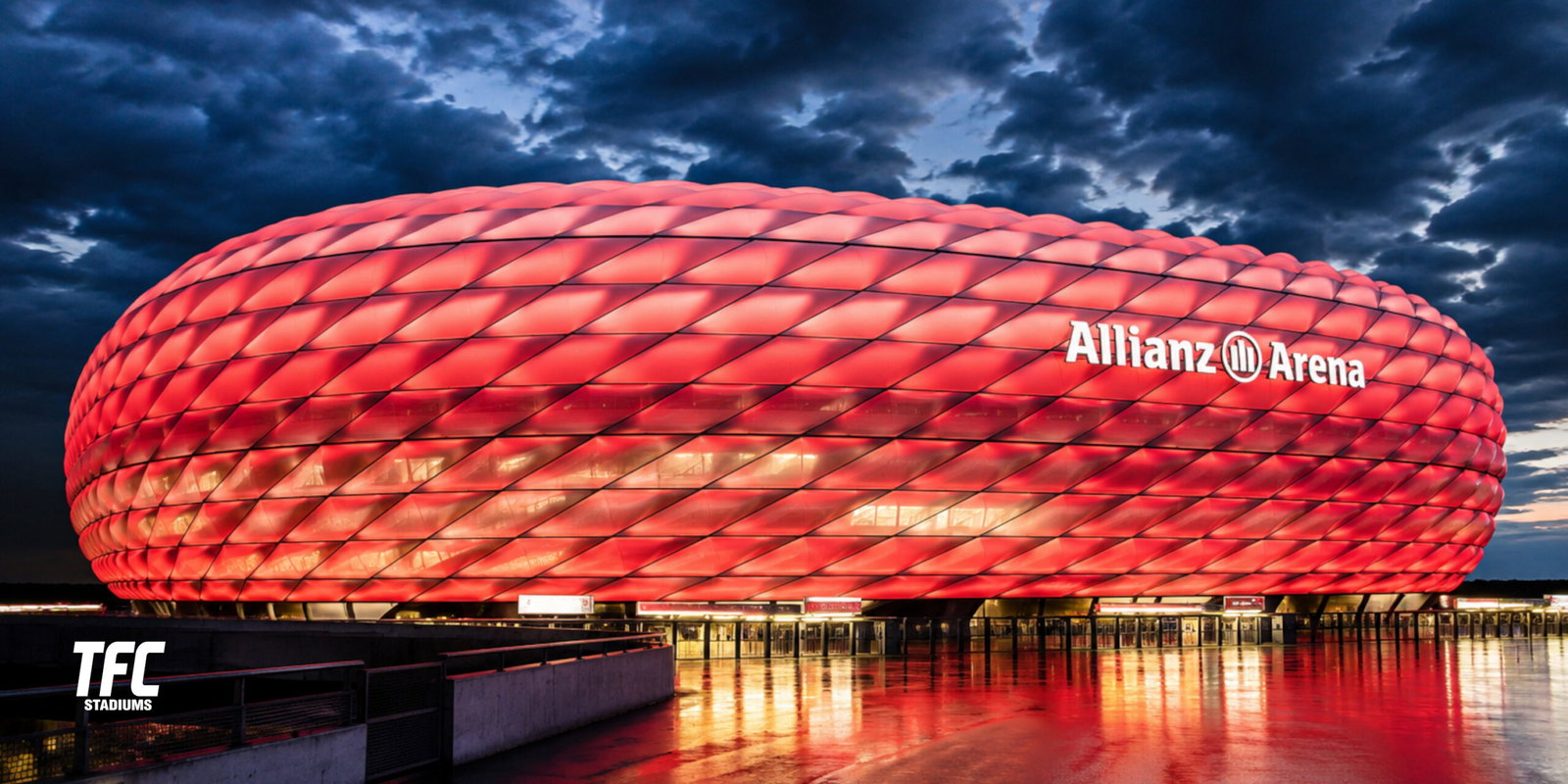
Few stadiums are recognised as quickly as the Allianz Arena. Even in silhouette it stands apart. While many football grounds impress through size or history, Munich’s famous stadium captures attention through something less obvious. Mathematics.
At first glance, the building appears almost organic, like a glowing cloud resting beside the motorway. Look closer and everything is remarkably precise. Every curve, panel and structural element follows carefully calculated geometric principles that balance beauty, engineering and practicality.
Completed in 2005, Allianz Arena became one of the defining architectural landmarks of the modern sporting era. More than twenty years later, it still feels futuristic.
A Stadium Designed Around Simplicity
Architects Herzog & de Meuron approached the project with a deceptively simple question.
How do you design a stadium that feels completely different from every other football ground?
Rather than creating another concrete bowl, they imagined a smooth, continuous form without obvious corners or interruptions. Geometry became the tool that made this possible.
Instead of relying on decorative features, the building’s identity comes from its shape itself.
The result is a stadium that appears soft despite being constructed from thousands of tonnes of steel and reinforced concrete.
The Diamond Pattern That Defines the Arena
The most recognisable feature is the exterior façade.
It consists of almost 2,900 inflated ETFE cushions arranged in a repeating diamond pattern across the entire building.
These cushions are not random decorative elements. Their geometry allows the curved surface to be divided into manageable sections while maintaining structural consistency.
Allianz Arena Façade Facts
| Feature | Detail |
|---|---|
| Opening Year | 2005 |
| Architects | Herzog & de Meuron |
| Exterior Panels | Approximately 2,874 ETFE cushions |
| Stadium Height | Around 50 metres |
| Length | Approximately 258 metres |
| Width | Approximately 227 metres |
| Capacity | Around 75,000 for Bundesliga matches |
Each cushion measures differently depending on its location, allowing the curved outer shell to maintain its flowing appearance.
Standing nearby, you quickly realise there are almost no perfectly flat surfaces. The geometry constantly changes as the stadium curves around you.
Why Diamonds Instead of Squares?
Square panels would have introduced visible distortion as the surface curved around the stadium.
Diamond-shaped modules adapt far more naturally to changing angles.
This offers several advantages.
- Reduced structural stress
- More even distribution of loads
- Greater visual consistency
- Easier replacement of individual cushions
- Better accommodation of the stadium’s compound curves
Nature often uses similar principles.
Honeycombs, fish scales and certain leaf structures rely on repeating geometric forms that create both flexibility and strength. Allianz Arena applies comparable ideas on a monumental scale.
The Engineering Behind the Curves
One of the greatest challenges was constructing a bowl that appeared continuous while supporting tens of thousands of spectators.
The roof and seating structure rely on an intricate steel framework that distributes enormous loads throughout the stadium.
Key engineering considerations included:
- Crowd loading during full capacity events
- Wind pressure across the curved exterior
- Snow accumulation during Bavarian winters
- Thermal expansion during seasonal temperature changes
- Earth movement and long-term settlement
Every beam sits within a larger geometric framework. Nothing is placed purely for visual effect.
This hidden skeleton allows the elegant outer form to exist without compromising safety or durability.
The Mathematics of Sightlines
Geometry inside the stadium is just as important as outside.
Modern football grounds are designed using precise calculations to ensure supporters remain as close as possible to the action while maintaining unobstructed views.
At Allianz Arena this meant carefully balancing:
- Rake angle of seating
- Height of each row
- Distance from the pitch
- Roof overhang
- Viewing angles from every section
The bowl wraps tightly around the playing surface, creating excellent visibility while helping contain crowd noise.
Watching a match here, you notice how steep some upper sections feel. It might seem intimidating for first-time visitors, but those angles are exactly what improve the viewing experience.
ETFE Changed Stadium Architecture
The decision to use ETFE rather than glass transformed the project.
ETFE is a transparent fluoropolymer that weighs only a fraction of traditional glazing while remaining remarkably durable.
Advantages include:
| ETFE Benefits | Impact |
|---|---|
| Lightweight | Reduced structural requirements |
| High light transmission | Bright daytime appearance |
| Self-cleaning surface | Lower maintenance costs |
| Excellent insulation | Improved energy efficiency |
| Flexible material | Ideal for complex geometry |
Each cushion is inflated using low-pressure air systems, allowing the façade to maintain its distinctive appearance while remaining surprisingly lightweight.
Lighting as Part of the Architecture
The lighting system is not simply attached to the stadium.
It is integrated into its geometry.
Each cushion can be illuminated, transforming the entire building into a giant three-dimensional display.
Originally, the stadium changed colour depending on which club was playing.
- Red for Bayern Munich
- Blue for TSV 1860 Munich
- White for the German national team
Today, lighting technology allows for thousands of colour combinations and animated displays during major events.
Rather than highlighting the architecture, the lighting becomes part of it.
A Bowl Designed for Acoustics
Geometry influences sound just as much as appearance.
The continuous roof reflects crowd noise back towards the pitch while preventing much of it from escaping vertically.
Combined with steep seating angles, this creates an atmosphere that often feels louder than the raw attendance figures might suggest.
Architects increasingly recognise acoustics as part of stadium design rather than an afterthought.
Allianz Arena demonstrated how carefully calculated geometry could enhance both player experience and spectator atmosphere.
Structural Efficiency Through Repetition
Although the stadium appears highly complex, repetition keeps construction practical.
Thousands of similar structural components reduce manufacturing costs while improving installation efficiency.
This principle appears throughout the project.
- Repeating steel members
- Modular façade cushions
- Standardised seating sections
- Consistent roof supports
Good architecture often hides complexity behind apparent simplicity.
Allianz Arena achieves exactly that.
How the Design Influenced Future Stadiums
Many modern stadiums owe something to Allianz Arena.
Its success encouraged architects to explore lightweight membranes, illuminated façades and cleaner exterior forms.
Later venues across Europe, Asia and the Middle East adopted similar ideas, although few achieved the same balance between engineering precision and visual identity.
Rather than relying on giant video screens or dramatic roof sculptures, Allianz Arena proved geometry itself could become the defining feature.
That remains surprisingly rare.
Does the Design Still Feel Modern?
Considering it opened in 2005, the answer is an easy yes.
Many stadiums built during the same period already feel tied to their era. Allianz Arena largely avoids that problem because its design is driven by mathematical principles rather than passing architectural trends.
The smooth curves, restrained detailing and illuminated skin still look contemporary more than two decades later.
That is often the hallmark of exceptional architecture. When the underlying geometry is right, fashions come and go while the building continues to feel fresh.
TFC Takeawayhttps://youtu.be/lqW7KybDQeE?si=Iq6s-oaojpvoncPQ
Some stadiums become famous because of unforgettable matches. Others because of their history or atmosphere.
Allianz Arena belongs in another category altogether.
Its greatest achievement may be making mathematics feel emotional.
Behind every glowing panel lies careful engineering, precise geometry and thousands of interconnected calculations working together so seamlessly that most visitors never notice them. They simply see a stadium unlike any other.
Perhaps that is the highest compliment architecture can receive. When extraordinary complexity disappears beneath effortless elegance, the design speaks for itself.
About the Author