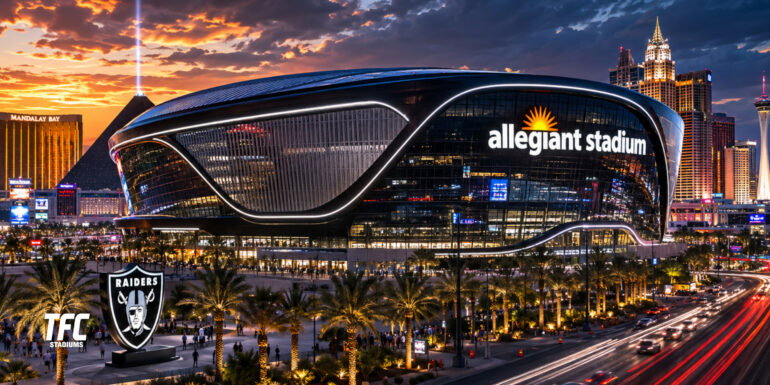
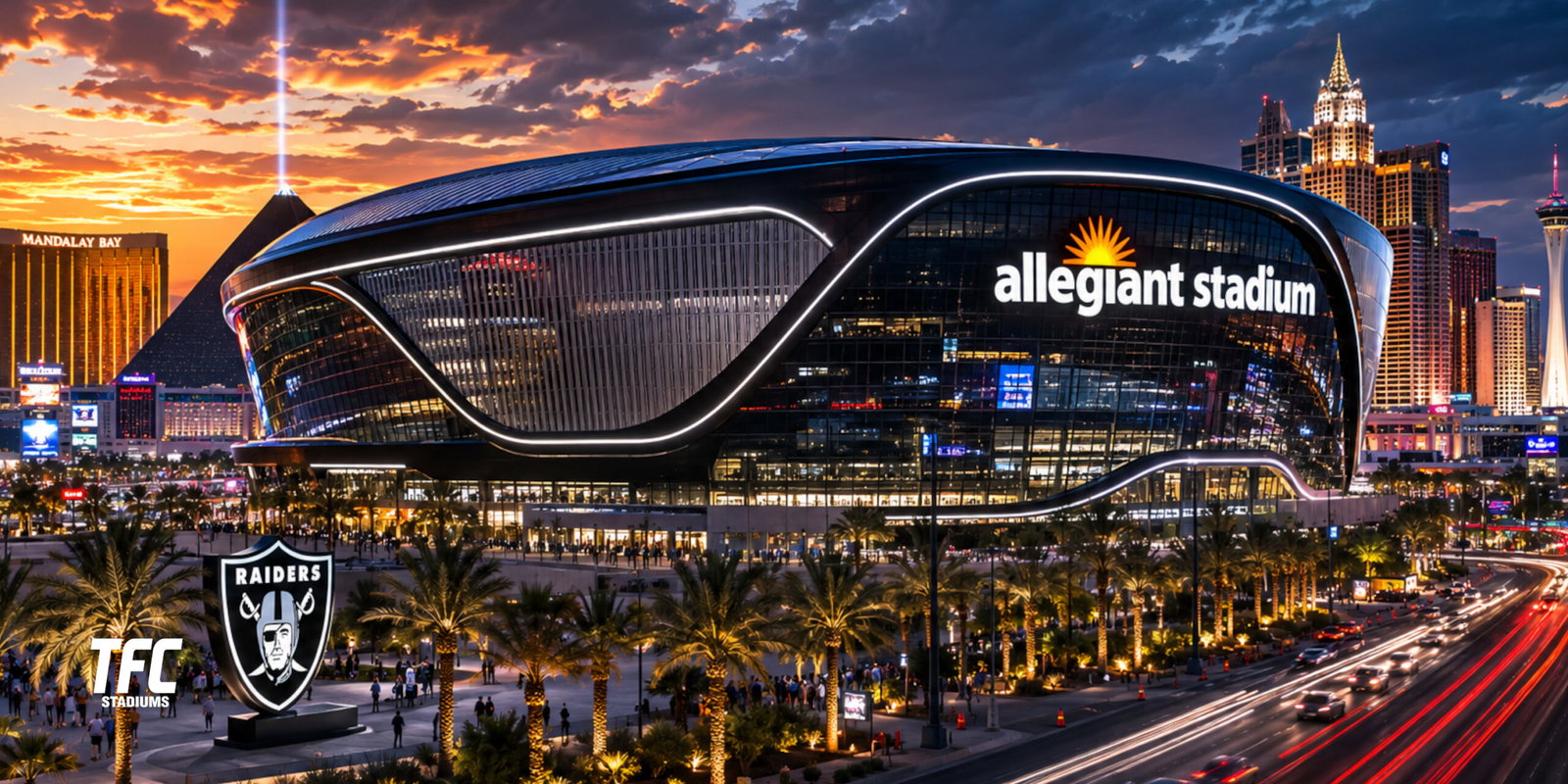
Allegiant Stadium looks like someone parked a gigantic black spaceship beside the Las Vegas Strip and decided to play football inside it.
Which, frankly, is about as Raiders as architecture gets.
Opened in 2020 as the new home of the Las Vegas Raiders, the stadium was designed by MANICA Architecture with HNTB serving as architect of record. The finished building covers roughly 1.8 million square feet, seats around 65,000 spectators and cost approximately $1.9 billion to construct.
Yet the numbers only explain the scale. They do not explain why Allegiant Stadium looks the way it does.
The design grew from several overlapping ideas: the visual identity of the Raiders, futuristic automotive styling, Las Vegas entertainment architecture, the Nevada climate and a desire to create something that could immediately become recognisable on television.
There is also the small matter of the Death Star.
That nickname was not an architectural accident.
The Raiders Came Before Las Vegas
The most important design influence was always the Raiders themselves.
Silver and black is one of the strongest visual identities in American professional sport. Moving the franchise to Nevada created a problem architects could easily have got wrong. The Raiders needed a modern Las Vegas stadium without looking as though somebody had put slot machines in the Oakland Coliseum.
Instead, the design went in the opposite direction.
The exterior is dominated by dark glass, black structural surfaces and silver elements. There is relatively little visual clutter. From a distance, the stadium appears almost monolithic.
That restraint matters.
Las Vegas is filled with buildings screaming for attention. Allegiant Stadium gets attention by looking strangely calm among them.
Architect David Manica had already worked with Raiders owner Mark Davis on plans connected with an earlier proposed move to Southern California. When the Las Vegas project developed, elements of that work were retained and refined for the new location. The Raiders themselves describe the eventual design as enhancing characteristics from the earlier project while creating a building that complemented the Las Vegas Strip.
So Allegiant Stadium was not conceived entirely from scratch after the Raiders arrived in Nevada. There was already a design language developing around what a purpose-built Raiders stadium should look like.
A Futuristic Luxury Car Was a Major Inspiration
One of the more interesting documented influences is automotive design.
Mortenson describes the stadium as being visually inspired by the gradual curves of a futuristic luxury vehicle.
Once you know that, it becomes difficult not to see it.
Look at Allegiant Stadium from the side rather than directly from the front. The building has the long horizontal profile of a concept car. The black glazing resembles tinted automotive glass, while silver structural elements act almost like trim.
There are few unnecessary projections interrupting the silhouette.
It is closer to automotive industrial design than traditional stadium architecture.
That also makes considerable sense for the Raiders. Their visual culture has always contained motorcycles, leather, chrome, customised cars and a certain slightly threatening road-warrior quality.
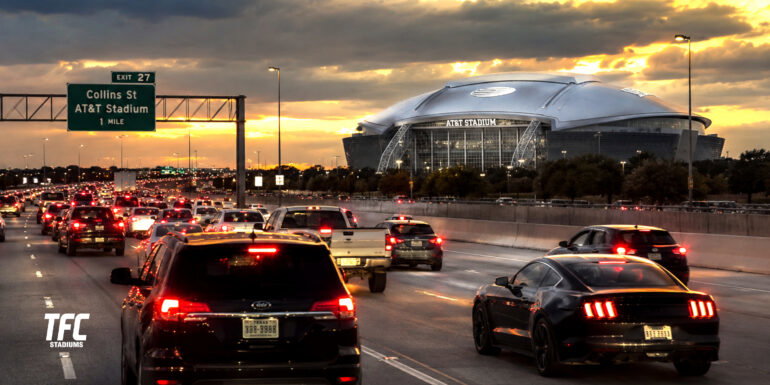
If the Dallas Cowboys built an enormous monument to Texas spectacle at AT&T Stadium, the Raiders effectively built the NFL equivalent of a black concept car.
Naturally, they parked it in Vegas.
Why Allegiant Stadium Looks Like the Death Star
The Death Star comparison appeared almost immediately.
There is no need to pretend otherwise. The building is enormous, black, futuristic and slightly sinister. Put it against the Nevada desert and the comparison more or less writes itself.
Raiders owner Mark Davis enthusiastically adopted the nickname.
When the team first practised inside the stadium in August 2020, Davis welcomed them to the “Death Star” and added that it was where opponents’ dreams would come to die.
That tells us something important about the success of the architecture.
The nickname fits the franchise.
Raiders branding has traditionally leaned into intimidation. The pirate shield, black uniforms, silver helmets and reputation of the old Oakland teams all contributed to an identity built around being outsiders.
A shiny white stadium would have felt peculiar.
Allegiant looks imposing without relying upon decorative gimmicks. Its sheer dark mass does most of the work.
And yes, it looks especially good at night.
Las Vegas Influenced the Stadium Without Taking It Over
Designing anything substantial in Las Vegas presents an interesting architectural problem.
How much Vegas do you put into it?
Too little and the building could be anywhere. Too much and you risk constructing a football-themed casino.
Allegiant Stadium takes a fairly disciplined approach.
Its connection with Las Vegas is expressed primarily through orientation, views, entertainment spaces and atmosphere rather than obvious decorative references.
The stadium stands just west of Interstate 15, close enough to the Strip for the skyline to become part of the experience.
Large operable walls at the north end can open towards views of Las Vegas.
That was a smart piece of design.
Instead of attempting to compete architecturally with the Strip, Allegiant uses the Strip itself as scenery.
The city becomes part of the stadium.
The Lanai Doors Create the Las Vegas Connection
Among Allegiant Stadium’s most distinctive architectural elements are the huge operable openings at its northern end.
Opening this part of the building visually connects the enclosed stadium with Las Vegas beyond.
It helps solve one of the fundamental problems of domed stadium design.
Enclosed NFL venues can become inward-looking boxes. Climate control improves comfort, but you sometimes lose any sense of where the stadium actually is.
Allegiant attempts to provide both.
Fans get an air-conditioned environment suitable for southern Nevada while retaining a visual relationship with the city.
It is particularly effective because Las Vegas has a skyline worth framing.
Nobody is spending two billion dollars designing giant windows towards an industrial estate.
The Roof Was Inspired by Climate as Much as Appearance
The roof provides one of the best examples of architecture responding to Las Vegas rather than simply decorating it.
Allegiant Stadium uses an approximately seven-acre ETFE roof supported by a cable-net system involving 100 stainless-steel cables.
ETFE has become increasingly common in modern stadium architecture because it is lightweight and capable of admitting natural light.
But Las Vegas creates an obvious complication.
Sunlight is not exactly difficult to find.
Early thinking included more transparent roof panels, similar in concept to those used at U.S. Bank Stadium in Minneapolis. According to Mortenson, Mark Davis attended Super Bowl LII there and felt the sunny environment was too bright. Nevada’s desert climate also created energy and cooling issues.
The solution was silver fritting within the ETFE material, which reflects heat and reduces the amount of direct light entering the building. Mortenson says the frit patterns can provide opacity of up to 95 per cent.
It is a nice example of engineering changing the aesthetic.
The roof still feels light and modern, but Allegiant does not become a 65,000-seat greenhouse.
As somebody raised in Los Angeles, I appreciate architecture that eventually remembers the sun exists.
Why Allegiant Stadium Has a Fixed Roof
The absence of a conventional retractable roof is significant.
During the 1990s and 2000s, retractable roofs became one of those features every ambitious American stadium seemed expected to have. Houston got one. Dallas got one. Indianapolis got one.
Then owners began looking at how often some of these things were actually opened.
Retractable roofs are heavy, expensive and mechanically complicated. Mortenson has noted the broader movement towards fixed translucent roofing as stadium designers looked for ways of producing an indoor-outdoor feeling without installing enormous moving roof structures.
In Las Vegas, climate control was always going to dominate the conversation.
A fixed translucent roof therefore made sense financially and operationally while still allowing daylight into the stadium.
It is less theatrical than watching a roof slide open.
It is also considerably harder to break.
The Retractable Grass Field Flips the Traditional Idea
If the roof does not move, the football field does.
This is one of Allegiant Stadium’s cleverest engineering decisions.
The Raiders play on natural grass. Rather than attempting to maintain that grass permanently beneath the roof, the entire playing surface sits on a huge movable tray.
The field weighs close to 20 million pounds and travels on 540 electrically powered wheels. When required, it can be moved outside the stadium where the grass receives natural sunlight and irrigation.
Inside, an artificial surface can be used for UNLV football and other events.
There is a certain beautiful absurdity to moving an entire football field outdoors because the roof refuses to move.
But technically it makes sense.
It also reflects one of the larger ideas behind Allegiant Stadium: separate systems according to their function rather than forcing one enormous mechanism to solve everything.
The Al Davis Memorial Torch Gives the Building a Heart
For all the glass, cables, engineering and luxury spaces, Allegiant Stadium needed something emotionally connected to Raiders history.
That role belongs largely to the Al Davis Memorial Torch.
The torch honours the longtime Raiders owner whose influence shaped almost every aspect of the franchise’s identity.
That matters because Allegiant could otherwise have felt like a complete break with Oakland.
Modern NFL stadiums can sometimes resemble extremely expensive international airports. They are technologically impressive, commercially efficient and strangely detached from the teams playing inside them.
The Raiders avoided some of that by incorporating their history directly into the building.
The torch gives supporters a symbolic focal point and connects the Las Vegas era with everything that came before it.
Without elements like this, Allegiant might simply have been an impressive building.
With them, it becomes recognisably a Raiders building.
Las Vegas Entertainment Culture Shaped the Interior
The influence of Las Vegas becomes more obvious once you move inside.
Allegiant Stadium was designed as a multipurpose entertainment venue rather than simply somewhere to stage eight or nine NFL regular-season games each year.
Premium hospitality occupies a significant role.
Perhaps the most Vegas example is Wynn Field Club, an approximately 11,000-square-foot nightlife venue located at field level in the north end zone. It incorporates DJ booths, bottle service, extensive screens and a 45,000-watt sound system.
At most stadiums, having a nightclub practically touching the end zone would seem ridiculous.
In Las Vegas, you wonder why nobody installed two.
The design acknowledges that the stadium competes within one of the world’s largest entertainment markets.
Fans arriving in Las Vegas already have hundreds of places demanding their money and attention. Allegiant therefore has to function as part sporting arena, part hospitality venue and part major-event destination.
Technology Became Part of the Architecture
Another major influence was the changing expectation of what an NFL stadium should provide.
Allegiant was built during an era when stadiums were becoming enormous digital platforms.
Mortenson reports more than 66,000 square feet of LED displays, three 4K HDR-capable video boards and extensive wireless infrastructure. Earlier construction information detailed more than 1,700 Wi-Fi access points and hundreds of miles of connectivity infrastructure.
Those systems influence architecture because modern stadium design has to accommodate far more than seats and concourses.
Power, data, screens, broadcast infrastructure, mobile ticketing and wireless coverage have become fundamental building services.
The modern stadium is essentially a giant computer with hot dogs.
Allegiant Stadium by the Numbers
| Feature | Allegiant Stadium |
|---|---|
| Opened | 2020 |
| Primary tenant | Las Vegas Raiders |
| Capacity | Approx. 65,000 |
| Floor area | Approx. 1.8 million sq ft |
| Construction cost | Approx. $1.9 billion |
| Design architect | MANICA Architecture |
| Architect of record | HNTB |
| Main contractor | Mortenson-McCarthy |
| Roof | Fixed translucent ETFE |
| Roof area | Approx. 7 acres |
| Roof support | 100 stainless-steel cables |
| Raiders field | Retractable natural grass tray |
| Field tray weight | Nearly 20 million lb |
| Field movement | 540 electrically powered wheels |
How Allegiant Fits Into Modern NFL Stadium Design
Allegiant Stadium belongs to the generation that followed AT&T Stadium and preceded the next wave of increasingly specialised American sports venues.
AT&T Stadium demonstrated the commercial potential of turning an NFL ground into a destination in its own right.
Mercedes-Benz Stadium pushed expressive roof architecture.
U.S. Bank Stadium demonstrated how extensive translucent roofing could transform an enclosed stadium.
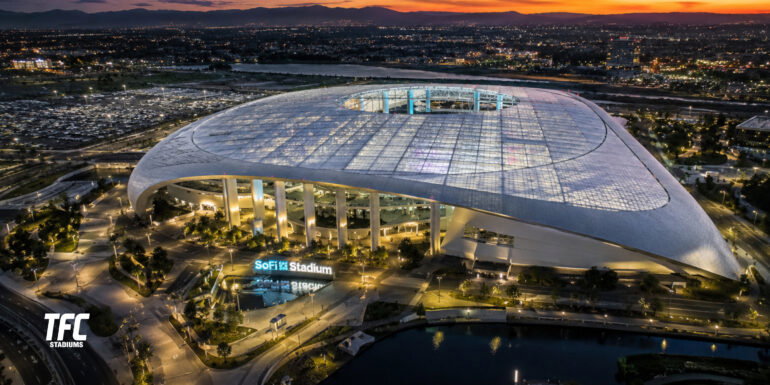
SoFi Stadium went considerably further, essentially blurring the boundaries between stadium, entertainment complex and urban development.
Allegiant sits somewhere between these philosophies.
It is less architecturally complicated than SoFi and considerably more restrained externally than Mercedes-Benz Stadium. Its strongest visual idea is remarkably simple.
Make it black.
Make it sleek.
Make it unmistakably Raiders.
Then point part of it towards Las Vegas.
That simplicity has aged rather well.
Design Versus Practicality
The clever thing about Allegiant Stadium is that several features which look dramatic are actually responses to practical problems.
| Design decision | Practical reason | Visual effect |
| Black and silver exterior | Raiders identity | Creates the Death Star appearance |
| Enclosed stadium | Nevada heat | Allows year-round climate control |
| ETFE roof | Daylight without conventional heavy roofing | Bright, futuristic interior |
| Silver roof frit | Reduces solar heat and glare | Reinforces Raiders colouring |
| Operable north walls | Connection with outside environment | Frames the Las Vegas skyline |
| Movable grass field | Natural grass needs sunlight | Creates major engineering spectacle |
| Extensive hospitality | Las Vegas event economy | Gives stadium a resort-like character |
This is where I think Allegiant succeeds.
There are flashier stadiums.
There are probably more beautiful ones.
But relatively few modern NFL buildings connect team identity, location and engineering this cleanly.
Is Allegiant Stadium Good Architecture?
I think so, although it depends what you want a stadium to be.
If you prefer traditional football grounds where the architecture grew organically over decades, Allegiant can feel almost unnervingly polished.
There are no mismatched stands or odd corners created by 70 years of redevelopment. Nothing looks accidental.
This is corporate-era stadium architecture from the ground up.
Yet the Raiders were unusually well suited to that approach.
Their visual identity was already minimalist before minimalism became fashionable. Silver, black, steel, leather and menace have been doing the heavy lifting since long before somebody in Silicon Valley discovered monochrome branding.
Allegiant translates that identity into architecture surprisingly well.
It also understands Las Vegas.
Rather than covering the building with neon and pretending to be another casino, the stadium largely lets the city provide the spectacle around it.
That restraint may ultimately be the smartest design decision of all.
Takeaway
Allegiant Stadium could only really belong to the Raiders.
Its black shell, silver detailing, enormous translucent roof and futuristic curves translate the franchise’s visual identity into something approaching monumental architecture.
Automotive design influenced its silhouette. Raiders history influenced its colours and symbolism. Las Vegas shaped its entertainment spaces and relationship with the skyline. Nevada’s climate dictated major engineering decisions involving the roof and playing surface.
The result is one of the most immediately recognisable stadiums in the NFL.
And then there is the Death Star nickname.
Architects can spend years developing design concepts, visual narratives and carefully worded descriptions of their work.
Sometimes the public looks at the finished building and says, “That’s a Death Star.”
In this case, I suspect everybody involved was perfectly happy with that.
About the Author