SoFi Stadium does roofs differently.
Most modern NFL stadiums follow one of three approaches. They are open to the weather, sealed beneath a fixed roof, or fitted with a retractable system that spends a suspicious amount of its life closed.
SoFi Stadium went another way.
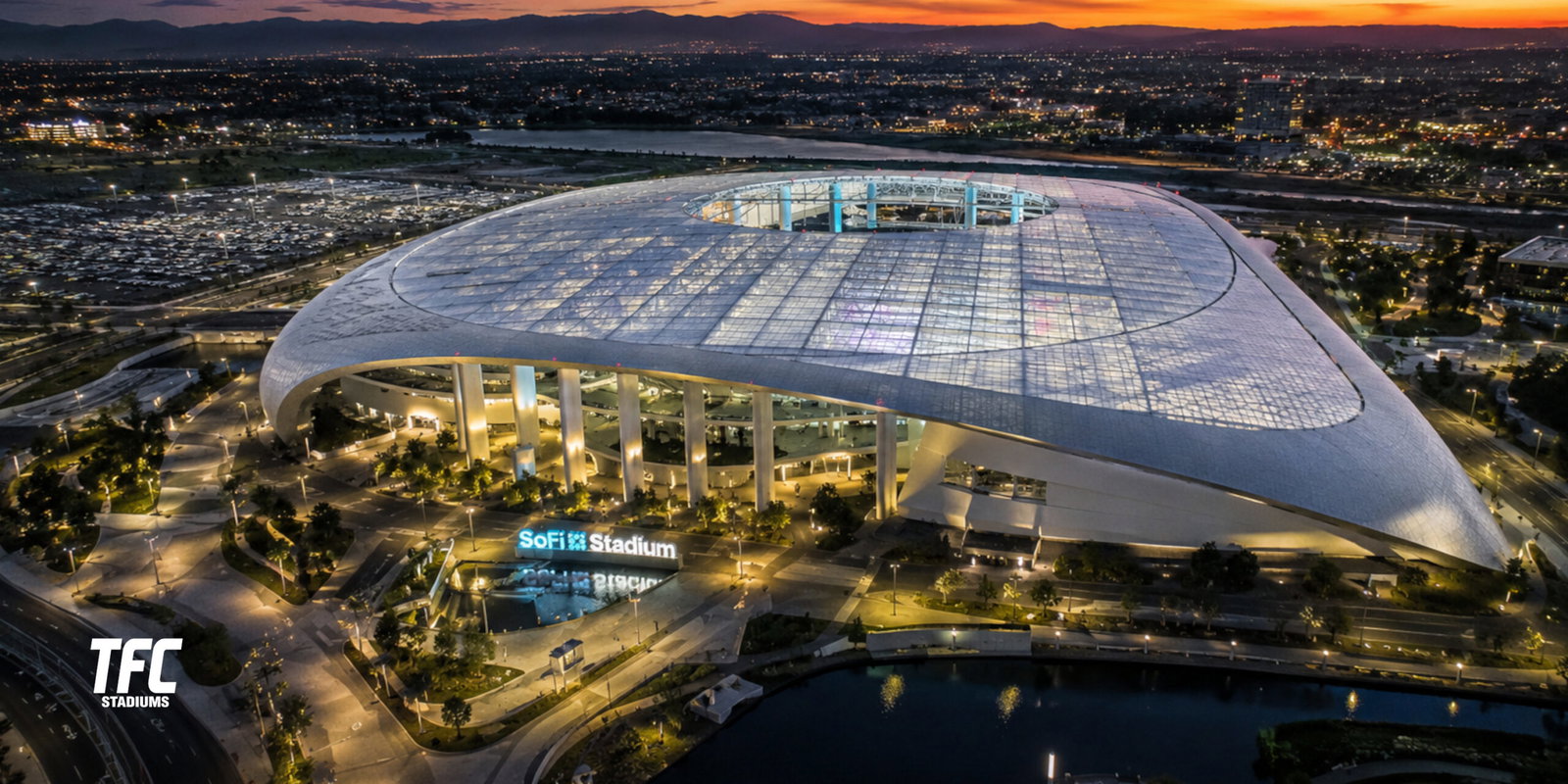
The stadium sits beneath an enormous translucent canopy made partly from ETFE, a lightweight fluoropolymer that allows daylight through while providing protection from direct sun and rain. Yet the stadium itself remains open around the sides.
That distinction matters. SoFi is not really a conventional dome. It is closer to an outdoor stadium placed beneath an extraordinarily sophisticated umbrella.
And because this is Los Angeles, even the umbrella has a video display.
What Is the SoFi Stadium Roof Made From?
The transparent portion of SoFi Stadium’s roof uses ethylene tetrafluoroethylene, mercifully shortened to ETFE.
ETFE is a lightweight polymer increasingly used in large architectural projects where designers want transparency without the enormous weight associated with glass.
At SoFi, the single-layer ETFE system consists of more than 300 panels. According to architect HKS, 46 can be opened to improve ventilation depending on conditions.
The material is translucent rather than perfectly clear. A 65 percent frit pattern is incorporated into the ETFE, helping shelter spectators from direct sunlight and reducing solar heat gain while still allowing large amounts of natural light into the stadium.
That balance is important in Southern California.
A completely transparent roof over 70,000 football fans in September could rapidly start feeling less like an NFL stadium and more like a greenhouse with $18 beer.
SoFi Stadium Roof Facts
| Feature | Detail |
|---|---|
| Primary transparent material | ETFE |
| ETFE construction | Single-layer membrane |
| ETFE panels | More than 300 |
| Operable panels | 46 |
| Frit coverage | 65 percent |
| Stadium capacity | Around 70,000 |
| Stadium floor area | Around 3.1 million sq ft |
| Main architect | HKS |
| Stadium opening | 2020 |
| Roof type | Fixed canopy with operable ventilation panels |
| Exterior stadium walls | None in the conventional sense |
| Main purpose | Shade, rain protection, daylight and ventilation |
| Additional feature | Integrated LED display visible from aircraft |
The roof also covers considerably more than the football field.
It stretches across the stadium, surrounding spaces and adjacent entertainment areas, creating a single architectural canopy over multiple parts of the Hollywood Park development.
The Roof Isn’t Actually Attached to the Stadium
This is where SoFi becomes particularly interesting.
The giant canopy and the stadium bowl are structurally independent.
SoFi does not have conventional exterior walls supporting a roof. Instead, its long-span cable roof structure is anchored to the ground at four main locations.
The stadium bowl essentially sits underneath it.
There is a serious engineering reason for this arrangement.
Southern California has earthquakes.
The roof, stadium bowl, American Airlines Plaza and neighboring theater were designed so they can move independently during seismic activity associated with the nearby Inglewood fault.
Visually, everything appears to be one enormous building.
Structurally, it is more complicated.
Very LA, really. Everyone is at the same party, but nobody wants to commit.
Why Didn’t SoFi Stadium Get a Retractable Roof?
A retractable roof would have been the obvious solution.
Dallas has one. Atlanta has one. Indianapolis has one. Arizona has one.
But Los Angeles possesses something those cities cannot reliably order from an engineering contractor: remarkably cooperative weather.
Southern California’s climate made a permanently covered but naturally ventilated stadium practical.
HKS designed SoFi around the region’s indoor-outdoor lifestyle. Instead of sealing spectators inside an air-conditioned building, the architects allowed air to circulate through the open sides of the structure.
The ETFE canopy handles sun and rain while the open perimeter allows prevailing breezes into the seating bowl. Some roof panels can also open to increase airflow.
In 2026, HKS described the approach as specifically adapted to LA’s temperate climate. The company says the fritted ETFE reduces solar heat gain while the open-sided bowl allows wind through the venue.
A giant retractable mechanism would therefore have introduced additional structural weight, machinery and maintenance for relatively little benefit.
The roof doesn’t need to disappear.
It needs to let Los Angeles through.
Does SoFi Stadium Have Air Conditioning?
This is one of the most common misconceptions about the stadium.
SoFi Stadium is not a conventionally air-conditioned indoor stadium.
The open sides make traditional whole-building air conditioning impractical. Instead, its environmental strategy relies heavily on shade, reduced solar gain and natural ventilation.
HKS describes 46 operable ETFE panels that can help maximize airflow without requiring conventional stadium-wide air conditioning.
That is clever engineering, but it does come with a trade-off.
SoFi can still feel warm during particularly hot Southern California weather. A roof does not magically reduce the temperature outside, especially when tens of thousands of people are sitting beneath it.
What the canopy does is reduce exposure to direct sunlight while allowing air movement.
That is quite different from walking into the refrigerated atmosphere of an enclosed stadium such as AT&T Stadium.
How the Roof Controls Heat
The ETFE membrane does more work than its almost transparent appearance suggests.
Its 65 percent frit pattern reduces direct sunlight and solar gain.
Think of fritting as thousands of tiny printed elements distributed across the surface. They alter the amount of solar radiation passing through the membrane without turning the roof opaque.
This produces a useful compromise.
Spectators still experience natural daylight and can sense the sky above them, but they are not sitting directly beneath unrestricted Southern California sunshine.
HKS says the roof is substantially cooler underneath than simply sitting in direct sunlight.
For a football stadium, that is arguably more valuable than having a roof that can dramatically slide open twice a year for television.
ETFE vs Glass
At first glance, glass might appear to be the obvious choice for a transparent stadium roof.
At SoFi’s scale, it would be an engineering headache.
| Factor | ETFE | Glass |
| Weight | Extremely light | Heavy |
| Transparency | High | Very high |
| Structural demands | Lower | Much higher |
| Solar control | Can incorporate frit patterns | Requires coatings or treatments |
| Large-span suitability | Excellent | More challenging |
| Flexibility | High | Low |
| Seismic advantages | Significant | More complex |
| Architectural effect | Light, translucent | Hard, highly transparent |
Weight becomes especially important when a roof spans an enormous stadium in earthquake country.
HKS says the cable-truss strategy used at SoFi created a roof with roughly one-tenth the structural weight of a more conventional solution.
That has consequences throughout the structure.
Less roof mass means less structural material required to support it and less mass moving around during seismic events.
Suddenly the plastic roof doesn’t sound quite so cheap.
The Roof Covers More Than SoFi Stadium
One of the smartest things about the design is that the canopy isn’t simply a football stadium roof.
It forms the architectural centerpiece of the wider Hollywood Park complex.
Beneath the monumental canopy sit three distinct venues:
- SoFi Stadium
- American Airlines Plaza
- YouTube Theater
HKS designed them so different events can take place simultaneously beneath the same overall roof structure.
American Airlines Plaza alone provides a major covered outdoor event space between the stadium and theater.
This makes the roof part of the site’s commercial logic.
Building something this enormous simply to protect NFL spectators for a handful of home games would be difficult to justify. Extending it across entertainment and public spaces makes the structure useful throughout the year.
It turns the roof into infrastructure rather than decoration.
The Roof Can Also Become a Giant Screen
Naturally, someone eventually looked at several acres of translucent roofing next to LAX and thought: advertising opportunity.
LED technology integrated into the ETFE allows images and video to be displayed across sections of the roof while retaining transparency from inside.
The audience isn’t necessarily sitting in SoFi Stadium.
Some of them are several thousand feet above it.
Aircraft approaching and departing nearby Los Angeles International Airport can see roof displays from the air.
It is a wonderfully excessive Los Angeles detail.
Most stadium roofs stop rain.
SoFi’s can communicate with Boeing 777 passengers.
Why SoFi Stadium Was Built So Far Below Ground
The roof also influenced another unusual aspect of SoFi’s architecture.
The stadium is close to LAX, which meant the project faced Federal Aviation Administration height restrictions.
The solution was not to make the stadium smaller.
They dug down.
The seating bowl sits approximately 100 feet below the existing ground level, around two to three times deeper than comparable multipurpose venues according to HKS.
This allowed the enormous stadium and roof canopy to remain within aviation restrictions.
It also creates one of SoFi’s stranger arrival experiences.
Rather than climbing high into a traditional stadium, spectators gradually descend toward the seating bowl.
You can spend several minutes walking downward and still somehow end up in the cheap seats.
Architecture is capable of cruelty.
The Roof Is Part of SoFi’s Earthquake Strategy
Building a structure this large close to an active fault required seismic movement to be considered from the beginning.
The roof canopy is structurally detached from the stadium bowl and other major elements underneath it.
During an earthquake, these components can therefore respond independently rather than behaving as one enormous rigid mass.
The stadium’s partially excavated construction also affects how the building interacts with the surrounding ground.
This is one reason SoFi’s roof should be considered an engineering system rather than simply architectural styling.
Its appearance is spectacular, but its structural independence is arguably more impressive.
How SoFi Compares With Other NFL Roof Designs
SoFi represents a different branch of modern stadium design.
| Stadium | Roof approach | Climate strategy |
| SoFi Stadium | Fixed ETFE canopy, open sides | Natural ventilation and solar control |
| AT&T Stadium | Retractable roof | Enclosed climate control |
| Mercedes-Benz Stadium | Retractable roof | Enclosed climate control |
| U.S. Bank Stadium | Fixed ETFE roof | Fully enclosed protection from cold |
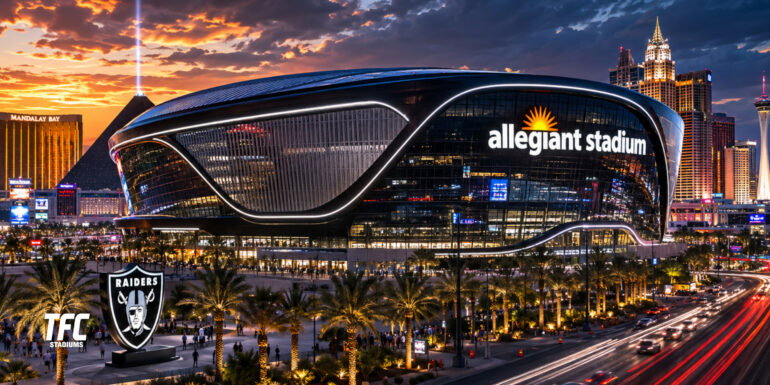
| Allegiant Stadium | Fixed translucent roof | Enclosed climate control |
| State Farm Stadium | Retractable roof | Climate-controlled interior |
The comparison with U.S. Bank Stadium is particularly interesting.
Both were designed by HKS and both use ETFE, but Minneapolis and Los Angeles required completely different environmental solutions.
Minnesota needs protection from serious winter weather. Los Angeles needs shade while retaining ventilation.
Same material. Completely different job.
That is good stadium architecture because the climate dictates the building rather than somebody deciding every new NFL venue needs the same expensive party trick.
The Roof Helps Make SoFi Feel Bigger
There is another effect that does not appear neatly on an engineering spreadsheet.
Space.
Because the roof floats above an open-sided stadium, SoFi rarely feels like a traditional enclosed dome.
Daylight reaches deep into the bowl. Air circulates through the concourses. Views extend beyond the seating structure.
The roof effectively defines the building without completely enclosing it.
That helps explain why a stadium containing roughly 70,000 permanent seats can feel considerably larger than the capacity figure suggests.
The 3.1-million-square-foot building is already enormous.
The canopy makes its perceived boundaries even less obvious.
Is the Transparent Roof Worth It?
Architecturally, yes.
From a fan-comfort perspective, the answer needs slightly more qualification.
The roof provides excellent protection from direct sun and rain while retaining the atmosphere of an outdoor stadium. Natural daylight is vastly preferable to spending Sunday afternoon inside something resembling a giant convention center.
But SoFi isn’t climate controlled in the traditional sense.
On unusually hot days, you can feel it.
That is the price of the indoor-outdoor concept. Personally, I think it is a reasonable trade. Football should retain some relationship with the weather outside. Otherwise we might as well play the whole NFL season inside Costco.
The clever part is that SoFi’s roof does several jobs simultaneously.
It provides shade. It reduces solar gain. It keeps rain away from spectators. It supports natural ventilation. It helps define the wider Hollywood Park development. It contributes to the stadium’s seismic strategy. It even carries digital displays visible from the sky.
That is a lot of work for something that initially looks like a sheet of transparent plastic.
Why the SoFi Roof Matters
When SoFi Stadium opened in 2020, much of the attention understandably went toward the enormous Infinity Screen hanging above the field.
The roof may ultimately prove the more influential piece of engineering.
Retractable roofs dominated prestige stadium design for years because they offered the best of both worlds, at least theoretically. But they bring weight, moving components, maintenance requirements and considerable expense.
SoFi demonstrates another possibility.
In climates where extreme cold or heat is not the dominant concern, designers can cover the spectators without enclosing the entire building.
HKS has described SoFi as the first true indoor-outdoor stadium, and while architectural marketing departments are rarely known for understatement, the description is pretty accurate.
SoFi feels protected rather than enclosed.
That distinction is the whole point.
Los Angeles spent decades without an NFL team and then, apparently concerned it might have underdone the comeback, built one of the most technically ambitious stadiums in the world.
The roof captures the philosophy perfectly.
Huge, complicated, slightly ridiculous, technically clever and visible from LAX.
In other words, completely at home in Los Angeles.
About the Author