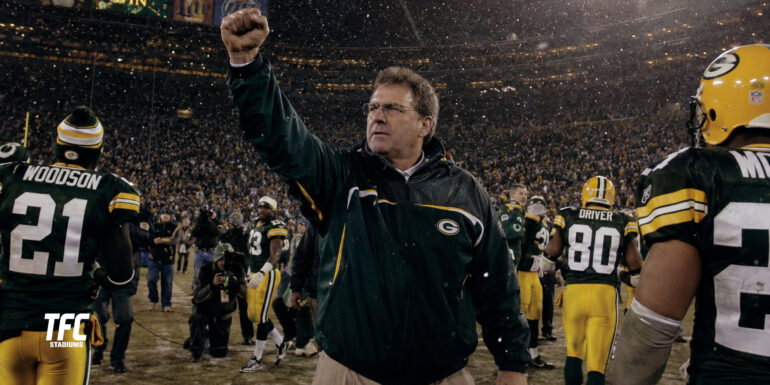
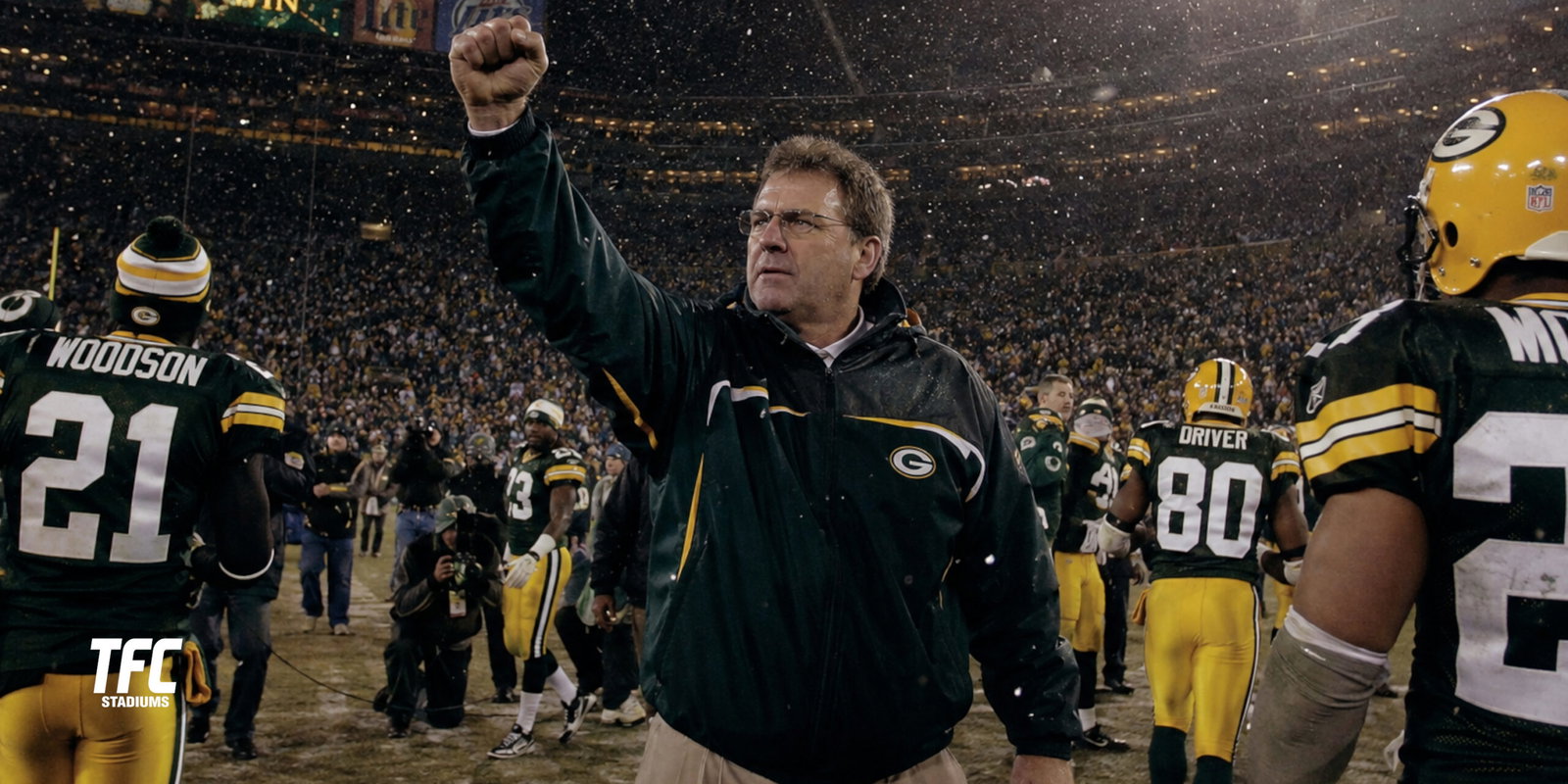
Mike Holmgren arrived in Green Bay in 1992 facing one of those jobs that looks considerably more romantic several decades later.
The Packers had Vince Lombardi, Bart Starr, 11 championships and arguably the most evocative stadium in American football. They also had a much more immediate problem. They had spent most of the previous 24 seasons being fairly ordinary.
Between 1968 and 1991, Green Bay produced only four winning seasons. Lambeau Field still had the history, frozen breath and aluminum benches, but visiting teams were not exactly trembling at the prospect of playing there.
Holmgren helped change that.
Across seven seasons from 1992 through 1998, his Packers went 75-37 in the regular season and 9-5 in the playoffs. More remarkably, Green Bay went 47-5 at Lambeau Field including postseason games during his tenure.
That works out at a winning percentage of roughly 90.4 percent.
For a generation of Packers fans, this was when Lambeau stopped being primarily a monument to the Lombardi years and became intimidating again.
Green Bay Before Holmgren
To understand Holmgren’s impact on Lambeau, you need to remember what the Packers looked like before he walked through the door.
Green Bay had reached the playoffs just twice between Lombardi’s departure and Holmgren’s appointment, following the 1972 and strike-shortened 1982 seasons.
The home advantage was nothing particularly frightening either. From 1985 through 1991, the Packers went just 2-7 in December games at Lambeau Field. In 1986 they went 0-5 there and scored only three touchdowns in those five games.
Cold weather is considerably less intimidating when the home team is losing too.
Then came a sequence of decisions that changed the franchise.
Ron Wolf became general manager in late 1991. Holmgren, previously offensive coordinator of the San Francisco 49ers, was hired as head coach on January 11, 1992. A month later, Wolf traded a first-round pick to Atlanta for a young quarterback named Brett Favre.
Not a bad few weeks at the office.
Holmgren, Favre and the Beginning of Something
Holmgren came from Bill Walsh’s coaching tree and brought a version of the West Coast offense to Wisconsin.
The principles were relatively simple: accurate passing, timing routes, yards after the catch and using short throws as an extension of the running game.
Then he gave the controls to Brett Favre.
Which was a little like teaching somebody classical piano before discovering they occasionally preferred throwing the piano through a window.
Favre’s talent was obvious. So was his willingness to attempt passes that would make an offensive coordinator develop a nervous twitch.
Holmgren provided structure.
Their relationship became one of the defining coach-quarterback partnerships of the 1990s. Holmgren could design the offense, correct Favre’s mechanics and attempt to contain his more spectacular impulses. Favre could then occasionally ignore all of that and produce something ridiculous.
It worked.
Green Bay finished 9-7 in 1992, five wins better than the previous season. Holmgren became only the third Packers head coach to produce a winning record in his first year.
The rebuilding project was already moving faster than expected.
The Game That Started the Favre Era
One of the most important games of the entire Holmgren era came at Lambeau on September 20, 1992.
Green Bay was playing Cincinnati when starting quarterback Don Majkowski injured his ankle.
Favre entered.
With the Packers trailing 23-17 late in the fourth quarter, Favre led a dramatic comeback, eventually throwing the winning touchdown pass to Kitrick Taylor with 13 seconds remaining.
It wasn’t technically Favre’s first appearance as a Packer, but culturally this was the beginning.
The following week he started against Pittsburgh.
He wouldn’t miss another Packers start for 16 years.
Looking back, that Cincinnati game feels almost suspiciously neat. The quarterback who would define modern Green Bay football effectively announced himself at Lambeau Field, under the coach who would teach him how to become an NFL MVP.
Hollywood would probably reject the script for being a bit obvious.
Reggie White Changed the Packers Too
The Holmgren era is understandably associated with Favre, but the transformation of Green Bay required another superstar.
In 1993 the Packers signed Reggie White.
This was enormous.
White was arguably the most coveted player available during the NFL’s new era of unrestricted free agency. His decision to join Green Bay demonstrated that elite players could willingly choose Wisconsin.
The Packers suddenly possessed a franchise quarterback and one of the greatest defensive players in NFL history.
White’s presence also changed what Lambeau felt like.
Green Bay no longer needed Favre to win every game by improvisational chaos. The Packers could pressure quarterbacks, control games defensively and physically overwhelm opponents.
Holmgren’s Packers were known for their offense, but their championship team was far more balanced than nostalgia sometimes suggests.
The Lambeau Leap Arrives
Another piece of modern Lambeau culture appeared during Holmgren’s second season.
On December 26, 1993, Green Bay hosted the Los Angeles Raiders in brutal conditions. The wind chill was approximately minus 22°F.
LeRoy Butler forced a fumble, Reggie White recovered it and lateraled the ball back to Butler, who scored.
Butler then jumped into the stands.
The Lambeau Leap was born.
Green Bay won 28-0 and secured its first playoff berth since 1982.
For all the tactical analysis surrounding Holmgren’s tenure, moments like this mattered. The Packers were rebuilding an identity around Lambeau itself.
Cold weather, defensive football, Favre’s recklessness, fans hanging over the wall and a stadium increasingly becoming part of the team’s competitive personality.
The Packers Finally Leave Milwaukee
One of the most significant developments of the Holmgren era had little to do with coaching.
For decades, Green Bay split its home schedule between Green Bay and Milwaukee.
That ended after the 1994 season.
Beginning in 1995, every Packers home game would be played at Lambeau Field for the first time since 1932.
That decision strengthened the relationship between the modern Packers and their historic stadium.
And the timing couldn’t have been better.
Green Bay was about to become one of the best teams in football.
Holmgren’s Packers at Lambeau by the Numbers
| Category | Holmgren-era figure |
|---|---|
| Seasons as Packers head coach | 1992-1998 |
| Regular-season record | 75-37 |
| Overall record including playoffs | 84-42 |
| Lambeau record including playoffs | 47-5 |
| Lambeau winning percentage | 90.4% |
| Consecutive Lambeau victories | 25 |
| Consecutive winning seasons | 7 |
| Consecutive playoff appearances | 6 |
| NFC Championship Game appearances | 3 |
| Super Bowl appearances | 2 |
| Super Bowl championships | 1 |
The 25-game Lambeau winning streak became a franchise record and, at the time, the second-longest home winning streak in NFL history.
That’s the statistic that best captures what changed.
Before Holmgren, playing at Lambeau carried historical significance.
Under Holmgren, playing at Lambeau became a competitive problem.
1995: The Packers Become Contenders
Green Bay’s progression under Holmgren was remarkably steady.
The Packers went 9-7 in each of Holmgren’s first three seasons before breaking through in 1995.
They finished 11-5, winning their first NFC Central championship since 1972.
The division title was clinched at Lambeau on Christmas Eve with a 24-19 victory over Pittsburgh. Green Bay then beat Atlanta 37-20 at Lambeau in the Wild Card round.
The Packers eventually reached the NFC Championship Game, where Dallas ended their season.
But something had clearly changed.
Green Bay wasn’t rebuilding anymore.
It was chasing championships.
1996: Lambeau Becomes the Centre of the NFL Again
The 1996 Packers were Holmgren’s masterpiece.
Green Bay finished 13-3, ranked first in the NFL in scoring offense and first in scoring defense, and secured home-field advantage through the NFC playoffs.
That last part mattered enormously.
The road to the Super Bowl went through Wisconsin.
The Packers beat San Francisco 35-14 in the divisional round at Lambeau before facing Carolina in the NFC Championship Game.
On January 12, 1997, Green Bay defeated the Panthers 30-13.
For the first time since the Lombardi era, the Packers were going back to the Super Bowl.
And they had earned the trip at Lambeau.
That image remains one of the defining scenes of modern Packers history: players celebrating on a freezing field while the stadium realised its team was finally going back to football’s biggest game.
Super Bowl XXXI
Two weeks later, Green Bay defeated New England 35-21 in Super Bowl XXXI.
Favre threw two touchdown passes and ran for another.
Desmond Howard produced the game’s decisive moment with a 99-yard kickoff return touchdown.
Reggie White recorded three sacks.
The Packers were champions again.
Their previous title had come following the 1967 season.
For an organization whose identity was built around championships, that 29-year wait had become uncomfortable. Holmgren’s team finally ended it.
Lambeau could stop living entirely on black-and-white footage of Lombardi.
It had its own championship generation.
1997: Almost a Dynasty
Green Bay might actually have been better during stretches of the following season.
The Packers again finished 13-3.
They returned to the NFC Championship Game and beat San Francisco 23-10 at Candlestick Park, earning a second consecutive Super Bowl appearance.
They were heavily favoured against Denver in Super Bowl XXXII.
Then Terrell Davis happened.
Denver won 31-24.
For Packers fans of a certain age, this remains one of those games that can still trigger an involuntary facial expression.
Had Green Bay won, Holmgren would have delivered consecutive championships and potentially established the Packers as the defining NFC dynasty of the late 1990s.
Instead, they became a great team with one championship rather than a dynasty.
That distinction still shapes how Holmgren’s Packers are remembered.
The 25-Game Lambeau Winning Streak
Perhaps the most impressive achievement of Holmgren’s tenure wasn’t the Super Bowl.
It was what happened at home.
Between 1995 and 1998, Green Bay won 25 consecutive games at Lambeau Field.
The streak finally ended on October 5, 1998, when Minnesota defeated Green Bay 37-24.
Randy Moss caught five passes for 190 yards and two touchdowns that night.
If you’re going to end a historic home winning streak, apparently having a rookie Randy Moss is a useful starting point.
The streak showed how thoroughly the Packers had reclaimed Lambeau.
Opponents weren’t simply dealing with cold weather. They were dealing with Favre, White, Antonio Freeman, Robert Brooks, Dorsey Levens, Gilbert Brown and a team that genuinely expected to win every time it walked onto that field.
That expectation matters in sports.
Lambeau had developed psychological weight again.
Lambeau Was Changing Around Holmgren
The stadium itself evolved considerably during Holmgren’s tenure.
When Holmgren arrived, Lambeau’s capacity was around 59,500.
A major addition to the Packers’ administrative building was completed in 1993, including expanded team facilities and a much larger Pro Shop. A Sony Jumbotron was also installed that year.
In 1995, another 90 suites were added to the north end zone, increasing capacity to 60,890.
These weren’t cosmetic changes.
Green Bay needed to increase revenue while competing against franchises operating in much larger metropolitan markets.
The modernisation of Lambeau therefore paralleled the modernisation of the Packers themselves.
They were preserving the old bowl while quietly building a more sophisticated NFL business around it.
A very Green Bay solution, really. Keep the aluminum benches, add luxury suites.
Why Holmgren’s Offense Worked So Well at Lambeau
There’s an assumption that cold-weather football requires running the ball 47 times while everyone develops frostbite.
Holmgren’s Packers offered a slightly different argument.
His West Coast system relied heavily on short and intermediate passing, precise timing and receivers creating yards after the catch.
That actually suited Lambeau rather well.
Instead of relying exclusively on deep passing in difficult winter conditions, Green Bay could attack horizontally and control possession through shorter throws.
Favre’s arm strength provided another advantage. Wind and cold affect passing offenses, but having a quarterback capable of firing the football through Wisconsin weather certainly helps.
The Packers could therefore maintain a sophisticated passing game deep into December.
Meanwhile, opponents frequently had to adjust to conditions Green Bay regarded as normal.
The Numbers Behind the Transformation
Holmgren’s overall Green Bay record was 84-42, including postseason play.
That’s a .667 winning percentage.
At Lambeau, however, the Packers went 47-5.
That’s .904.
The difference is enormous.
For context, the Packers’ broader transformation beginning in 1992 became one of the most successful sustained runs in modern NFL history. Green Bay has owned the NFL’s best regular-season winning percentage over the period beginning with the Wolf-Holmgren revival through recent seasons.
Holmgren didn’t merely produce a good seven-year stretch.
He helped establish the foundation for more than three decades of competitive Packers football.
Why Lambeau Mattered to Holmgren’s Packers
Home-field advantage is sometimes discussed like it’s a mystical force generated by noise and expensive beer.
Usually there’s something more practical happening.
For Holmgren’s Packers, Lambeau provided several genuine advantages.
Green Bay understood the surface and weather. The Packers increasingly played meaningful late-season games there. The crowd became louder as expectations increased. Visiting teams faced one of football’s best quarterbacks and one of its best defenses.
Most importantly, Green Bay was simply very good.
The mythology grew because the football justified it.
That’s the crucial distinction.
Lambeau didn’t make Holmgren’s Packers great.
Holmgren’s Packers made Lambeau frightening again.
Holmgren Leaves Green Bay
The 1998 season produced another 11-5 record and Green Bay’s sixth consecutive playoff appearance.
But the Packers were eliminated in heartbreaking fashion by San Francisco.
Favre had driven Green Bay ahead 27-23 late in the fourth quarter before Steve Young found Terrell Owens for a 25-yard touchdown with three seconds remaining.
San Francisco won 30-27.
Five days later, Holmgren resigned.
He became head coach and executive vice president of football operations with the Seattle Seahawks, gaining the personnel authority he wanted.
His Green Bay tenure was over after seven seasons.
There would be no gradual decline, awkward rebuilding cycle or farewell season.
He simply left.
Holmgren’s Lambeau Legacy
Holmgren’s importance to Green Bay goes beyond Super Bowl XXXI.
He arrived when the Packers were historically important but contemporarily irrelevant.
He left with:
- Seven consecutive winning seasons
- Six consecutive playoff appearances
- Three consecutive NFC Championship Game appearances
- Two NFC championships
- One Super Bowl victory
- A 47-5 record at Lambeau including playoffs
- A 25-game home winning streak
More importantly, he helped connect two versions of the Packers.
There was the old Green Bay, defined by Lambeau, Lombardi and championships from another era.
Then there was the modern franchise built around Wolf, Holmgren, Favre and White.
Lambeau Field was the bridge between them.
From Historic Stadium to Modern Fortress
I’ve always thought the most interesting thing about Holmgren’s Green Bay years is that he didn’t need to manufacture Packers tradition.
There was already enough tradition in that building to fill several documentaries and approximately 400 hours of NFL Films narration.
What Green Bay needed was relevance.
Holmgren gave Lambeau contemporary memories.
Favre’s emergence against Cincinnati. The birth of the Lambeau Leap. Reggie White terrorising quarterbacks. December games that actually mattered. Playoff football returning to Wisconsin. The NFC Championship victory over Carolina. Fans watching their team become champions again.
Those moments changed the meaning of Lambeau Field for an entire generation.
The Lombardi years remained sacred.
But by the late 1990s, Packers fans no longer needed their fathers or grandfathers to explain what championship football at Lambeau felt like.
They had seen it themselves.
And Mike Holmgren had a lot to do with that.
About the Author