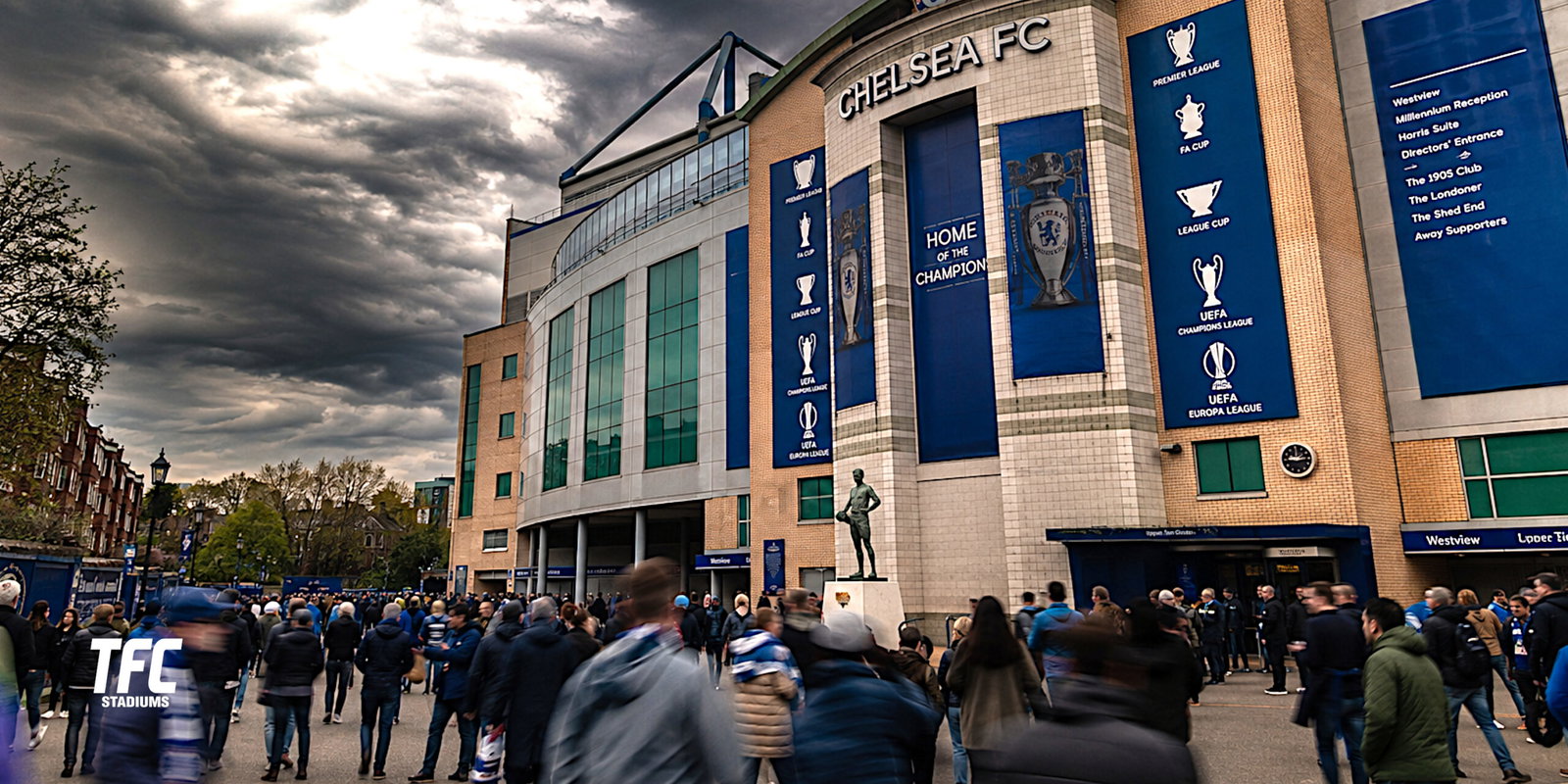
Stamford Bridge is one of those football grounds where the location is almost as important as the stadium itself. Chelsea have played here since 1905, yet unlike plenty of historic English clubs, they never packed up and headed for a shiny new bowl beside a motorway.
The result is a ground squeezed into west London, surrounded by housing, pubs, restaurants, railway lines and some of the most expensive property in Britain. It makes getting 40,000-plus football supporters in and out of the area slightly chaotic, but it also gives Stamford Bridge something many modern stadiums struggle to manufacture: a proper sense of place.
A Chelsea matchday begins well before you reach the turnstiles. Fulham Broadway fills with blue shirts, Fulham Road gets progressively busier, pubs become increasingly optimistic about their remaining floor space, and eventually Stamford Bridge appears between the buildings.
For a first visit, it can actually be surprising how suddenly the stadium arrives.
Here is what to expect.
Stamford Bridge Matchday at a Glance
| Matchday detail | What to expect |
|---|---|
| Club | Chelsea FC |
| Location | Fulham Road, west London |
| Capacity | Around 40,000 |
| Nearest Tube | Fulham Broadway |
| Tube line | District line |
| Alternative stations | West Brompton, Earl’s Court |
| Best transport | London Underground |
| Stadium payments | Cashless |
| Bag limit | Maximum A4 size, roughly 30cm x 20cm x 10cm |
| Bag storage | No matchday bag-drop facility |
| Main atmosphere areas | Matthew Harding Stand and Shed End |
| Recommended arrival | Around 60 to 90 minutes before kick-off |
| Driving recommended? | No |
The relatively modest capacity is important. Stamford Bridge feels very different from the huge modern grounds built for 60,000 or more spectators.
You are closer to the pitch, the stands feel enclosed and the atmosphere can become surprisingly intense when Chelsea are playing well.
Getting to Stamford Bridge
For most supporters, Fulham Broadway Underground station is the obvious choice.
It sits on the District line and is only a few minutes’ walk from Stamford Bridge. Chelsea describe the ground as one of London’s most centrally located major football stadiums, and in practical terms they have a point.
Coming from central London, you will normally travel towards Wimbledon on the District line. If your train is heading elsewhere, changing at Earl’s Court is usually straightforward.
West Brompton is another useful option. It is served by London Overground and is roughly a 15-minute walk from Stamford Bridge.
The Tube journey itself tends to provide an unofficial warning that you are getting close. A carriage that looked perfectly civilised ten minutes earlier gradually becomes populated by Chelsea shirts.
Then everyone gets off at once.
Should you drive?
I wouldn’t.
Parking around Stamford Bridge is extremely limited and Chelsea themselves recommend using public transport. There are also resident parking restrictions around the area.
Fulham Road can also close at least 90 minutes before kick-off and remain closed until around an hour after the final whistle for some matchday operations.
Unless you have a very specific reason to bring a car, the Underground is considerably less painful.
Arriving Around Fulham Broadway
One of the pleasures of Stamford Bridge is that the matchday doesn’t feel separated from London.
Some newer stadiums are surrounded by plazas, retail parks and carefully landscaped pedestrian zones. Stamford Bridge spills directly into Fulham.
That changes the experience.
The pubs and restaurants around Fulham Broadway become increasingly busy several hours before kick-off. Supporters stream along Fulham Road, while the closer you get to the stadium, the more obvious the Chelsea presence becomes.
If it’s your first visit, I’d arrive at least 90 minutes before kick-off.
That gives you enough time to walk around the stadium, visit the club shop, get something to eat and find your entrance without turning the final 15 minutes into an Olympic walking event.
Walking Around Stamford Bridge Before the Match
Stamford Bridge isn’t the easiest stadium to appreciate architecturally from outside.
The ground has been redeveloped gradually rather than created as one enormous unified project. Hotels, restaurants and other buildings form part of the wider Stamford Bridge complex, meaning you don’t always get the dramatic full-stadium view offered by places such as Tottenham Hotspur Stadium.
There are still several things worth seeing.
The Shed Wall celebrates important figures from Chelsea’s history with images, statistics and information about former players. It occupies part of the historic southern boundary of the site and is free to view.
The Stamford Bridge Megastore is also here if you fancy discovering just how many objects can legally have a Chelsea badge attached to them.
For a first-time visitor, I would allow 20 to 30 minutes simply to wander around.
The Four Stands
Stamford Bridge consists of four main stands, each offering a slightly different experience.
| Stand | General character | Atmosphere |
| Matthew Harding Stand | Traditional home support | Very strong |
| Shed End | Historic Chelsea end | Strong |
| East Stand | Older three-tier stand | More mixed |
| West Stand | Modern hospitality and premium seating | Generally calmer |
Matthew Harding Stand
For atmosphere, this would be my choice.
Named after former Chelsea vice-chairman Matthew Harding, who died in a helicopter crash in 1996, the stand behind the north goal contains some of Chelsea’s most vocal supporters.
The lower tier in particular can be excellent.
When Stamford Bridge is properly alive, a lot of the noise begins here.
The Shed End
The Shed carries enormous historical significance.
The original Shed terrace became synonymous with Chelsea’s hardcore support during the twentieth century. The modern stand is very different physically, but the name remains part of the club’s identity.
Away supporters are also accommodated in this end for men’s matches, which naturally creates plenty of interaction between the two sets of fans.
East Stand
The East Stand dates from the major 1970s redevelopment of Stamford Bridge.
It is the oldest surviving major stand and its three-tier construction gives it a distinctive appearance.
There is something I quite like about it. It isn’t trying to look futuristic. It looks like a large football stand that has watched several generations of Chelsea teams come and go.
West Stand
The West Stand represents the more corporate side of modern Chelsea.
Hospitality facilities are concentrated here, while the upper tier has undergone substantial refurbishment through the Westview development, including upgraded food and drink facilities.
The view can be excellent, although supporters chasing maximum atmosphere will probably prefer the Matthew Harding Stand or Shed End.
What Is the Atmosphere Like at Stamford Bridge?
This is where Stamford Bridge can be difficult to judge.
On the right day, it is superb.
A major London derby, Champions League night or big Premier League fixture can transform the place. Because the stadium is relatively compact, noise doesn’t disappear upwards into enormous open spaces.
The proximity of the stands helps.
But Stamford Bridge isn’t thunderous every week.
Against less glamorous opposition, particularly during awkward lunchtime kick-offs, the atmosphere can become subdued. That’s hardly unique to Chelsea. Almost every major Premier League club suffers from the strange phenomenon of tens of thousands of people simultaneously waiting for somebody else to start singing.
The Matthew Harding Stand usually provides the most consistent vocal support.
When Chelsea score at that end, particularly in a major match, you understand why supporters remain emotionally attached to Stamford Bridge despite its obvious limitations.
How Close Are You to the Pitch?
Pretty close by modern Premier League standards.
This is one of Stamford Bridge’s greatest strengths.
The stadium wasn’t designed around an athletics track and doesn’t have the enormous gaps found at some multi-purpose venues. Sightlines vary depending on your seat, but generally the pitch feels connected to the stands.
That intimacy matters.
A 40,000-seat stadium can sometimes create a more intense football environment than a 60,000-seat venue because the crowd is physically concentrated into a smaller space.
Stamford Bridge demonstrates that quite nicely.
Safe Standing and Rail Seating
Rail seating has been installed in sections of the Matthew Harding Lower and the upper and lower tiers of the Shed End.
That is significant because these are already among the most atmospheric sections of Stamford Bridge.
Standing supporters create a noticeably different visual and acoustic environment from spectators sitting quietly in rows.
For visitors who want the traditional English football experience rather than simply the best panoramic view, these areas are particularly interesting.
Food and Drink Inside Stamford Bridge
Food inside Stamford Bridge has improved over the years, although you’re still eating inside a Premier League football stadium rather than accidentally wandering into Borough Market.
Expect the usual football staples alongside a broader selection of food and drink depending on your stand.
Chelsea has also introduced CFC Express, allowing supporters to pre-order food and drink for collection from designated points around the stadium. The system offers a considerably larger menu than standard concourse kiosks.
This is actually a sensible development.
Half-time lasts 15 minutes. Spending 11 of them standing behind somebody ordering drinks for seven people has never been one of football’s great traditions.
Stamford Bridge operates cashless payment systems, so bring a debit or credit card or use mobile contactless payment.
Bag Policy and Stadium Security
This is worth knowing before you leave home.
Chelsea currently restrict bags entering Stamford Bridge to A4 size or smaller, approximately:
30cm x 20cm x 10cm
More importantly, the club does not operate a matchday bag-drop facility.
Turn up carrying a large suitcase and you have created a fairly serious logistical problem for yourself.
My advice is simple: bring as little as possible.
Security checks also mean queues can build close to kick-off, another reason not to arrive with five minutes remaining.
Digital Tickets and Entry
Chelsea have moved towards digital ticketing and continue to tighten controls around ticket ownership and touting.
For the 2026/27 season, supporters over 16 purchasing or accessing men’s match tickets are being required to complete online identity verification. Chelsea has also changed its loyalty system so points for men’s first-team home games are awarded based on attendance, with the ticket needing to be scanned at the turnstile.
The practical lesson for visitors is straightforward.
Make sure your ticket is loaded and accessible before approaching the turnstile.
Trying to remember your password while several hundred Chelsea supporters queue behind you is character building, but unnecessary.
When Should You Enter the Stadium?
I’d aim to be through the turnstiles around 45 minutes before kick-off if it’s your first visit.
Regulars naturally leave it later because they know exactly where they’re going.
Going in earlier gives you time to find your seat, use the facilities, get food or drink and watch the teams warm up.
There is also something about watching a football ground gradually fill that I still enjoy. Empty seats become scattered groups, then entire blocks of supporters, then suddenly the teams emerge and the place looks completely different.
The Matchday Build-Up
The atmosphere noticeably changes during the final 20 minutes.
Players complete their warm-ups, supporters move from the concourses into their seats and the noise starts to build.
For major fixtures, this is when Stamford Bridge can feel particularly impressive.
The compact dimensions work in Chelsea’s favour. Noise generated behind either goal travels quickly around the stadium, while away supporters in the Shed add another layer.
Then comes kick-off.
Whatever you think about Chelsea, there aren’t many grounds where you feel quite so physically close to Premier League football.
Half-Time at Stamford Bridge
Half-time is organised chaos.
Everyone simultaneously decides they require food, drink or a toilet.
Queues form rapidly, particularly in older concourse areas. If you’re desperate for refreshments, leaving your seat a couple of minutes before half-time will save time.
Personally, I’d rather watch the football.
I’ve never understood paying Premier League ticket prices and deliberately missing part of the match because I urgently require a pie.
Pre-ordering through CFC Express is another way of reducing queue time.
What Happens After the Final Whistle?
Getting into Stamford Bridge is usually easier than getting away from it.
More than 40,000 people suddenly head towards the same handful of transport routes.
Fulham Broadway is naturally the main destination, so expect queues and crowd-management measures around the station.
If you’re not in a hurry, there is a better option.
Walk.
Earl’s Court is roughly 15 to 20 minutes away depending on your route and pace, while West Brompton offers Underground and Overground connections.
Sometimes spending 15 minutes walking through west London is considerably more pleasant than spending those same 15 minutes staring at the back of somebody’s Chelsea jacket in a station queue.
How Does Stamford Bridge Compare With Modern Premier League Stadiums?
This is where the ground becomes interesting.
Stamford Bridge is objectively constrained.
Its capacity is relatively small for a club of Chelsea’s international size. Expansion is extremely difficult because of railway lines, neighbouring properties and the dense urban environment surrounding the site.
Compare it with some major English grounds:
| Stadium | Approximate capacity |
| Old Trafford | 74,000 |
| Tottenham Hotspur Stadium | 62,850 |
| London Stadium | 62,500 |
| Anfield | 61,000 |
| Emirates Stadium | 60,700 |
| Stamford Bridge | 40,000 |
Chelsea are therefore operating with roughly 20,000 fewer seats than several direct Premier League rivals.
Across 19 league home matches, that potentially represents hundreds of thousands fewer available tickets over a season.
Commercially, that’s a major limitation.
Emotionally, things become more complicated.
A larger stadium would generate more matchday revenue and allow more supporters to attend. But Stamford Bridge’s compact scale and west London location are fundamental parts of Chelsea’s identity.
Replacing that isn’t simply an architectural exercise.
Is Stamford Bridge Good for Families?
Generally, yes.
Premier League football is considerably more family-oriented than it was several decades ago, and Chelsea has continued developing dedicated family provision.
For 2026/27, the East Lower North remains a designated family area for men’s matches.
Families attending for the first time should still arrive early.
Navigating crowded Tube platforms, security checks and packed concourses with younger children is much easier when you’re not racing against kick-off.
Accessibility
Fulham Broadway has step-free access, including lifts, making it the most convenient Underground station for many supporters with mobility requirements.
Chelsea also provides accessible seating and matchday assistance within Stamford Bridge.
Anyone requiring specific accessibility arrangements should contact the club before travelling, particularly when accessible parking or specialist seating is required.
Is Stamford Bridge Worth Visiting?
Absolutely.
It isn’t the biggest stadium in England. It isn’t the newest. Parts of it feel constrained and the concourses can become crowded.
But that’s partly why I like it.
You still feel as though you’re attending football in the middle of a neighbourhood rather than visiting a purpose-built entertainment district.
Stamford Bridge has witnessed league titles, European nights, relegation battles, cup runs, managerial chaos and enough ownership drama to fill several television series.
The modern Chelsea era transformed the club beyond recognition, but the address stayed the same.
For supporters visiting for the first time, my advice would be to arrive early, walk down Fulham Road, spend some time around the stadium and don’t disappear immediately after the final whistle.
The football lasts 90 minutes.
The matchday is much bigger than that.
Stamford Bridge Matchday Tips
- Use Fulham Broadway unless another route clearly suits your journey better.
- Arrive around 60 to 90 minutes before kick-off.
- Avoid driving if possible.
- Bring no bag, or make certain it meets the A4 restriction.
- Have your digital ticket ready before reaching the turnstile.
- Bring a card or contactless payment method because Stamford Bridge is cashless.
- Choose the Matthew Harding Stand if atmosphere is your priority.
- Consider walking to Earl’s Court or West Brompton after particularly busy matches.
- Allow time to explore Fulham Road rather than treating the stadium as an isolated destination.
- Check Chelsea and TfL travel information on the morning of the game because London transport has a habit of developing a personality at weekends.
About the Author