The 2026-27 Champions League campaign is now well underway. Every one of the 36 teams in the league phase has now completed two games, one away from home and one in their own stadium. Like last year, there are four clubs making their debuts in the competition this season, so that should mean four new Champions League stadiums.
The four new sides are Como, Sabah, LASK, and Viking, representing Italy, Azerbaijan, Austria, and Norway, respectively. If you are looking to read an Xbet review to get information on betting on the Champions League, it is unlikely that you will be backing any of these clubs. But thanks to the expanded format, they will all get to play eight games – with four at home – at least.
Although three of the four have played in European competition before, with only Como making its first-ever appearance in a continental tournament, these will be mostly new stadiums as far as the Champions League goes. Read on to find out more about some new stadiums hosting Europe’s premier club competition this season.
Stadio Giuseppe Sinigaglia
Let’s start with one of the most picturesque stadiums in world football, let alone the Champions League this season. Situated on the shore of Lake Como, the Stadio Giuseppe Sinigaglia is, like many in Italy, a municipality-owned, multi-use stadium, and has a capacity of 13,062. Como’s recent journey to the top table of European football is one of the most exciting around, and now its fans get to watch their team up against the very best.
Built on the orders of Benito Mussolini, the stadium is an example of the nationalist architecture of the time and was completed in 1927. A series of renovations has updated the complex over the years, with the athletics and cycling tracks the first to go in the 1970s. Although there are still magnificent views of Lake Como from sections of the stadium, an opening in the middle of one stand, specifically for that purpose, is now long gone. The stadium is still in the middle of major renovations, but will undoubtedly be one of the most spectacular in the Champions League this season.
Viking Stadion
Norway’s Viking FK has a long and successful history that includes over 80 games of European football dating back to its first UEFA Cup campaign in 1972. The club was particularly successful in the 1970s and 1980s, and played a number of European Cup ties, although this is the first time it has competed in the rebranded Champions League.
Unlike many other smaller clubs, or those from smaller leagues, Viking is able to play at its home stadium, as it successfully meets all requirements, even though it does only have a capacity of 15,900 and an artificial turf surface. Currently known as the Lyse Arena for sponsorship reasons, it first opened in 2004 and was initially all-seater, but there are now safe standing sections included as well. Further expansion plans were postponed a few years ago when attendances were dropping, but recent success – the first Champions League game was a 3-3 draw against Bayern Munich – suggests that those plans may be revisited soon.
Raiffeisen Arena
Like Viking, LASK has an extensive European record and did actually play a few Champions League qualifying rounds in 2019, but this is the first time that the current Austrian title holders are playing in this stage of the competition – and the first time that this stadium is hosting games of such prestige.
The Raiffeisen Arena was only opened in 2023, and built on the site of the old Linzer Stadion, which was demolished in 2021. LASK actually went bankrupt in the 1990s and merged with FC Linz to continue playing, but fortunes have been better in recent times, with a first league title for 61 years claimed last season. There will be around 19,000 fans crammed into the stands for four Champions League games this season, although the result of the first one – a 6-3 loss to Liverpool – suggests that there may not be many more, at least until next season.
Baku Olympic Stadium
Although our final team is playing in its debut Champions League campaign after winning the Azerbaijan Premier League title for the first time last season, the stadium it is playing its home game in has some experience of the competition. Sabah’s regular stadium, the Bank Respublika, only holds 9,000 and does not meet UEFA requirements, so the club will be playing its Champions League home fixtures at the Baku Olympic Stadium instead.
Used by Qarabag for its European campaigns in 2017 and 2018, as well as for the 2019 Europa League final between Chelsea and Arsenal, the Baku Olympic Stadium was specifically designed to meet international standards and has a capacity of just over 69,000. The main tenant is the Azerbaijan national team, who have been playing some of their home games there since 2015, and it was also a host stadium for the 2020 European Championship that took in most of the continent. Sabah will be hoping that its 2-0 victory over Slavia Prague will be the first of many in this year’s league phase.
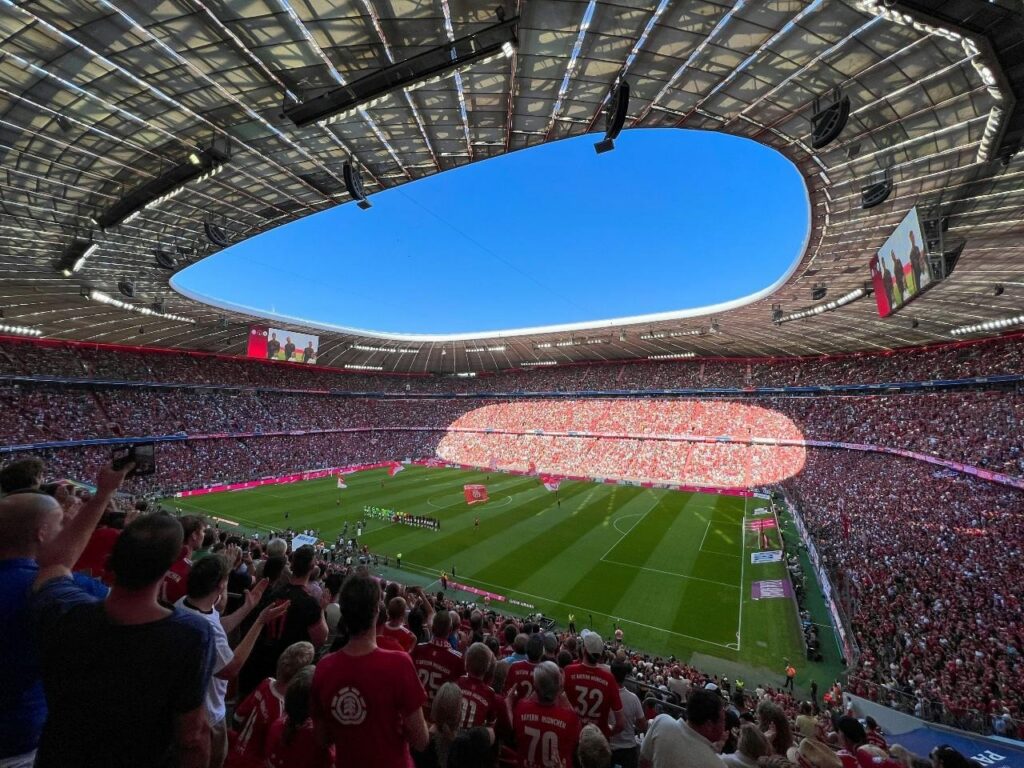
Some of the old favorites will also be in action over the coming weeks – Source: Unsplash
New Stadiums to Enjoy
Although we are well used to watching Champions League games at places like the Camp Nou, the Emirates, and the Parc des Princes, the expanded format means that we could regularly enjoy new experiences over the next few years. For fans of football – and football stadiums – that can only be a good thing.
About the Author