A Roof Built For More Than Keeping Out The Rain
The roof of the Etihad Stadium is one of the most important parts of its identity. While many fans focus on the pitch, seating bowl, or Manchester City’s transformation into a global football powerhouse, the stadium’s engineering above the stands tells its own story.
Originally designed for athletics before being converted into a football venue, the Etihad required a roof system that could balance visibility, atmosphere, structural efficiency, and future expansion. The result is a design that reflects the stadium’s unusual journey from Commonwealth Games arena to one of Europe’s leading football venues.
It is not the loudest architectural statement in world football, but that is almost the point. The Etihad roof is a clever piece of engineering that quietly does a lot of work.
Origins: Designing A Stadium That Had To Change
The stadium opened in 2002 as the City of Manchester Stadium for the Commonwealth Games. Unlike many football grounds, it was not originally built purely around the demands of supporters close to the pitch.
The original requirements included:
| Requirement | Design Challenge |
|---|---|
| Athletics configuration | Larger footprint and wider spectator distances |
| Future football conversion | Roof and bowl had to adapt |
| Clear sightlines | Avoid columns blocking views |
| Manchester climate | Protect supporters from frequent rain |
| Long-term growth | Allow later capacity increases |
After the Games, the athletics track was removed, the playing surface was lowered, and additional seating was added. The roof became central to making the converted arena feel like a football stadium rather than a repurposed athletics venue.
How The Etihad Roof Works
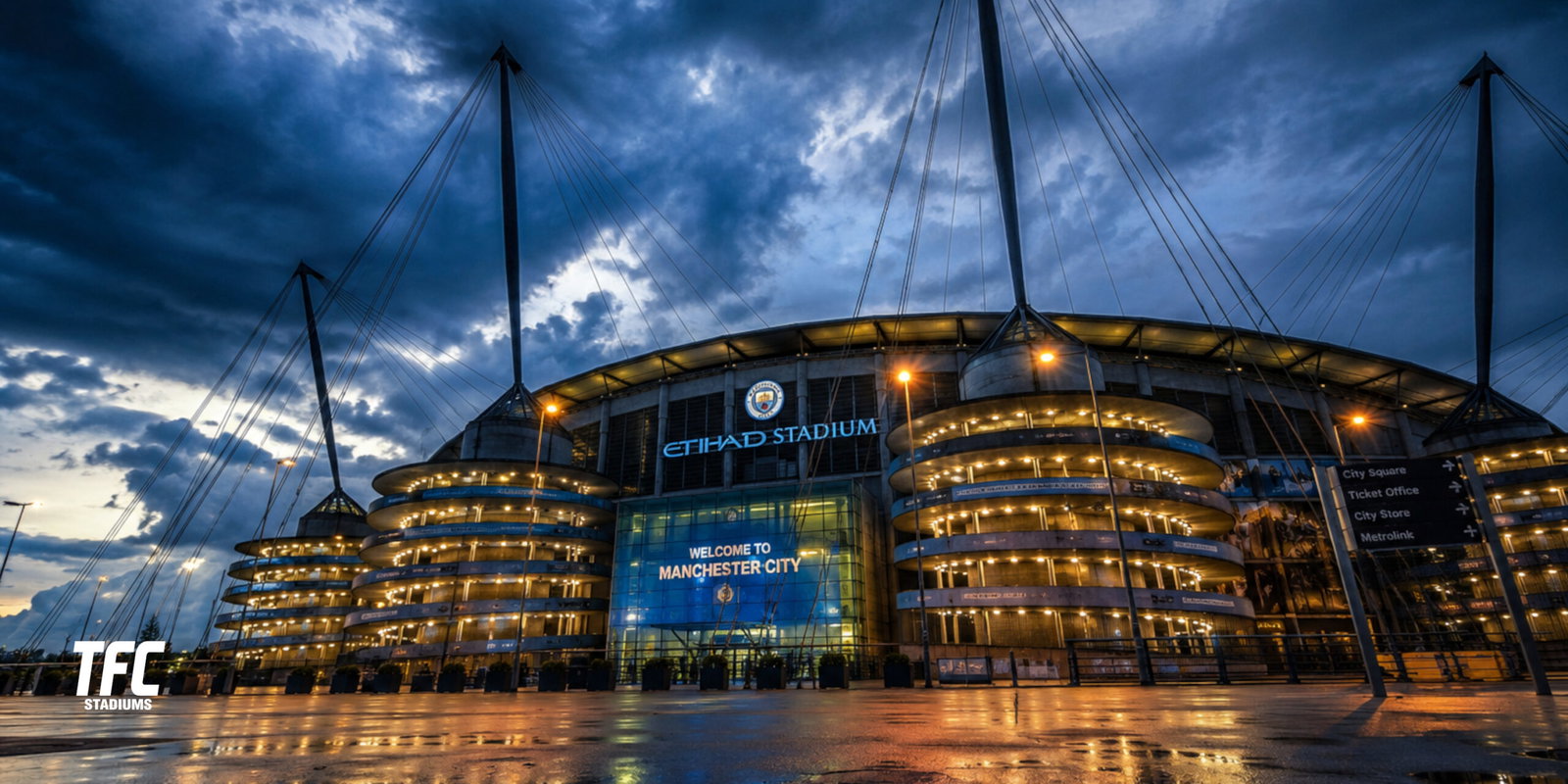
The Etihad uses a cable-supported roof structure, a solution designed to provide strength while avoiding heavy traditional supports.
The system relies on:
- External masts supporting the structure
- A tensioned cable network
- Lightweight roof sections extending over seating areas
- A large open central area above the pitch
Instead of placing huge columns inside the stadium bowl, loads are transferred outward through the cable system. This gives supporters uninterrupted views and creates the clean, open appearance associated with the stadium.
From an engineering perspective, it works a little like a suspension bridge. Strength comes from tension rather than simply adding more steel.
The Iconic Roof Masts
One of the most recognisable parts of the Etihad’s silhouette is the collection of tall external masts surrounding the stadium.
They are not just decorative features. These masts:
- Carry major roof loads
- Reduce the need for internal supports
- Create the stadium’s distinctive exterior profile
- Allow a lighter roof structure
The design gives the Etihad a very different appearance compared with traditional English football grounds where roofs often developed gradually over decades.
Impact On Atmosphere
A football stadium roof has a second job beyond weather protection. It controls sound.
The Etihad has sometimes faced criticism compared with older, tighter grounds, but the roof plays an important role in containing noise, especially after later redevelopment work.
Key atmosphere factors include:
- Roof angle influencing how sound returns towards supporters
- Larger covered areas improving crowd noise retention
- Expansion projects creating steeper seating sections
- Closed corners reducing sound escape
The South Stand expansion, completed in 2015, helped improve the stadium atmosphere by adding a larger single-tier style supporter area and changing the feel behind the goal.
Roof Expansion And Engineering Challenges
Increasing capacity at the Etihad was not as simple as adding extra seats.
Expanding the stadium required major structural changes because the roof was already part of a carefully balanced tension system.
During the South Stand expansion:
- Parts of the existing roof structure were altered
- A larger roof section was installed
- New supporting structures were added
- Capacity increased from roughly 48,000 to over 53,000
The project showed the advantage of the original flexible design. Many stadiums built for a single purpose struggle to evolve without enormous reconstruction costs.
The North Stand Expansion And Future Design
The ongoing North Stand redevelopment represents another major step in the stadium’s evolution.
The project is expected to increase capacity to more than 60,000 and includes:
- A larger upper tier
- New roof modifications
- Improved fan facilities
- A covered fan zone
- Hospitality and entertainment spaces
Modern stadium design is increasingly about creating a venue used beyond matchday. The Etihad roof is becoming part of a larger entertainment campus rather than simply a football enclosure.
Comparison With Other Modern Stadium Roofs
| Stadium | Roof Style | Key Difference |
|---|---|---|
| Etihad Stadium | Cable-supported roof | Lightweight adaptable structure |
| Wembley Stadium | Arch-supported roof | Large-span national stadium design |
| Tottenham Hotspur Stadium | Compression ring roof | Designed around maximum football atmosphere |
| Allianz Arena | Inflated panel exterior and roof system | Strong visual identity |
| Emirates Stadium | Curved bowl roof | Focus on comfort and premium viewing |
The Etihad is less dramatic visually than Wembley or the Allianz Arena, but it was designed around adaptability. Its greatest strength is that it has been able to change with the club.
Sustainability And Efficiency
The roof contributes to the stadium’s overall efficiency by reducing the amount of heavy construction material needed.
Modern stadium roofs must consider:
- Steel usage
- Maintenance access
- Lighting integration
- Energy systems
- Weather resistance
As Manchester City continues developing the wider Etihad Campus, future improvements are likely to focus even more on sustainability and year-round use.
An Underrated Piece Of Stadium Engineering
The Etihad roof will probably never be the first thing fans mention when discussing famous football architecture. It does not have Wembley’s arch or the glowing exterior of the Allianz Arena.
What it does have is intelligent engineering.
It helped transform an athletics venue into a Premier League stadium, allowed major expansion without starting again, and continues to evolve as Manchester City’s ambitions grow. For a structure built around flexibility, that might be the biggest achievement of all.
About the Author