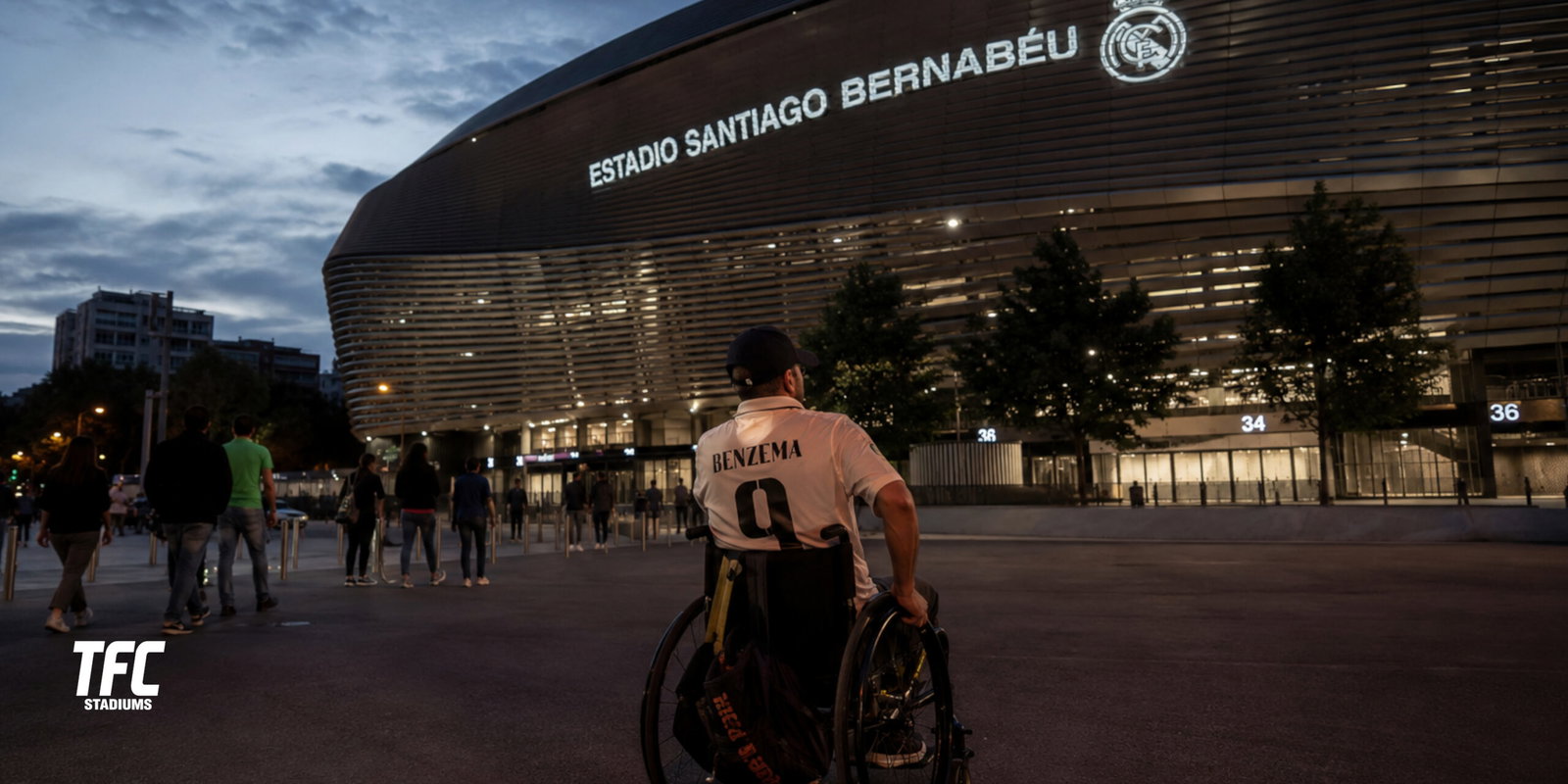
The Santiago Bernabéu has always been about spectacle. European nights, impossible comebacks, white shirts under the floodlights and 80,000 voices expecting something ridiculous to happen. Yet one of the most important parts of the stadium’s transformation has been less about glamour and more about making the building work for every supporter.
Real Madrid’s huge redevelopment project has turned the Bernabéu from a historic football cathedral into a modern multi-purpose venue. Alongside the retractable pitch, new roof, upgraded hospitality and digital technology, accessibility has become a key part of the redesign.
A stadium built in 1947 was never originally designed around modern accessibility standards. Retrofitting one of football’s most famous arenas while keeping its identity intact has been a serious architectural challenge.
Santiago Bernabéu Accessibility Overview
| Feature | Availability |
|---|---|
| Wheelchair-accessible seating | Yes |
| Accessible entrances | Yes |
| Accessible toilets | Available in adapted areas |
| Lifts | Available in accessible sections |
| Public transport access | Excellent |
| Accessible parking | Limited, with arrangements required |
| Assistance for disabled visitors | Available through club services |
| Modern redevelopment upgrades | Major improvements included |
The Bernabéu benefits from its location in central Madrid. Unlike many stadiums built outside cities, supporters are not forced into long journeys through remote parking zones. The trade-off is that space around the stadium is tighter, particularly on major matchdays.
Wheelchair Seating and Viewing Areas
The renovated Bernabéu includes designated wheelchair-accessible areas with companion seating.
These areas are designed to provide:
- Step-free access routes
- Clear sightlines of the pitch
- Nearby adapted facilities
- Space for wheelchair manoeuvring
- Access to stadium services
The old Bernabéu was famous for its steep stands, which created a brilliant atmosphere but presented challenges for accessibility. The redevelopment helped address this by improving circulation routes and modernising internal movement.
The stadium’s vertical design still means planning ahead is important. This is not a flat bowl-style arena built from scratch in open space, it remains a historic ground carefully adapted for the future.
Accessible Entrances and Movement Around the Stadium
One of the biggest improvements from the renovation is how supporters move around the Bernabéu.
Accessibility upgrades include:
- Improved entrances
- New lifts and vertical transport systems
- Wider internal circulation spaces
- Better organisation between different levels
- Modernised concourses
Before redevelopment, navigating parts of the stadium could feel like exploring a football museum that happened to host matches. Charming? Absolutely. Ideal for accessibility? Not always.
The new Bernabéu keeps the history but makes the building much easier to use.
Accessible Transport to Santiago Bernabéu
The stadium has one of the strongest public transport locations in elite football.
Metro Access
The easiest route for many supporters is the Madrid Metro.
The Santiago Bernabéu station on Line 10 is directly beside the stadium, making it one of the most convenient football transport links in Europe.
Fans should remember that accessibility varies across the wider Madrid Metro network, so checking step-free routes before travelling is recommended.
Bus and Taxi Access
Accessible options include:
- Madrid city buses with low-floor access
- Adapted taxi services
- Drop-off points close to the stadium
Traffic around Paseo de la Castellana becomes extremely busy before and after major fixtures, especially Champions League nights.
Accessible Parking
Parking is one of the Bernabéu’s biggest challenges.
The stadium sits in a dense urban district rather than a large sporting campus. Unlike newer venues surrounded by huge car parks, space is naturally limited.
Supporters requiring accessible parking should:
- Arrange requirements before matchday
- Contact Real Madrid supporter services
- Allow extra arrival time
- Check current restrictions around the stadium
The central location makes public transport the better option for many visitors.
Accessible Toilets and Facilities
Accessible toilets are provided in adapted areas of the stadium.
Modernisation work has improved:
- Facility quality
- Accessibility standards
- Internal signage
- Movement between concourse areas
The renovation was especially important because older European stadiums often struggled with facilities built decades before accessibility expectations changed.
Bernabéu Stadium Tour Accessibility
The Santiago Bernabéu Stadium Tour is one of Madrid’s most popular attractions, attracting hundreds of thousands of visitors every year.
Accessibility varies depending on redevelopment work and operational changes, but the modernised stadium has improved visitor routes compared with the previous layout.
Visitors requiring step-free access should check current tour arrangements before booking, as some historic sections of the building may have different access conditions.
How Does Bernabéu Compare With Other Elite Stadiums?
| Stadium | Accessibility Context |
|---|---|
| Santiago Bernabéu | Historic stadium heavily modernised with new accessibility upgrades |
| Tottenham Hotspur Stadium | Purpose-built modern accessibility design |
| Wembley Stadium | Large modern venue with extensive accessible facilities |
| Camp Nou | Major redevelopment planned to improve older infrastructure |
| San Siro | Historic venue with more structural limitations |
New-build stadiums have an advantage because accessibility can be included from the first blueprint. The Bernabéu’s achievement is different, taking a legendary but ageing stadium and dragging it into the modern era without losing its character.
Tips for Disabled Supporters Visiting the Bernabéu
Before attending:
- Book accessible tickets early
- Confirm entrance information before travelling
- Arrive earlier for major fixtures
- Plan Metro routes carefully
- Contact the club for specific assistance needs
- Allow extra time after matches due to crowds
Real Madrid games are not exactly quiet neighbourhood events. When the Bernabéu empties after a Champions League knockout match, Madrid temporarily forgets how pavements work.
Accessibility Meets Football Heritage
The Santiago Bernabéu’s biggest challenge has always been balancing history with progress. Football fans want the magic of the old stadium, but modern supporters need comfort, safety and accessibility.
The renovation has made major steps forward, creating a venue better suited for disabled visitors while preserving the intimidating vertical stands and atmosphere that made the Bernabéu famous.
It is still a city-centre stadium with natural limitations, but it is no longer a 20th-century venue trying to survive in a modern sporting world. It is a historic arena redesigned around a wider range of supporters, which is exactly where football should be heading.
You have not enough Humanizer words left. Upgrade your Surfer plan.
About the Author