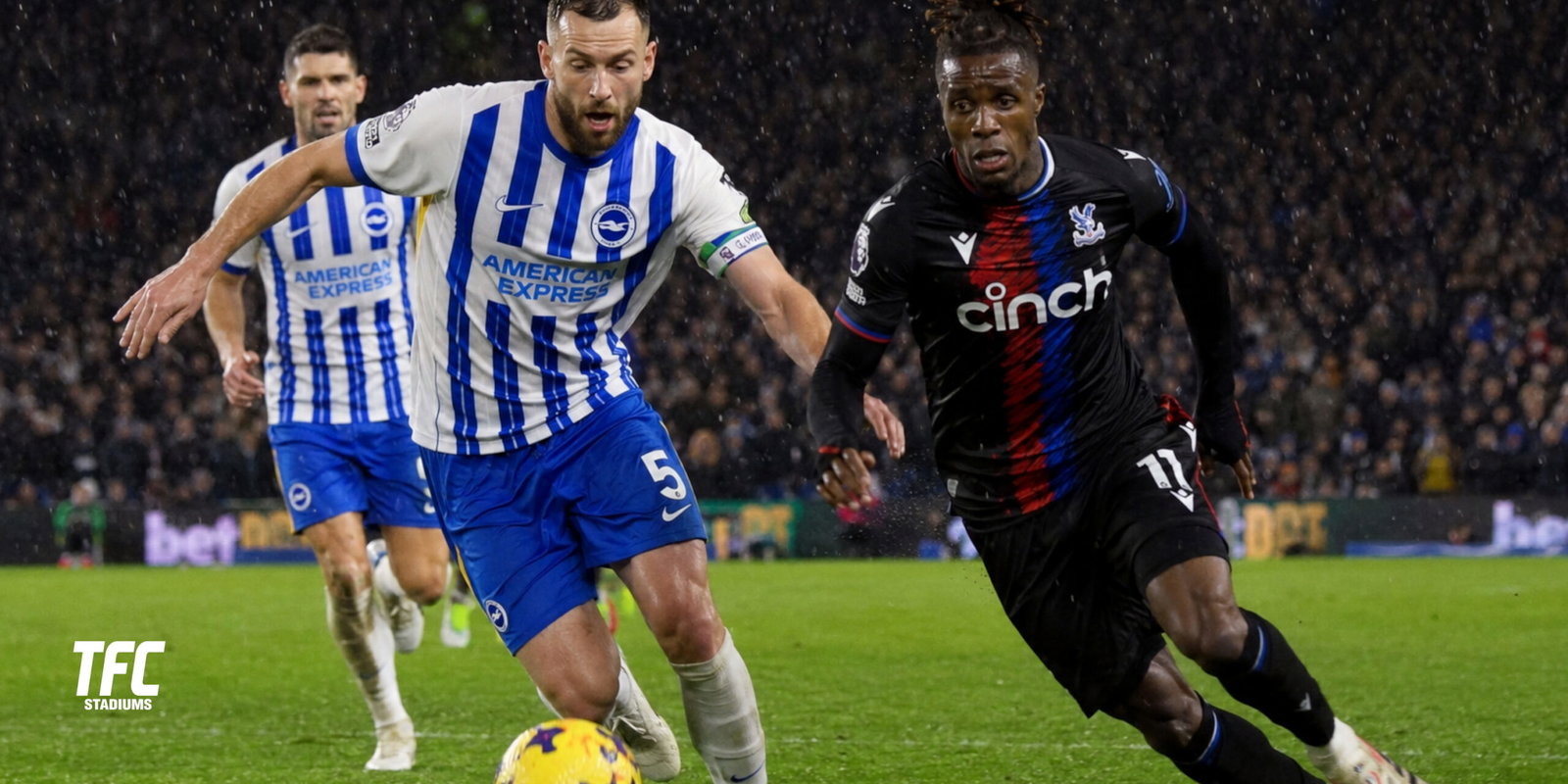
Some football rivalries make obvious sense. Same city, same streets, generations of neighbours arguing over colours.
Brighton & Hove Albion versus Crystal Palace is not one of those.
Separated by around 45 miles rather than a few bus stops, the so-called M23 derby has always confused outsiders. Yet ask supporters from either side and there is nothing artificial about it. The rivalry was forged through fierce matches, controversial moments, competing personalities and a mutual irritation that has lasted decades.
The Amex Stadium added a new chapter. Since opening in 2011, Brighton’s modern home has hosted Premier League clashes, late winners, red cards, emotional celebrations and plenty of reminders that geography is only one ingredient in football hatred.
How the Brighton vs Crystal Palace Rivalry Started
The rivalry truly caught fire in the late 1970s.
Brighton, managed by Alan Mullery, and Crystal Palace, managed by Terry Venables, were ambitious clubs climbing through English football. Both managers had previously been teammates at Tottenham Hotspur, but their competitive personalities helped turn regular fixtures into something much sharper.
The 1976 FA Cup meetings between the clubs became the foundation story. After two draws, Palace defeated Brighton in a second replay after controversy involving a retaken penalty. Mullery’s reaction after the match became part of rivalry folklore.
From there, the clubs followed surprisingly similar journeys:
- Promotion battles
- Financial difficulties
- Stadium struggles
- Championship clashes
- Premier League survival fights
- Ambitions to become established top-flight clubs
By the time Brighton moved into the Amex, the rivalry already had decades of emotional baggage.
The Amex Stadium Factor
Opened in 2011, the Amex represented a transformation for Brighton.
After years without a permanent home and later playing at the Withdean Stadium, Brighton finally had a venue capable of matching their ambitions.
Key Amex details:
| Stadium | Amex Stadium |
|---|---|
| Opened | 2011 |
| Capacity | Around 31,800 |
| Location | Falmer, Brighton |
| Club | Brighton & Hove Albion |
| First Palace league visit | 2013 Championship play-offs |
The Amex is not an old, intimidating ground in the traditional sense. There are no crumbling terraces or decades-old stands packed tightly against the pitch. Instead, its power comes from noise, design and the feeling Brighton finally have a footballing home worth defending.
Against Palace, that feeling becomes amplified.
Head-To-Head Record: Brighton vs Crystal Palace
The overall rivalry has remained remarkably balanced.
Across competitive meetings:
| Team | Wins |
|---|---|
| Brighton & Hove Albion | Around 40+ |
| Crystal Palace | Around 40+ |
| Draws | Around 30 |
The numbers tell an important story. Neither club has ever completely dominated the rivalry for long.
Palace historically held bragging rights through several major moments, especially the 2013 Championship play-offs, while Brighton’s Premier League rise under Graham Potter and Roberto De Zerbi helped shift momentum.
The modern era has been less about league position and more about individual moments. Palace could arrive struggling and still ruin Brighton’s afternoon. Brighton could be chasing Europe and still find Palace awkward.
That unpredictability is exactly why the fixture works.
Best Brighton vs Crystal Palace Matches at the Amex
Brighton 0-2 Crystal Palace, 2013 Championship Play-Off Semi-Final
This remains the most painful Amex night for many Brighton supporters.
After a goalless first leg, Brighton entered the second match with home advantage and dreams of reaching Wembley.
Instead, Palace produced the ultimate away performance.
Wilfried Zaha scored twice, sending Palace into the play-off final where they defeated Watford and reached the Premier League.
For Palace fans, it was perfection. Beat your rivals, at their new stadium, then win promotion.
For Brighton fans, it was football choosing maximum cruelty.
Brighton 3-1 Crystal Palace, 2018 Premier League
One of Brighton’s defining Amex derby victories.
The match had everything:
- Glenn Murray scoring against his former club
- Shane Duffy receiving an early red card
- Brighton somehow improving with 10 men
- A spectacular solo goal from Florin Andone
The atmosphere was electric because Brighton did not just win, they won in the most chaotic way possible.
A derby with sensible decision-making and calm defending would almost feel wrong.
Brighton 1-1 Crystal Palace, 2022 Premier League
A perfect example of the modern rivalry.
Brighton dominated possession, created chances and controlled long periods. Palace survived pressure and frustrated their opponents.
Joachim Andersen’s own goal eventually rescued Brighton a point after Conor Gallagher had given Palace the lead.
It highlighted a recurring theme, Brighton often have the statistics, Palace often find a way to make life uncomfortable.
Brighton 4-1 Crystal Palace, 2024 Premier League
One of Brighton’s strongest Premier League derby performances.
Roberto De Zerbi’s side overwhelmed Palace with aggressive pressing, fast transitions and attacking movement.
Goals from Lewis Dunk, Jack Hinshelwood, Facundo Buonanotte and João Pedro turned the Amex into a celebration.
For Brighton fans, it represented how far the club had travelled since the difficult years before the Amex.
Iconic Brighton Players in the Rivalry
Glenn Murray
Few players represent the unusual connection between the clubs better.
Murray played for both Brighton and Palace, scored important goals for both, and somehow managed to remain a significant figure in rivalry history.
At Brighton, his intelligent movement and finishing helped establish the club in the Premier League.
Lewis Dunk
Brighton born, academy developed and club captain.
Dunk became the symbol of Brighton’s rise from Championship hopefuls into an established Premier League side.
Against Palace, his leadership and defensive presence gave Brighton a local figure supporters could rally behind.
Pascal Groß
Not a traditional derby warrior, but exactly the type of player who represented Brighton’s modern identity.
Smart, technical and painfully annoying for opponents, Groß became one of the Premier League’s most underrated creators.
Iconic Crystal Palace Players at the Amex
Wilfried Zaha
The villain Brighton fans loved to dislike.
Zaha’s 2013 play-off performance at the Amex remains arguably the most important individual display in the stadium’s rivalry history.
His combination of skill, confidence and ability to produce decisive moments made him the perfect derby character.
Conor Gallagher
During his Palace loan spell, Gallagher brought energy and aggression that suited derby football.
His goal at the Amex in 2022 showed why Palace supporters connected with him so quickly.
Mile Jedinak
Jedinak represented the Palace side that climbed back into the Premier League.
Physical, organised and relentless, he was exactly the type of midfielder opponents hated playing against.
Tactical Evolution: How the Rivalry Changed
The early Amex meetings were often about Championship intensity:
- Physical battles
- Direct football
- Set pieces
- Defensive organisation
The Premier League era changed the style.
Brighton became associated with:
- Possession football
- High pressing
- Data-led recruitment
- Young international talent
Palace often relied on:
- Explosive wide players
- Counter-attacks
- Defensive structure
- Individual match winners
The contrast has made recent games fascinating. Brighton often want control. Palace are perfectly happy turning control into frustration.
Why Brighton vs Crystal Palace Still Matters
Football has bigger rivalries by trophies, crowds and global attention.
Few, however, are quite as unusual.
Brighton and Palace built their rivalry through shared history rather than location. The Amex years have added Premier League quality, bigger audiences and a new generation of memorable moments.
It is a rivalry where both clubs see something familiar in the other. Ambitious clubs from outside English football’s traditional elite, fighting to prove they belong.
They just absolutely do not want the other one proving it first.
About the Author