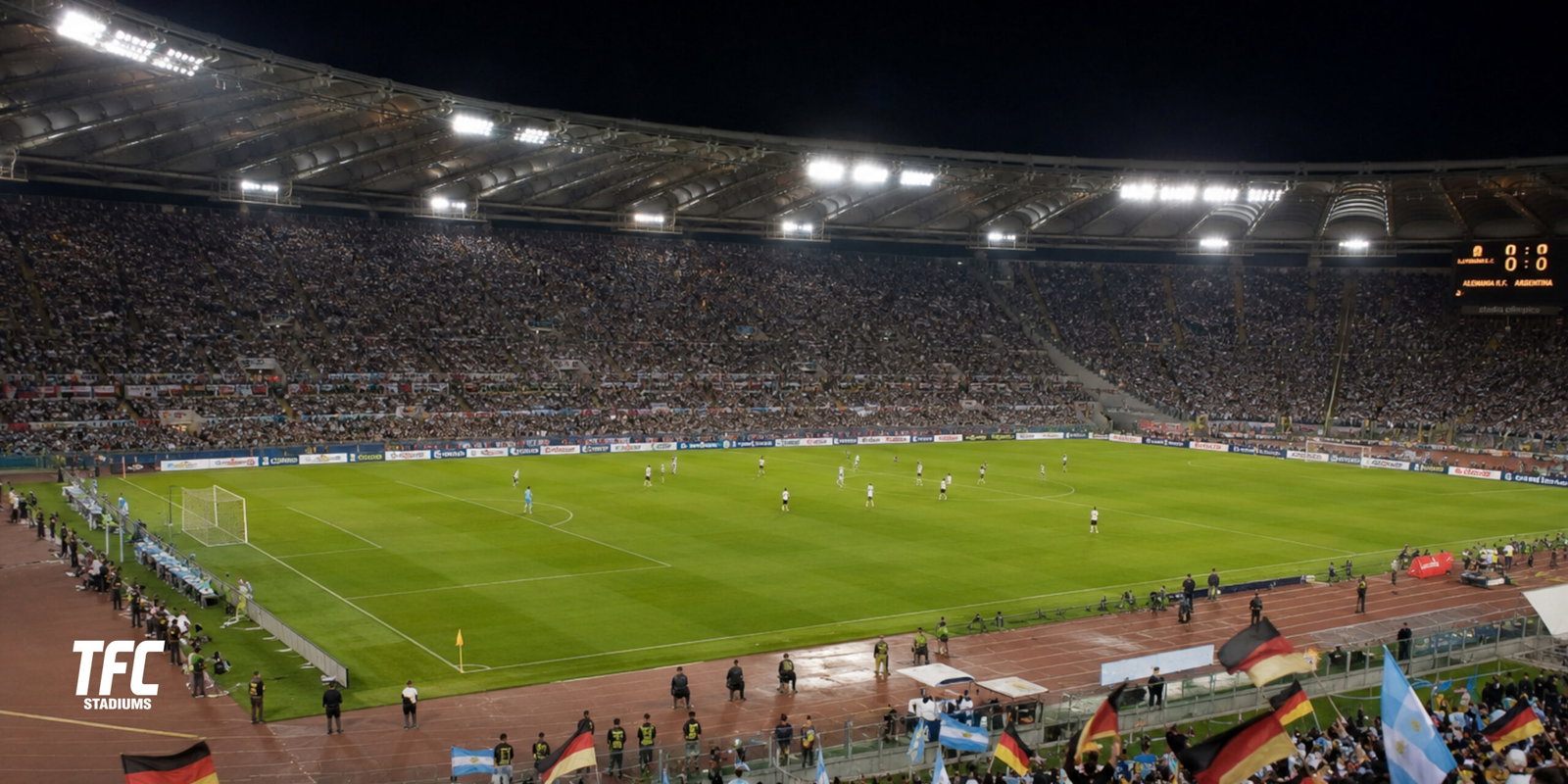
The 1990 FIFA World Cup remains one of football’s most atmospheric tournaments. Italia 90 was a month of operatic drama, defensive masterclasses, unforgettable kits and enough emotional close-ups to keep television producers busy for decades.
At the centre of it all stood Stadio Olimpico in Rome.
Already one of Europe’s great sporting arenas, the stadium was transformed before the tournament into a modern football venue capable of hosting the biggest moments on the planet. It staged six matches, including the opening fixture involving Italy and the final between West Germany and Argentina.
Italia 90 did not always deliver endless goals, but it delivered moments. Few places captured those moments better than the Olimpico.
Stadio Olimpico Before Italia 90
Originally opened in 1953, Stadio Olimpico had already lived several sporting lives before the World Cup arrived.
It had hosted:
- The 1960 Summer Olympics
- European Cup finals
- Major athletics events
- Home matches for Roma and Lazio
By the late 1980s, however, FIFA World Cup standards had changed. Bigger television audiences, increased commercial demands and modern spectator expectations meant Italy’s flagship stadium needed a major upgrade.
Rome was not simply preparing a football ground. It was preparing a global stage.
The Italia 90 Renovation
The redevelopment of Stadio Olimpico was one of the largest stadium projects undertaken for the tournament.
Key changes included:
| Feature | Italia 90 Upgrade |
|---|---|
| Capacity | Increased to around 73,000 seated spectators |
| Roof | A new continuous roof structure added |
| Seating | Conversion towards a modern all-seater design |
| Facilities | Improved media, hospitality and spectator areas |
| Structure | Major reconstruction of existing stands |
The most dramatic visual change was the roof. Supported by a tensioned steel structure, it gave the Olimpico the sweeping appearance many fans recognise today.
The redesign was not without debate. Some felt the larger roof and increased distance from the pitch affected the old atmosphere. Italian stadium arguments rarely arrive quietly, and Rome had plenty of opinions.
Matches Hosted At Stadio Olimpico During Italia 90
The Olimpico hosted some of the tournament’s defining fixtures:
| Date | Match | Stage | Result |
| 9 June 1990 | Italy vs Austria | Group Stage | Italy 1-0 Austria |
| 14 June 1990 | Italy vs United States | Group Stage | Italy 1-0 United States |
| 19 June 1990 | Italy vs Czechoslovakia | Group Stage | Italy 2-0 Czechoslovakia |
| 25 June 1990 | Italy vs Uruguay | Round of 16 | Italy 2-0 Uruguay |
| 8 July 1990 | West Germany vs Argentina | Final | West Germany 1-0 Argentina |
Rome became Italy’s fortress during the tournament. Every Italian match at the Olimpico ended in victory without conceding a goal.
Until the semi-final in Naples, the dream felt almost unstoppable.
Italy’s Magical Nights At The Olimpico
The story of Italia 90 at Stadio Olimpico cannot be separated from Italy’s national team.
Under manager Azeglio Vicini, Italy combined defensive discipline with attacking flashes from players such as Roberto Baggio and Salvatore “Toto” Schillaci.
Schillaci became the unexpected hero of the tournament. He arrived as a squad player and left as the Golden Boot winner, scoring six goals.
His first came at the Olimpico against Austria, a header that turned him from a relatively unknown Juventus forward into the face of a World Cup.
Football loves a surprise hero. Italy found theirs under the Roman lights.
The 1990 World Cup Final At Stadio Olimpico
The final on 8 July 1990 brought together two football giants:
West Germany
Manager:
- Franz Beckenbauer
Key players:
- Lothar Matthäus
- Jürgen Klinsmann
- Andreas Brehme
- Rudi Völler
Argentina
Manager:
- Carlos Bilardo
Key players:
- Diego Maradona
- Sergio Goycochea
- Claudio Caniggia, suspended for the final
The match was tense rather than spectacular. Argentina defended deep, West Germany controlled possession, and chances were limited.
The decisive moment came in the 85th minute when Andreas Brehme scored from the penalty spot.
West Germany won 1-0, giving Beckenbauer the rare achievement of winning the World Cup as both player and manager.
Atmosphere And Fan Experience
Italia 90 arrived during a unique era of football culture. It was before smartphones, constant social media clips and instant analysis. The stadium experience carried a different weight.
At the Olimpico, fans experienced:
- Huge flag displays across the curved stands
- Packed evening matches under floodlights
- Italian supporters creating a wall of noise
- A mixture of traditional football culture and modern World Cup presentation
The running track meant supporters were further from the action compared with dedicated football stadiums, but the scale of the venue created a sense of occasion few arenas could match.
Architecture And Design Legacy
The Italia 90 version of Stadio Olimpico shaped the stadium for decades.
Advantages of the redevelopment:
- Greater spectator comfort
- Improved weather protection
- Better facilities for international events
- Ability to host elite finals
Criticism:
- Reduced connection between fans and pitch
- Athletics layout created viewing distance issues
- Some original architectural character was lost
The debate remains familiar today. Modernisation brings comfort, but sometimes football misses the rough edges that created the old magic.
Stadio Olimpico After Italia 90
Following the World Cup, the stadium continued as one of Europe’s major football venues.
It hosted:
- Champions League finals
- European Championship matches
- Coppa Italia finals
- Major concerts and events
- Weekly Roma and Lazio fixtures
The Italia 90 renovation effectively secured its position as Italy’s international football home.
Italia 90 By The Numbers At Stadio Olimpico
| Category | Detail |
| Tournament | FIFA World Cup 1990 |
| Host City | Rome |
| Stadium Capacity | Around 73,000 after renovation |
| Matches Hosted | 6 |
| Biggest Match | 1990 World Cup Final |
| Final Attendance | Around 73,000 |
| Champion Crowned | West Germany |
| Total Tournament Goals | 115 in 52 matches |
Italia 90 is often remembered as a low-scoring World Cup, but numbers only tell part of the story. The tournament produced some of football’s most memorable images, and many of them came from Rome.
The Olimpico’s Defining Summer
Stadio Olimpico has seen Olympic champions, European finals and generations of Roma and Lazio legends, but Italia 90 remains one of its signature chapters.
The tournament changed the stadium physically, while the matches played there added another layer to its history. Schillaci’s celebrations, Italian flags filling the stands, Maradona returning for another final and Germany lifting the trophy all became part of the Olimpico’s identity.
More than three decades later, the renovated arena still carries traces of that summer when Rome became football’s capital and the world watched.
About the Author