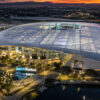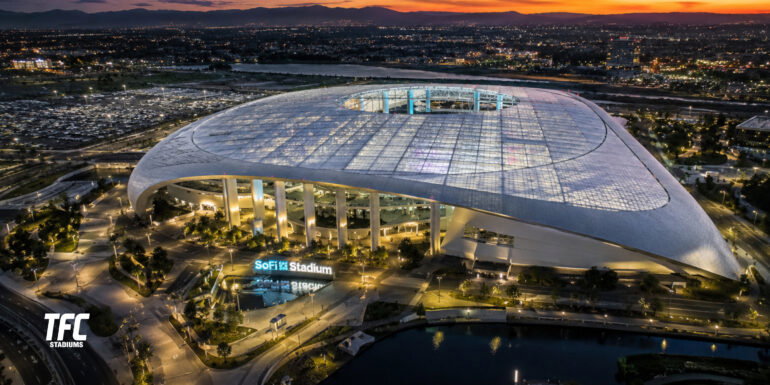
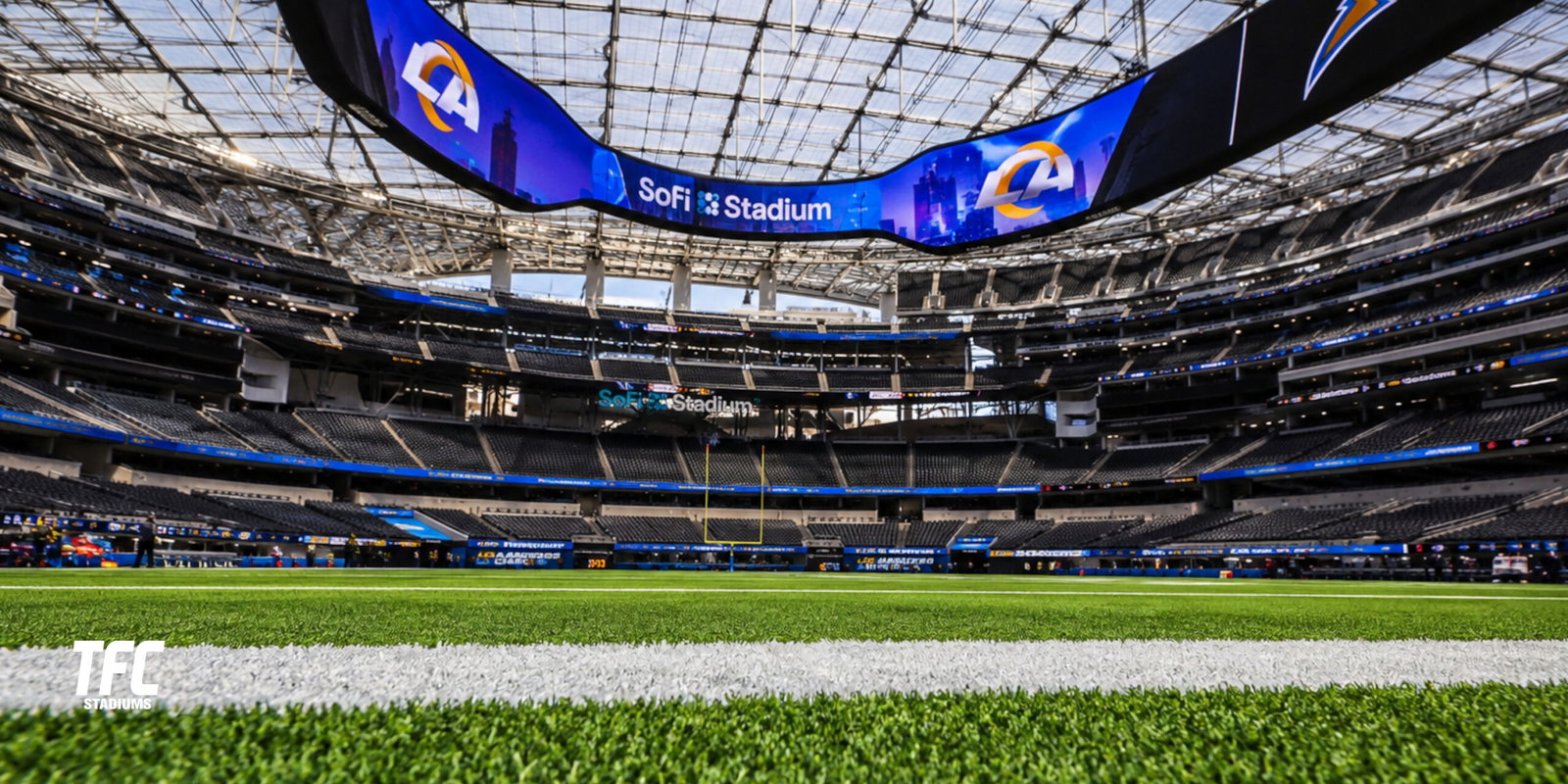
SoFi Stadium was designed to challenge almost every traditional idea of what an NFL venue could be. The roof is not a standard dome, the video board is not a normal scoreboard, and the playing surface is not simply a patch of artificial grass rolled across concrete.
Built as the home of the Los Angeles Rams and Los Angeles Chargers, SoFi needed a surface capable of handling a brutal schedule. NFL games, concerts, college football, international football, and global events all pass through the same building.
The answer was a modern synthetic turf system designed around durability, consistency, and quick event turnaround. It is a very Los Angeles solution, highly engineered, expensive, and built for a stadium that rarely gets a quiet weekend.
Why SoFi Stadium Uses Artificial Turf Instead Of Natural Grass
At first glance, a stadium in sunny Southern California feels like the perfect candidate for natural grass. Plenty of sunshine, warm weather, and no freezing winters. The reality is more complicated.
SoFi Stadium sits beneath a massive translucent ETFE roof canopy. While the building is open sided, the roof changes the growing environment. Natural grass would face challenges including:
- Reduced direct sunlight in certain areas
- Heavy event scheduling
- Rapid conversions between sports and entertainment events
- Wear from two NFL franchises sharing one venue
The Rams and Chargers each host regular season games, and the stadium calendar includes major concerts and special events. A natural grass field would need constant recovery time.
Synthetic turf gives operators far greater control.
The Turf System Used At SoFi Stadium
SoFi Stadium opened with Matrix Turf, a synthetic playing surface developed by Hellas Construction.
The system uses advanced artificial fibres designed to replicate many characteristics of natural grass while offering greater durability.
Key features include:
| Feature | Purpose |
|---|---|
| Synthetic grass fibres | Provide a consistent playing surface |
| Multi-layer backing system | Supports stability and drainage |
| Performance infill | Helps with cushioning and traction |
| Engineered base layers | Keeps the field level and responsive |
Unlike older artificial surfaces that felt closer to carpet over concrete, modern NFL turf systems are built as complex layered structures.
Players are not running directly on plastic blades. They are competing on an engineered system designed to manage grip, impact, speed, and weather conditions.
How The Turf Handles Two NFL Teams
Sharing a stadium creates unusual pressure.
A single NFL team normally hosts around 10 games including preseason. SoFi can double that before adding playoffs, college games, and other sporting events.
The field must withstand:
- Rams home games
- Chargers home games
- NFL playoff games
- College football showcases
- Soccer events
- Stadium tours
- Concert conversions
The ability to remove branding quickly is another advantage. End zones, midfield logos, and sponsorship markings can be changed between events.
A Chargers game can become a Rams game without needing an entirely new playing field.
Player Performance And Surface Design
Modern turf design focuses heavily on three areas:
- Shock absorption
- Foot stability
- Ball response
NFL players generate enormous forces when cutting, accelerating, and stopping. A wide receiver changing direction at full speed puts huge stress through the surface.
The challenge is creating enough grip for explosive movement without causing a player’s foot to become trapped.
Too little traction creates slipping. Too much traction increases stress on joints.
That balance is where modern turf engineering has become far more sophisticated.
The Injury Debate Around Artificial Turf
Artificial turf remains one of the biggest debates in professional football.
Many players prefer natural grass, arguing that it feels better and may reduce certain types of injuries. The NFL Players Association has repeatedly pushed for wider adoption of grass fields.
Supporters of synthetic surfaces point towards:
- More predictable conditions
- Lower maintenance requirements
- Better durability under heavy usage
- Consistent performance regardless of weather
SoFi sits right in the middle of that debate. Technologically, it is one of the most advanced stadiums in the world. Yet some players would still rather see grass installed.
Sometimes the most advanced answer is not automatically the most popular one in the locker room.
Maintenance Technology Behind The Surface
Artificial turf does not mean maintenance free.
The operations team still needs to manage:
- Fibre condition
- Surface hardness testing
- Infill distribution
- Cleaning and sanitation
- Seam inspections
- Field markings
Specialised equipment brushes and redistributes the infill to keep the field performing consistently.
The goal is that a player stepping onto the field late in the season experiences a surface close to opening week conditions.
Event Conversion: The Hidden Strength Of SoFi’s Turf
One of the biggest benefits appears when nobody is playing football.
SoFi Stadium was built as an entertainment venue first and a football stadium second. Major concerts require huge stages, flooring systems, equipment, and thousands of people moving across the field.
A natural surface would take significant punishment.
Synthetic turf allows the stadium to recover quickly after large events and return to NFL standards.
That flexibility is a major reason modern stadium economics often favour artificial surfaces.
How SoFi Compares With Other NFL Stadiums
NFL venues are split between natural and synthetic approaches.
| Stadium | Surface Approach |
| SoFi Stadium | Synthetic turf |
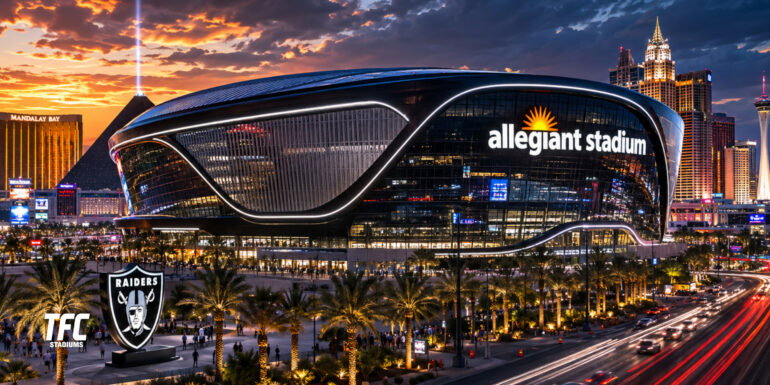
| Allegiant Stadium | Retractable natural grass field |
| State Farm Stadium | Retractable natural grass field |
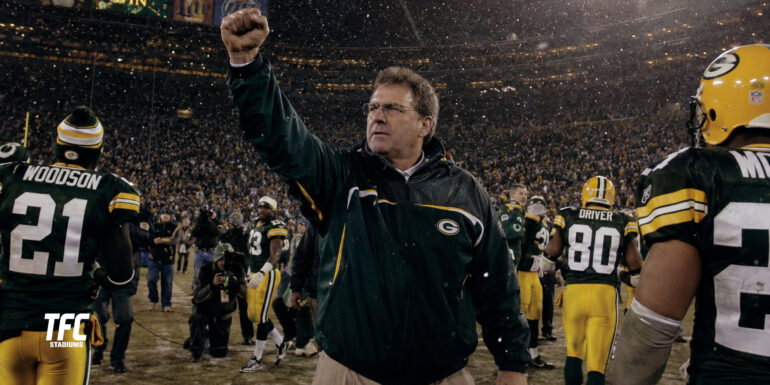
| Lambeau Field | Hybrid natural grass system |
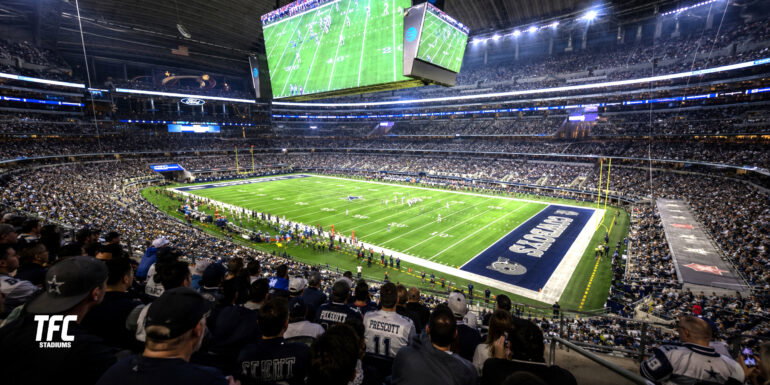
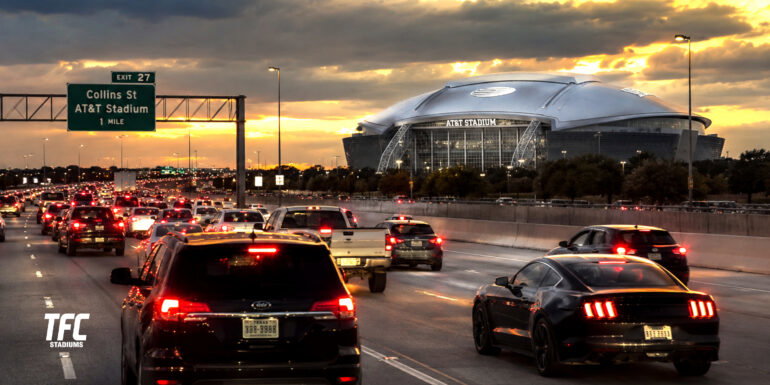
| AT&T Stadium | Synthetic turf |
The comparison shows there is no single answer. Climate, architecture, cost, and event schedules all influence the decision.
SoFi’s choice reflects its identity: a high-volume entertainment complex designed for maximum flexibility.
Future Of Turf Technology At SoFi Stadium
The future of stadium surfaces is likely to focus on improving player safety while keeping the advantages of synthetic systems.
Possible developments include:
- Softer infill materials
- Improved shock absorption layers
- More realistic fibre technology
- Better injury tracking data
- Hybrid grass alternatives
With events such as major football championships and global sporting showcases heading to SoFi, the playing surface will continue to attract attention.
TFC Takeaway
The turf at SoFi Stadium represents the modern stadium dilemma. Owners want flexibility, operators need reliability, and athletes want the safest possible conditions.
From an engineering perspective, the surface is impressive. It allows one building to transform from Rams territory, to Chargers territory, to a concert venue in days.
The debate over artificial turf will not disappear, and perhaps it should not. When athletes worth millions are sprinting, cutting, and colliding at full speed, the ground beneath them matters.
At SoFi Stadium, even the grass has a technology story.
About the Author