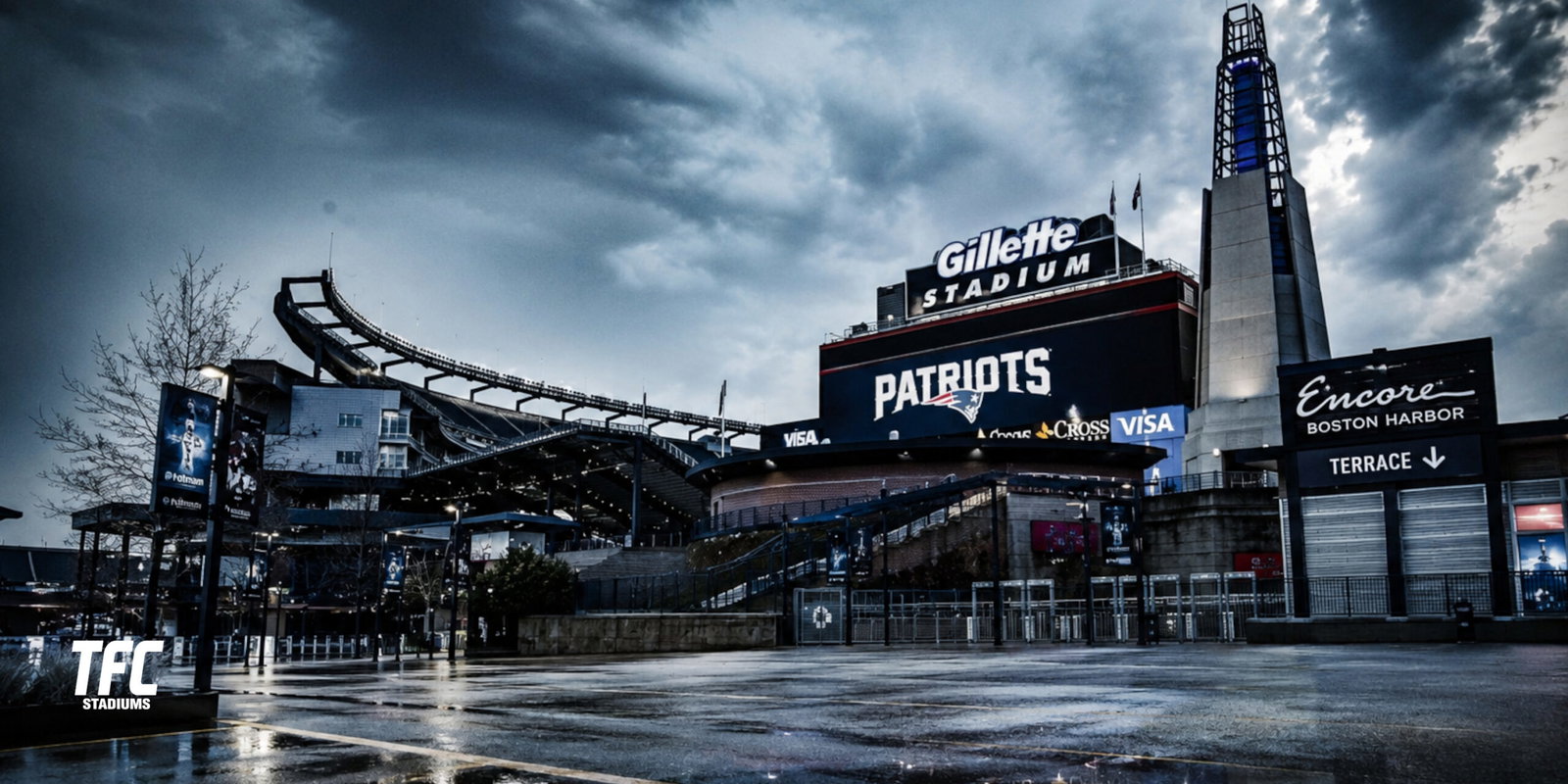
The story of Gillette Stadium is about far more than concrete, steel and luxury suites. It is the story of a franchise that finally stopped thinking about survival and started thinking about championships.
For decades, the New England Patriots occupied an awkward place in the NFL landscape. They had passionate fans but an ageing stadium. They enjoyed moments of success but rarely sustained excellence. By the early 2000s, everything changed.
Gillette Stadium arrived at exactly the right moment. The Patriots were becoming one of the greatest dynasties professional sport has ever seen, and suddenly they had a home worthy of their ambitions.
Today, it is difficult to separate the Patriots from Gillette Stadium. One helped build the other, creating one of the NFL’s strongest identities.
Before Gillette Stadium: Life at Foxboro Stadium
Long before giant video boards and premium hospitality became standard across the NFL, the Patriots called Foxboro Stadium home.
Opened in 1971, the stadium was built on a relatively modest budget of around $7 million. It was practical rather than glamorous. Concrete benches, exposed steel and basic facilities reflected the economics of professional football during that era.
Fans remember it fondly because of the atmosphere, not the comfort.
Anyone attending games during the late autumn or winter quickly discovered that metal bench seating in a Massachusetts blizzard was less than luxurious. The weather was part of the experience, whether you liked it or not.
Despite its shortcomings, Foxboro Stadium became associated with some memorable Patriots moments, including the franchise’s first Super Bowl appearance following the 1985 season.
By the late 1990s, however, the venue had become one of the NFL’s oldest and least profitable stadiums.
The NFL Was Changing
During the 1990s, stadium economics changed dramatically.
Luxury suites, club seating, restaurants and sponsorship deals became major sources of revenue. Television money continued growing, but teams increasingly relied on stadium income to compete financially.
Compared to newer venues, Foxboro Stadium generated relatively little premium revenue.
Many franchises were either constructing new stadiums or significantly renovating existing ones.
The Patriots faced a simple reality.
Either modernise or risk falling behind.
Robert Kraft’s Gamble
Everything might have turned out very differently without Robert Kraft.
In 1988, Kraft purchased the land surrounding Foxboro Stadium.
A few years later, he bought the stadium itself.
Then, in 1994, he acquired the Patriots for $172 million, at the time the highest price ever paid for an NFL franchise.
Many observers questioned the investment.
The Patriots had limited commercial opportunities, an outdated stadium and uncertainty surrounding their long-term future.
Relocation rumours regularly surfaced, with several cities expressing interest in attracting the franchise.
Kraft believed New England deserved an elite football team and knew a modern stadium was essential to keeping the Patriots in Massachusetts.
That belief ultimately reshaped the franchise.
Building a New Home
Construction began in March 2000.
Unlike many NFL stadium projects, Gillette Stadium was privately financed, with Robert Kraft contributing the overwhelming majority of the funding.
The final construction cost reached approximately $325 million.
That approach gave the Patriots considerable flexibility while avoiding many of the lengthy political disputes surrounding publicly funded stadium developments elsewhere in the United States.
The location remained beside Foxboro Stadium.
This decision proved remarkably practical.
The Patriots continued playing in their existing home while construction progressed only a few hundred metres away.
Once Gillette Stadium opened, Foxboro Stadium was demolished.
The transition happened with minimal disruption to fans or the team.
Opening in 2002 Could Not Have Been Better Timed
Sometimes history has impeccable timing.
Gillette Stadium officially opened in 2002.
Only months earlier, the Patriots had shocked the football world by winning Super Bowl XXXVI.
Tom Brady had emerged from relative obscurity.
Bill Belichick was beginning to establish what would become one of the greatest coaching careers in sports.
Instead of moving into a new stadium after years of disappointment, the Patriots arrived as reigning world champions.
The building immediately carried an aura of success.
That momentum never really disappeared.
Designed for the Modern NFL
Gillette Stadium represented a huge leap forward in every category.
Key Features
| Feature | Details |
|---|---|
| Opening Year | 2002 |
| Capacity | Approximately 64,600 |
| Construction Cost | Around $325 million |
| Surface | Natural grass |
| Suites | More than 80 luxury suites |
| Club Seating | Over 6,000 premium seats |
The stadium introduced:
- Modern luxury suites
- Premium club lounges
- Wider concourses
- Improved sightlines
- Enhanced concessions
- Better accessibility
- Large HD video boards
- Expanded retail facilities
Every improvement increased both fan satisfaction and commercial revenue.
Patriot Place Changed Everything
Perhaps the smartest decision extended beyond football.
Rather than treating the stadium as a venue used ten Sundays each season, the Kraft family developed Patriot Place.
The surrounding district features:
- Restaurants
- Shopping
- Hotels
- Entertainment venues
- Offices
- The Patriots Hall of Fame
- Medical facilities
This transformed the area into a year-round destination.
Instead of arriving shortly before kick-off and leaving immediately afterwards, supporters often spend an entire day around the complex.
From a business perspective, that dramatically increased revenue opportunities.
Many NFL teams have since followed similar mixed-use development models.
The Dynasty Grew Alongside the Stadium
It is impossible to discuss Gillette Stadium without acknowledging what happened on the field.
Since opening, the Patriots have experienced one of the greatest runs in professional sports history.
During the Brady and Belichick era, Gillette Stadium became one of the NFL’s most intimidating venues.
The numbers are extraordinary.
The Patriots won well over 80 percent of their regular season home games during much of the dynasty, making Foxborough one of the league’s toughest road trips.
Cold weather certainly played a role.
Preparation mattered even more.
The Patriots rarely beat themselves.
Visiting teams knew that even a minor mistake often proved fatal.
Gillette became synonymous with disciplined football, late game execution and relentless consistency.
The Fans Built the Atmosphere
Unlike some newer stadiums that can occasionally resemble luxury shopping centres with a football match attached, Gillette has largely maintained its New England character.
Patriots supporters are knowledgeable, demanding and rarely impressed by flashy gimmicks.
They appreciate winning.
Fortunately for everyone involved, there has been plenty of that.
Tailgating remains a central part of game day culture, with thousands arriving hours before kick-off despite temperatures that occasionally make Antarctica seem almost inviting.
If your coffee freezes before halftime, congratulations. You are enjoying authentic Patriots football.
Hosting More Than NFL Games
Although football remains its primary purpose, Gillette Stadium has become one of New England’s premier entertainment venues.
Major events include:
- International football matches
- Concerts by global artists
- College football
- International rugby
- Lacrosse championships
- Monster Jam
- Community events
The venue will also play a major role during the 2026 FIFA World Cup, hosting multiple matches as one of the tournament’s selected stadiums.
That international exposure further strengthens Gillette Stadium’s reputation beyond American football.
Why Gillette Stadium Matters
Some stadiums simply provide a place to play.
Others redefine entire organisations.
Gillette Stadium belongs firmly in the second category.
Without it, the Patriots may have remained financially constrained, relocation rumours might have continued and the franchise would have found it far harder to maximise the commercial success generated by its championship teams.
Instead, the stadium became a symbol of stability.
It reflected Robert Kraft’s long-term vision, provided Bill Belichick and Tom Brady with an elite home environment and gave New England supporters a venue that matched the ambitions of one of the NFL’s greatest dynasties.
That combination of timing, ownership, smart investment and sustained success is remarkably rare in professional sport.
Legacy
Today, Gillette Stadium stands as much more than the Patriots’ home ground.
It represents one of the most successful stadium investments in NFL history.
The venue arrived precisely when the franchise needed it most, supporting explosive commercial growth while becoming the backdrop for six Super Bowl championships and countless unforgettable moments.
Long after the Brady era has passed into NFL folklore, Gillette Stadium continues to represent what modern sports venues aspire to become. It is financially successful, deeply connected to its community and capable of hosting world class events throughout the year.
Most importantly, it gave the Patriots something every great dynasty eventually acquires.
A home that feels every bit as iconic as the team itself.
About the Author