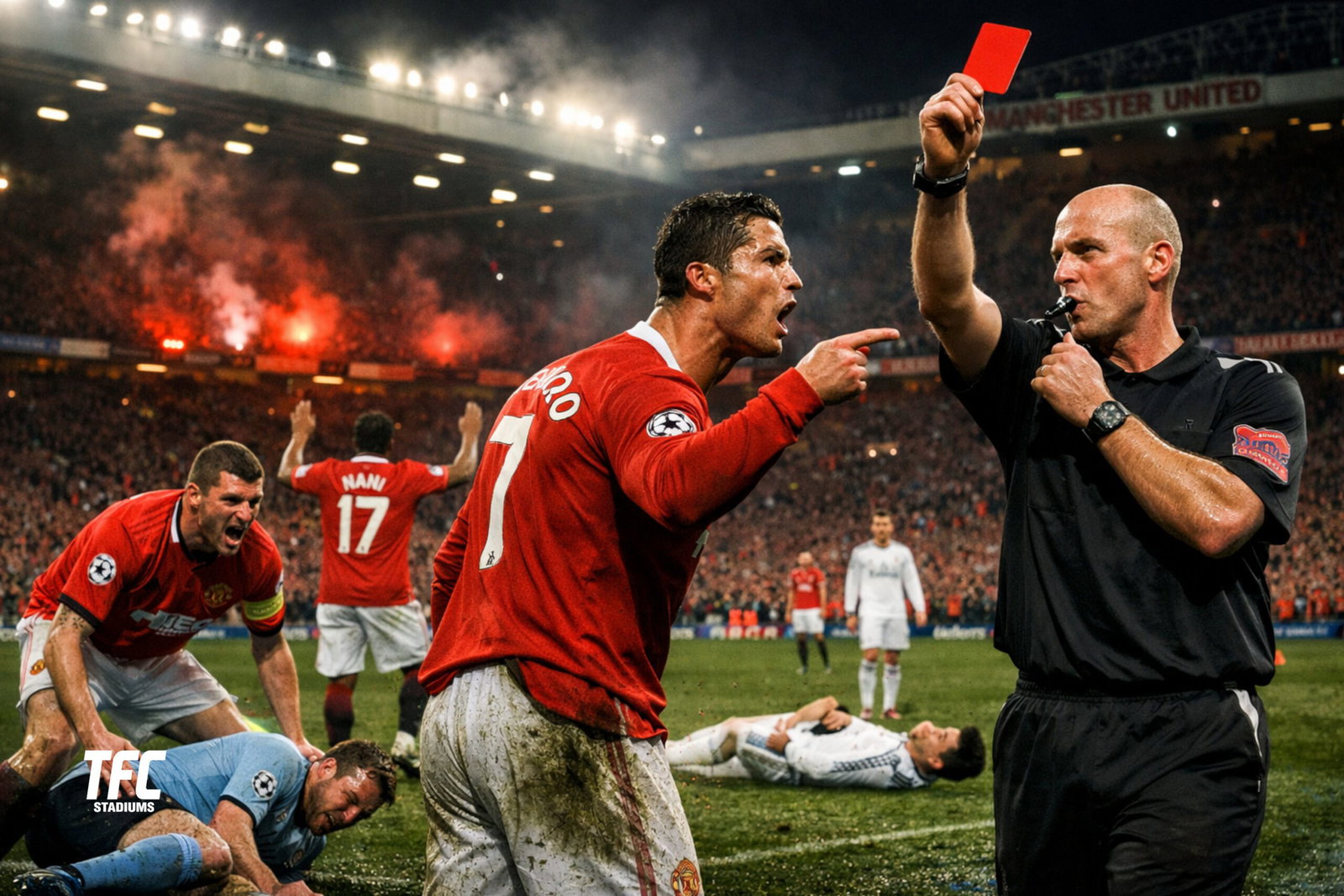
Few grounds in world football have seen referees placed under as much scrutiny as Old Trafford. The scale of the club, the pressure of the crowd, and the stakes of the matches have combined to produce decisions that still divide opinion years later. Some moments hardened reputations. Others became shorthand for perceived advantage. What follows is not a rant or a defence, but a clear-eyed look at the calls that shaped matches, seasons, and rivalries.
The Myth and the Setting
Old Trafford’s reputation for influencing officials did not appear overnight. It grew during an era when Manchester United dominated English football, often late into matches, often with the stadium roaring for one more decision. Officials insist the environment does not affect them. Former referees admit, usually after retirement, that no stadium is entirely neutral.
This tension matters because it frames how decisions are remembered. At Old Trafford, marginal calls rarely stay marginal.
Roy Keane vs Alf Inge Håland, 2001
In April 2001, Roy Keane launched himself into Alf Inge Håland with a challenge that was violent, deliberate, and personal. Referee David Elleray showed a red card immediately, which was correct. The controversy arrived later when Keane admitted in his autobiography that the tackle was premeditated.
The decision itself was not disputed, but its handling shaped later debates about retrospective punishment and player accountability. It remains one of the clearest examples where a referee acted decisively under intense pressure.
Cristiano Ronaldo and the Handball Line, 2008
During the late 2000s, Cristiano Ronaldo drew an extraordinary number of penalties at Old Trafford. Critics pointed to soft handball calls and minimal contact. Supporters argued defenders were reckless.
The key issue was consistency. Similar incidents elsewhere were often waved away. At Old Trafford, they were more likely to be punished. This fed the idea that the threshold for a foul shifted depending on venue.
The 2004 FA Cup Semi Final Replay vs Arsenal
United defeated Arsenal 2 to 0 in a replay that followed a fiery first match. Several Arsenal challenges escaped red cards. United benefited from strong interpretations of advantage and leniency in midfield battles.
Refereeing did not decide the tie alone, but Arsenal fans still cite the replay as an example of Old Trafford rules applied on neutral ground.
Nani vs Real Madrid, 2013
Although this match took place at Old Trafford, the sense of injustice came from both sides. Nani’s red card for a high boot on Álvaro Arbeloa changed a Champions League tie that United had controlled.
Referee Cüneyt Çakır judged the challenge dangerous play. Many disagreed, including Sir Alex Ferguson, who refused post-match interviews. This decision cuts against the Old Trafford advantage narrative and shows how the stadium can also be the stage for harsh calls against the home side.
The “Fergie Time” Era
Added time at Old Trafford became a running joke during the 1990s and early 2000s. Matches often continued beyond the minimum announced stoppage time, particularly when United were chasing a goal.
Statistically, this was not as extreme as folklore suggests, but perception matters. Referees were accused of waiting for a decisive moment before blowing the whistle. Whether conscious or not, this era cemented the belief that time behaved differently in Manchester.
Head to Head Snapshot at Old Trafford
The table below shows league results at Old Trafford against key rivals during the Premier League era, highlighting how often tight matches swung United’s way.
| Opponent | Matches | Man United Wins | Draws | Away Wins | Penalties Awarded to United |
|---|---|---|---|---|---|
| Arsenal | 31 | 17 | 8 | 6 | 10 |
| Liverpool | 32 | 15 | 9 | 8 | 6 |
| Chelsea | 30 | 13 | 10 | 7 | 7 |
| Manchester City | 27 | 16 | 5 | 6 | 5 |
Penalty data reflects league matches only and does not imply incorrect decisions, but it does show patterns that fuel debate.
Decisions That Went Against United
To present Old Trafford as a one-way street ignores several defining moments. Nani’s red card in 2013, disallowed goals in European ties, and controversial offside calls in domestic matches all cut against the home side.
The difference is longevity. Decisions favouring United fed into title runs. Decisions against them tended to end cup campaigns, then fade from weekly discussion.
Why These Decisions Still Matter
Refereeing controversies at Old Trafford endure because they sit at the intersection of power, pressure, and memory. Fans do not remember average calls. They remember moments that hurt or helped when it mattered most.
Modern VAR has not erased this history. It has simply added another layer to it.
About the Author