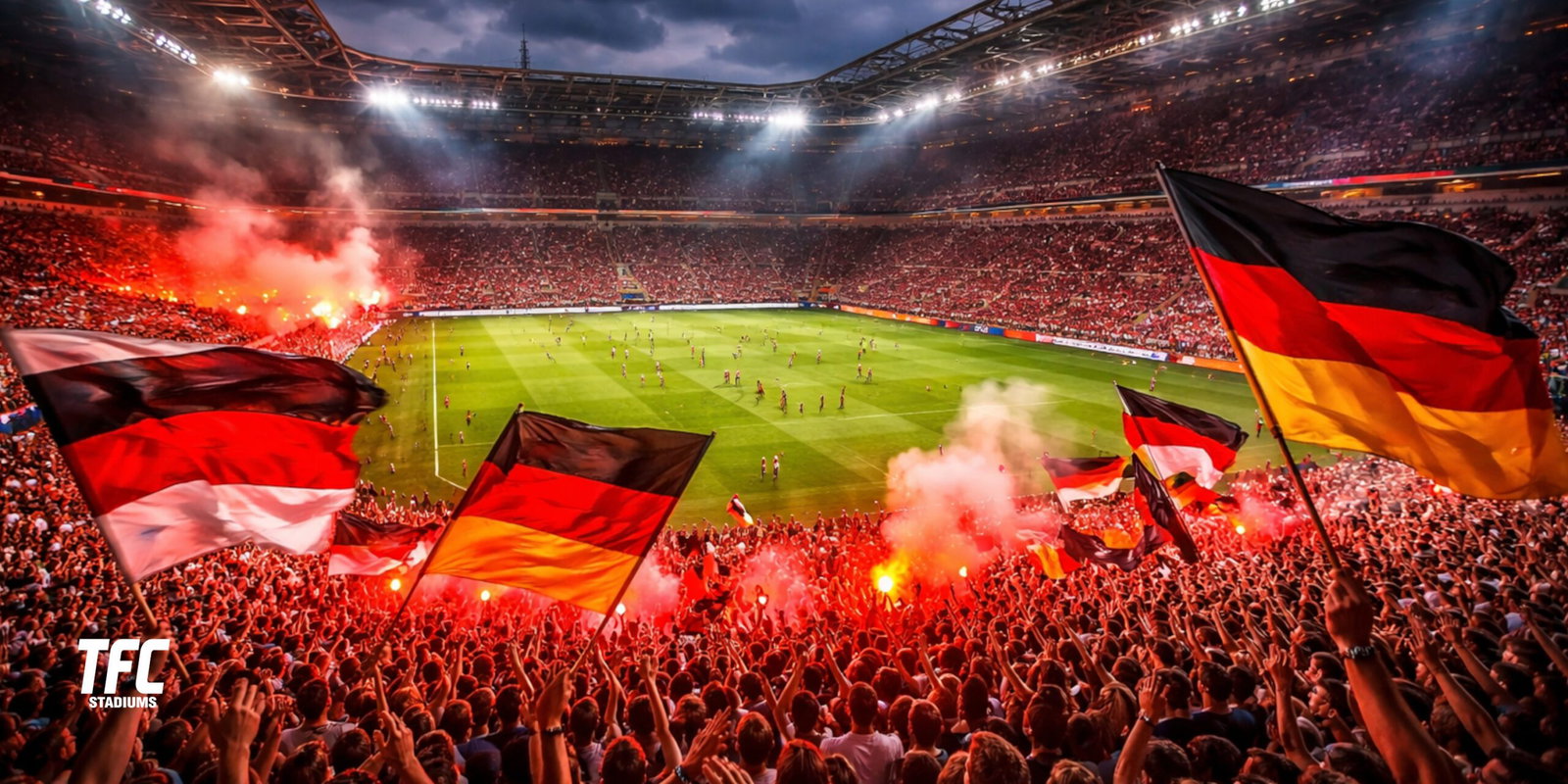
German football grounds have a reputation that borders on myth. Cheap tickets, standing terraces, choreographies the size of apartment blocks and fans who treat a mid-table match in February like a cup final. Plenty of countries have famous stadiums, but Germany has perfected the idea that the crowd should feel like part of the team.
The best atmospheres are not always found in the biggest grounds. Sometimes it is a huge wall of noise from 80,000 people. Sometimes it is 15,000 fans in a cramped old stadium singing for ninety minutes with the sort of commitment usually reserved for revolutions and family arguments.
What Makes a Great Stadium Atmosphere?
A great atmosphere usually comes down to five things:
- Steep stands close to the pitch
- Large standing sections
- Active ultras and supporter groups
- Traditions, songs and rituals unique to the club
- A stadium that feels full and intense, rather than simply large
In Germany, the 50+1 ownership model has helped preserve much of this culture. Clubs remain more closely tied to their supporters, ticket prices stay relatively reasonable, and stadiums are less likely to become silent bowls full of tourists taking photos of the corner flag.
Borussia Dortmund, Signal Iduna Park
No conversation about atmosphere in Germany starts anywhere else. Signal Iduna Park is the heavyweight champion, the one stadium every visiting fan wants to experience and every opposing player quietly dreads.
The famous Südtribüne, better known as the Yellow Wall, holds around 25,000 standing supporters. It is the largest terrace in European football. Before kick-off it looks like a giant yellow cliff. When Dortmund score, it looks like the whole stand has briefly lost its mind.
The noise is not constant in the polished, Premier League sort of way. It comes in waves. Long periods of tension, then a sudden explosion that feels like a train has gone through the stadium.
Atmosphere Highlights
- Capacity: 81,365
- Approximate standing capacity on the Yellow Wall: 25,000
- Famous for: “You’ll Never Walk Alone”, massive tifos and relentless pressure in big European nights
- Best matchday experience: European matches and the Revierderby against Schalke
Head-to-Head: Signal Iduna Park vs Allianz Arena
| Category | Signal Iduna Park | Allianz Arena |
|---|---|---|
| Capacity | 81,365 | 75,024 |
| Standing Areas | Huge | Limited |
| Crowd Noise | Constant and raw | Loud, but more polished |
| Intimidation Factor | Exceptional | Strong, but less hostile |
| Overall Atmosphere | Winner | Runner-up |
Dortmund has the edge because the crowd feels closer to the action and far less choreographed. Bayern’s stadium can be impressive, but Dortmund feels alive in a different way.
FC St. Pauli, Millerntor-Stadion
If Dortmund is the biggest atmosphere in Germany, St. Pauli may be the most distinctive.
Millerntor is not especially large. It holds just under 30,000. Yet few stadiums in Europe feel as intense or as personal. The ground sits in the middle of Hamburg’s St. Pauli district, surrounded by bars, music venues and enough political banners to make a government minister slightly uncomfortable.
The fans create a noise that is messy, defiant and completely genuine. There are no plastic light shows or carefully rehearsed crowd prompts. If anything, St. Pauli supporters would probably boo the idea of a sponsored drumbeat.
Atmosphere Highlights
- Capacity: 29,546
- Famous for: Punk culture, anti-establishment identity and non-stop singing
- Best matchday experience: Hamburg derby against HSV
- Unique feature: The entire area around the stadium feels like part of the occasion
A trip to Millerntor feels less like attending a football match and more like being absorbed into a very noisy political movement that occasionally pauses to discuss a left-back.
Union Berlin, Stadion An der Alten Försterei
Union Berlin’s ground is one of the last proper old-school football stadiums in Europe.
An der Alten Försterei holds around 22,000 fans, most of them standing. The terraces are steep, the roof traps the sound and the whole place feels close enough to the pitch that a defender can probably hear exactly what the front row thinks of his first touch.
What makes Union special is the emotional connection between club and supporters. Fans helped physically rebuild parts of the stadium in the late 2000s. There are very few places in modern football where the phrase “our stadium” actually means something.
Atmosphere Highlights
- Capacity: 22,012
- Standing percentage: More than 70%
- Famous for: “Eisern Union” chants and extraordinary fan loyalty
- Best matchday experience: Berlin derby against Hertha
Head-to-Head: Union Berlin vs St. Pauli
| Category | Union Berlin | St. Pauli |
| Raw Intensity | Excellent | Excellent |
| Stadium Size | Smaller | Larger |
| Political Identity | Strong | Stronger |
| Noise Relative to Size | Outstanding | Outstanding |
| Traditional Feel | Winner | Close second |
Union perhaps has the more traditional football atmosphere. St. Pauli has the more unusual one.
Schalke 04, Veltins-Arena
Schalke’s Veltins-Arena is a modern stadium, but unlike many modern grounds it has managed to keep a genuine edge.
Part of that comes from the club’s working-class identity and part of it comes from the Revierderby. When Schalke play Dortmund, the Veltins-Arena becomes one of the most hostile and emotionally charged places in European football.
The acoustics are helped by the enclosed design and roof. When 60,000 Schalke fans are in full voice, it has a deep, booming quality that can feel almost claustrophobic.
Atmosphere Highlights
- Capacity: 62,271
- Famous for: Revierderby matches and booming acoustics
- Best matchday experience: Schalke vs Dortmund
- Strength: Noise inside a modern enclosed stadium
Even during difficult seasons, Schalke fans rarely lose their passion. They may lose patience, certainly. Those are not quite the same thing.
Bayern Munich, Allianz Arena
The Allianz Arena is one of the most recognisable stadiums in the world. The glowing exterior is magnificent and on major European nights the atmosphere can be superb.
Yet Bayern’s stadium has long carried a certain criticism. For all its size and spectacle, it can feel more controlled than chaotic. Bayern’s dominance means there is often less tension in ordinary league matches. If your team wins almost every week, there are only so many times you can scream with existential desperation at a misplaced pass.
Still, when the stakes rise, so does the volume.
Atmosphere Highlights
- Capacity: 75,024
- Famous for: Huge Champions League nights and spectacular visual displays
- Best matchday experience: Bayern vs Dortmund or a European knockout tie
- Weakness: League matches against smaller clubs can feel subdued
Head-to-Head: Allianz Arena vs Veltins-Arena
| Category | Allianz Arena | Veltins-Arena |
| Stadium Design | Better | Very good |
| Crowd Passion | Strong | Stronger |
| Big Match Atmosphere | Excellent | Excellent |
| Week-to-Week Atmosphere | Mixed | More consistent |
| Winner | Veltins-Arena |
Schalke’s supporters simply produce more sustained noise across an average season.
Eintracht Frankfurt, Deutsche Bank Park
Frankfurt has one of the most underrated atmospheres in Europe.
The ultras behind the goal are among the loudest in Germany and the stadium often produces a level of noise far beyond what its size suggests. European nights have become particularly famous in recent years. The atmosphere before kick-off can be extraordinary, with scarfs held aloft and chants rolling around the ground long before the teams emerge.
Atmosphere Highlights
- Capacity: 58,000
- Famous for: Huge away support and ferocious European nights
- Best matchday experience: Frankfurt in Europe
- Signature moment: The stadium singing together before kick-off
Frankfurt perhaps lacks the international fame of Dortmund or Bayern, but in pure emotional intensity it belongs near the very top.
Hamburger SV, Volksparkstadion
Hamburg’s Volksparkstadion can be inconsistent, but at its best it is one of the loudest grounds in Germany.
The size of the stadium helps, but the real fuel comes from the sense that HSV supporters still see themselves as a giant club waiting impatiently to return to where they believe they belong.
That frustration has created a strangely combustible atmosphere. Matches can feel tense, passionate and occasionally one missed chance away from a collective emotional breakdown.
In other words, excellent entertainment.
Atmosphere Highlights
- Capacity: 57,000
- Famous for: The Hamburg derby and emotional home support
- Best matchday experience: HSV vs St. Pauli
- Strength: One of Germany’s best derby atmospheres
1. FC Köln, RheinEnergieStadion
Cologne’s stadium deserves far more attention. The crowd is loud, emotional and occasionally gloriously overdramatic, which suits the city perfectly.
The singing of club anthem “Mer stonn zo dir, FC Kölle” before kick-off is one of the great pre-match traditions in German football. Even neutral visitors often admit to getting caught up in it, usually right before insisting they definitely were not emotional at all.
Atmosphere Highlights
- Capacity: 50,000
- Famous for: Pre-match anthem and carnival spirit
- Best matchday experience: Köln vs Borussia Mönchengladbach
Which German Stadium Has the Best Atmosphere?
If you want the biggest, loudest and most intimidating experience, Signal Iduna Park is still the clear winner.
If you want something more raw and unusual, Millerntor and Union Berlin are difficult to beat.
If you want a modern stadium that still feels genuinely intense, Schalke and Frankfurt stand out.
Final Ranking
| Stadium | Club | Atmosphere Score |
| Signal Iduna Park | Borussia Dortmund | 10/10 |
| Millerntor-Stadion | FC St. Pauli | 9.5/10 |
| Stadion An der Alten Försterei | Union Berlin | 9.5/10 |
| Veltins-Arena | Schalke 04 | 9/10 |
| Deutsche Bank Park | Eintracht Frankfurt | 9/10 |
| Allianz Arena | Bayern Munich | 8.5/10 |
| Volksparkstadion | Hamburger SV | 8.5/10 |
| RheinEnergieStadion | 1. FC Köln | 8.5/10 |
The beauty of German football is that there is no single type of atmosphere. Dortmund gives you thunder. St. Pauli gives you chaos. Union Berlin gives you devotion. Cologne gives you drama. Schalke gives you noise mixed with just enough anxiety to make things interesting.
That is probably why German stadiums remain the benchmark. They still feel like football belongs to the people in the stands, not merely the people in the hospitality boxes.
About the Author