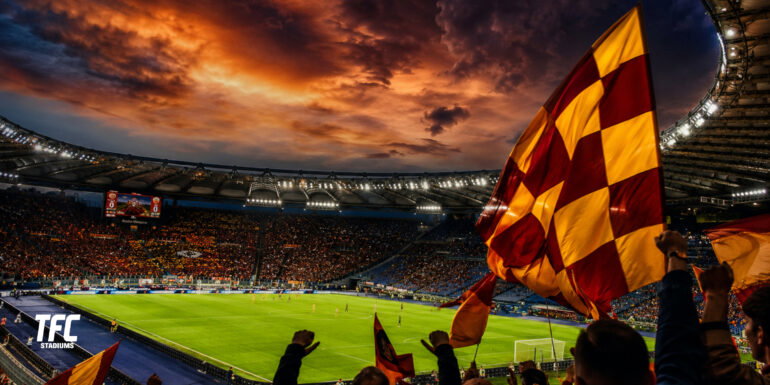

Europe is going through the biggest wave of stadium building since the years before Euro 2012 and the 2006 World Cup. Clubs are no longer simply adding a few thousand seats or a new corporate box. They are building entire districts around their grounds, complete with hotels, shops, apartments, museums and enough hospitality space to keep accountants very happy.
This ranking is based on four things:
- Planned capacity
- Construction cost
- Scale of the surrounding development
- Likely impact on the club, city and wider football landscape
Ranked Table: Capacity and Cost
| Rank | Stadium Development | Country | Planned Capacity | Estimated Cost |
|---|---|---|---|---|
| 1 | Spotify Camp Nou Redevelopment | Spain | 105,000 | €1.5 billion |
| 2 | New Trafford Stadium | England | 100,000 | £2 billion |
| 3 | San Siro Replacement | Italy | 71,500 | €1.5 billion |
| 4 | Nou Mestalla | Spain | 70,000 | €340 million |
| 5 | Santiago Bernabéu Redevelopment | Spain | 85,000 | €1.17 billion |
| 6 | New Roma Stadium | Italy | 55,000 | €1 billion |
| 7 | Everton Stadium at Bramley-Moore Dock | England | 52,888 | £760 million |
| 8 | Elland Road Redevelopment | England | 53,000 | £300 million |
| 9 | Benito Villamarín Redevelopment | Spain | 60,000 | €160 million |
| 10 | La Romareda Replacement | Spain | 43,000 | €250 million |
10. La Romareda Replacement, Zaragoza
Capacity and Cost
- Planned capacity: 43,000
- Estimated cost: €250 million
- Expected completion: 2028
Zaragoza’s new La Romareda may be smaller than the other projects on this list, but it is one of the most important for Spain’s 2030 World Cup plans.
The current stadium has charm, but it also has the faintly tired look of somewhere that has hosted football, concerts and perhaps a minor electrical fire or two over the years. The replacement will be a modern, enclosed bowl with improved hospitality, better sightlines and a proper public square outside.
Compared with the existing La Romareda, capacity will remain broadly similar. The real difference is revenue. Zaragoza want a stadium that can host major events all year rather than spending 48 weekends a year waiting for Real Oviedo.
9. Benito Villamarín Redevelopment, Seville
Capacity and Cost
- Planned capacity: 60,000
- Estimated cost: €160 million
- Expected completion: 2027
Real Betis are not increasing the capacity of the Benito Villamarín by much, but they are almost completely rebuilding the stadium.
The project includes:
- A full roof over every stand
- New premium seating and hospitality areas
- A redesigned exterior and club museum
- Better public space around the ground
Head-to-head with the Bernabéu or Camp Nou, the Betis redevelopment is much smaller. Yet in terms of value for money it is arguably one of the smartest projects in Europe. At around €160 million, it costs barely a tenth of Barcelona’s redevelopment while still transforming the matchday experience.
8. Elland Road Redevelopment, Leeds
Capacity and Cost
- Planned capacity: 53,000
- Estimated cost: £300 million
- Expected completion: Late 2020s
Elland Road currently holds just under 38,000 supporters. Leeds want to increase that to around 53,000 through a major expansion of the West and North Stands.
For context, that would make Elland Road larger than:
- Villa Park
- St James’ Park
- Stamford Bridge
Only Old Trafford, Tottenham Hotspur Stadium and the Emirates would remain clearly bigger among English club grounds.
Leeds probably have the strongest argument of any club in England for a larger stadium. Demand regularly exceeds supply by more than 20,000 seats per match. The present ground often feels like somebody trying to fit an entire city into a railway carriage.
7. Hill Dickinson Stadium, Liverpool
Capacity and Cost
- Capacity: 52,888
- Cost: £760 million
- Opened: 2025
Everton’s new stadium is already complete, but because it opened only recently and forms part of a much larger regeneration scheme, it deserves its place here.
The ground is slightly smaller than Elland Road’s proposed expansion, but the wider project is much more ambitious. Everton’s dockside stadium has transformed part of Liverpool’s waterfront and could bring more than £1 billion in long-term economic impact to the city.
Head-to-Head: Everton Stadium vs Tottenham Hotspur Stadium
| Feature | Everton Stadium | Tottenham Hotspur Stadium |
| Capacity | 52,888 | 62,850 |
| Cost | £760m | £1bn |
| Waterfront location | Yes | No |
| NFL-ready design | No | Yes |
| Historic surroundings | Stronger | More modern urban setting |
Tottenham’s stadium remains the benchmark in England for revenue and facilities. Everton’s new home, however, arguably has the more striking setting.
6. New Roma Stadium, Rome
Capacity and Cost
- Planned capacity: 55,000
- Estimated cost: €1 billion
- Expected completion: Around 2028
Roma’s long-awaited new stadium in Pietralata is finally beginning to feel real after years of delays, political wrangling and enough planning disputes to make ancient Roman senators feel right at home.
The 55,000-seat arena will give Roma a permanent home of their own rather than continuing to share the Stadio Olimpico.
Head-to-Head: Roma’s New Stadium vs Stadio Olimpico
| Feature | New Roma Stadium | Stadio Olimpico |
| Capacity | 55,000 | 70,600 |
| Ownership | Roma-controlled | Shared |
| Atmosphere | More compact | Larger but less intimate |
| Matchday revenue | Far higher | Limited |
Roma are sacrificing size for atmosphere and control. From a business point of view, it is the right trade.
5. Santiago Bernabéu Redevelopment, Madrid
Capacity and Cost
- Capacity after redevelopment: 85,000
- Estimated cost: €1.17 billion
- Status: Near completion
Real Madrid have not increased the Bernabéu’s capacity dramatically, but they have created perhaps the most advanced stadium in Europe.
The redevelopment includes:
- Retractable roof
- Retractable pitch stored underground
- New wraparound video screen
- Vast hospitality and event space
Head-to-Head: Bernabéu vs Camp Nou
| Feature | Bernabéu | Rebuilt Camp Nou |
| Capacity | 85,000 | 105,000 |
| Cost | €1.17bn | €1.5bn |
| Roof | Fully retractable | Full fixed roof |
| Pitch system | Retractable pitch tray | Traditional fixed pitch |
Camp Nou will be larger. The Bernabéu is likely to remain the more technically impressive stadium.
4. Nou Mestalla, Valencia
Capacity and Cost
- Planned capacity: 70,000
- Estimated cost: €340 million
- Expected completion: 2027
Nou Mestalla has been under construction, paused, argued over and generally stared at in confusion since 2007.
For years the unfinished concrete shell became the football equivalent of an abandoned shopping centre. Everybody knew it was there, nobody knew quite what to do with it.
Now, finally, Valencia are pushing ahead again.
At 70,000 seats, Nou Mestalla will be larger than the current Mestalla by more than 20,000 seats. It will also make Valencia one of only a handful of clubs in Spain with a stadium above 70,000.
Head-to-Head: Nou Mestalla vs Current Mestalla
| Feature | Nou Mestalla | Current Mestalla |
| Capacity | 70,000 | 49,430 |
| Hospitality | Extensive | Limited |
| Roof coverage | Full | Partial |
| Accessibility | Modern | Difficult in places |
3. San Siro Replacement, Milan
Capacity and Cost
- Planned capacity: 71,500
- Estimated cost: €1.5 billion
- Expected completion: Early 2030s
Inter and Milan are planning to replace San Siro with a new shared stadium beside the current ground.
This is perhaps the most controversial project in Europe. Many supporters love San Siro so much that they would probably defend it from bulldozers with nothing but a scarf and some fairly colourful language.
The new stadium would be smaller than the existing San Siro, which currently holds around 75,000, but it would generate far more money through hospitality, concerts and retail.
Head-to-Head: New San Siro vs Existing San Siro
| Feature | New Stadium | Existing San Siro |
| Capacity | 71,500 | 75,800 |
| Hospitality areas | Extensive | Limited |
| Revenue potential | Much higher | Lower |
| Character | Unknown | One of Europe’s greatest grounds |
The numbers favour the new stadium. The romance still favours the old one.
2. New Trafford Stadium, Manchester
Capacity and Cost
- Planned capacity: 100,000
- Estimated cost: Around £2 billion
- Expected completion: Around 2030
Manchester United’s proposed new stadium would become the largest club ground in the United Kingdom.
The project is expected to include:
- A giant canopy roof
- More than 15,000 hospitality seats
- Major transport upgrades
- A huge regeneration scheme around Old Trafford
Head-to-Head: New Trafford vs Wembley
| Feature | New Trafford | Wembley |
| Capacity | 100,000 | 90,000 |
| Main use | Club football | National stadium |
| Estimated cost | £2bn | £789m |
| Hospitality seats | Higher | Lower |
Manchester United want a stadium that is not merely larger than Wembley, but more profitable too.
1. Spotify Camp Nou Redevelopment, Barcelona
Capacity and Cost
- Capacity after redevelopment: 105,000
- Estimated cost: €1.5 billion
- Expected completion: 2027
When the rebuilt Camp Nou is complete, it will be the largest football stadium in Europe.
Barcelona are not replacing the stadium. They are rebuilding it around its existing identity. That matters, because Camp Nou is one of the few grounds in world football that still feels bigger than the club that plays in it.
The redevelopment forms part of the wider Espai Barça project and includes:
- A new roof covering every seat
- Expanded hospitality and VIP areas
- New commercial and museum space
- Improvements to the surrounding district
Head-to-Head: Camp Nou vs New Trafford
| Feature | Rebuilt Camp Nou | New Trafford |
| Capacity | 105,000 | 100,000 |
| Cost | €1.5bn | £2bn |
| Completion | 2027 | Around 2030 |
| Historic significance | Greater | Lower |
Camp Nou wins on size and history. Manchester United’s project may eventually produce the bigger commercial return.
Which Development Will Matter Most?
If this ranking were based only on size, Camp Nou would finish first and New Trafford second.
If it were based on technology, the Bernabéu would probably win.
If it were based on value for money, Betis and Leeds would be much closer to the top.
The project with the greatest effect on its city, however, may be Everton’s dockside stadium. It is not the biggest or most expensive, but it has already started to reshape an entire stretch of Liverpool’s waterfront.
That is the real story behind Europe’s new generation of stadiums. These are no longer just football grounds. They are giant urban projects, designed to change clubs, neighbourhoods and sometimes entire cities.
About the Author