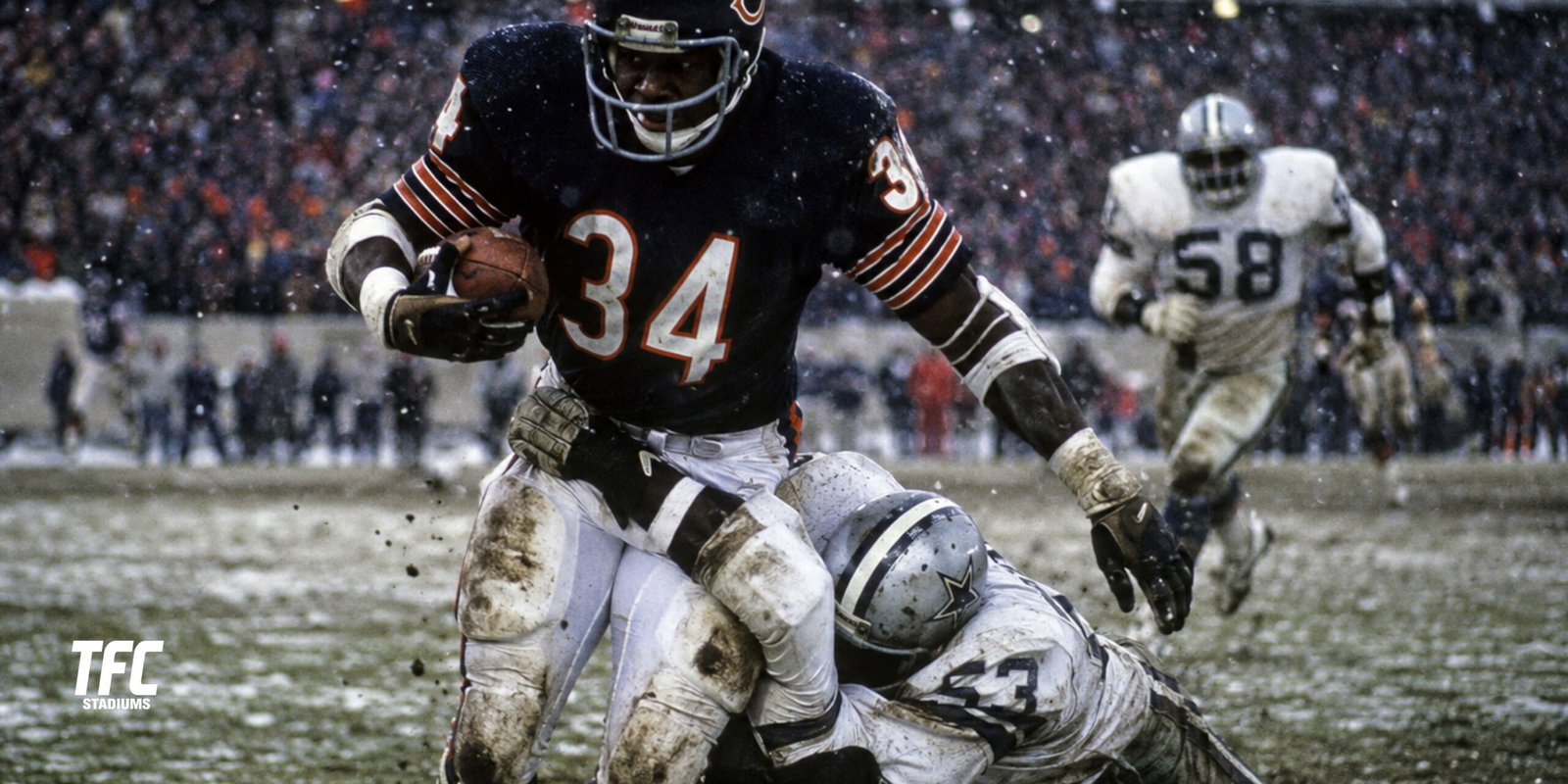
Every great stadium has an athlete whose story becomes inseparable from the concrete, steel and roaring crowds. Yankee Stadium had Ruth. Madison Square Garden had Ewing. Dodger Stadium had Koufax. Soldier Field had Walter Payton.
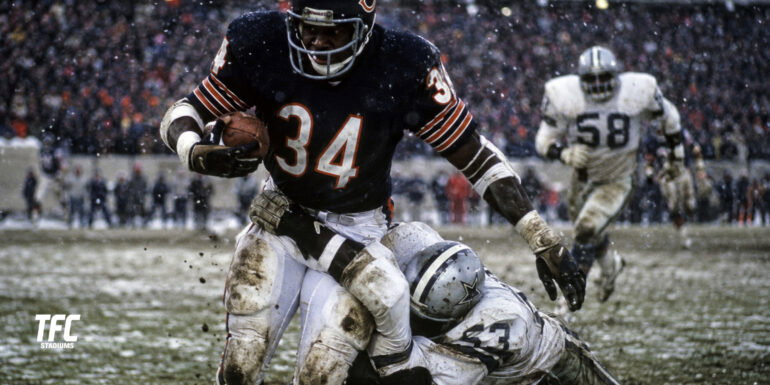
Mention the Chicago Bears and most fans, regardless of age, picture number 34 gliding through defenders with knees pumping impossibly high, smiling through pain and somehow making impossible runs look routine. Soldier Field became the backdrop for one of the greatest careers in NFL history, and decades after his retirement, his influence still shapes the stadium’s identity.
As someone who grew up appreciating football from the other side of the country, there was always something uniquely authentic about Payton. While flashier stars came and went, he represented toughness without theatrics. He made hard work look cool long before motivational Instagram quotes tried to sell the same idea.
Soldier Field Became Walter Payton’s Home
Walter Payton arrived in Chicago in 1975 after starring at Jackson State.
The Bears were struggling. The franchise had history but little recent success. Soldier Field remained one of the NFL’s iconic venues, yet the team needed someone capable of restoring excitement.
Payton became that player almost immediately.
For thirteen seasons he called Soldier Field home, playing there through brutal Midwest winters, muddy autumn afternoons and snow-covered December classics that looked more suited to a military survival exercise than professional football.
Unlike many modern stadiums with perfect playing surfaces, Soldier Field during Payton’s era could be unpredictable.
That suited him perfectly.
Rather than avoiding contact, he embraced it.
Rather than complaining about conditions, he used them to his advantage.
Fans loved him because they recognised something familiar. Chicago has never celebrated perfection nearly as much as resilience.
The Numbers That Defined Greatness
Statistics alone cannot explain Walter Payton’s greatness, but they certainly help.
By the time he retired following the 1987 season, he had rewritten the NFL record books.
| Career Achievement | Total |
|---|---|
| Rushing yards | 16,726 |
| Rushing touchdowns | 110 |
| Total touchdowns | 125 |
| Career carries | 3,838 |
| Games played | 190 |
| Seasons with Bears | 13 |
When Payton retired, his rushing total stood as the NFL’s all-time record.
That mark remained untouched until Emmitt Smith surpassed it in 2002.
More impressive than the total itself was the consistency.
Payton rushed for over 1,200 yards in ten different seasons despite playing during an era when defensive players were free to deliver hits that would trigger lengthy referee conferences today.
Sweetness Was More Than a Nickname
Walter Payton earned the nickname “Sweetness” because of his personality off the field.
Ironically, defenders experienced something entirely different.
He attacked every run with remarkable aggression.
One play might feature elegant footwork that left linebackers chasing shadows.
The next involved lowering his shoulder directly into a safety.
Then there was the famous stiff arm.
Watching Payton extend one arm into an approaching defender became almost expected. Somehow, even when everyone knew it was coming, very few could stop it.
He also possessed incredible balance.
Many running backs fall because contact knocks them sideways.
Payton often seemed to bounce, twist and continue running as though gravity had signed the wrong contract.
Soldier Field’s Greatest Performances
Some stadiums remember individual games forever.
Soldier Field remembers countless Payton moments.
Among the most remarkable came during the 1977 season when he rushed for an astonishing 275 yards against Minnesota.
That remains one of the finest rushing performances in NFL history.
Throughout the late 1970s and early 1980s, Soldier Field regularly witnessed Payton carrying an offence that often lacked elite passing support.
Opposing defences knew exactly who would receive the football.
Stopping him remained another matter entirely.
His vision consistently turned modest blocking into explosive gains.
Even routine three-yard runs often felt important because everyone in the stadium understood he would eventually break one.
The Heart of the 1985 Bears
The 1985 Chicago Bears are remembered primarily for their legendary defence.
Quite rightly.
Mike Singletary, Richard Dent, Dan Hampton and Buddy Ryan’s aggressive scheme remain football folklore.
Yet the offence revolved around Walter Payton.
Although quarterback Jim McMahon brought swagger and William Perry captured headlines with his goal line appearances, Payton remained the steady force that balanced the entire team.
Ironically, one of the biggest talking points from the Bears’ Super Bowl XX victory remains that Payton did not score a touchdown.
Fans still debate whether he deserved the opportunity near the goal line.
Given everything he contributed to the franchise, it remains one of football’s enduring “what if” moments.
Payton himself handled it with grace, demonstrating the team-first attitude that defined his career.
Why Chicago Connected With Him
Chicago has produced plenty of sporting legends.
Michael Jordan transformed basketball.
Ernie Banks embodied Cubs optimism.
Walter Payton became something different.
He reflected the city’s character.
Hard-working.
Reliable.
Unpretentious.
You never sensed he viewed himself as bigger than the game.
That mattered.
Bears supporters have always appreciated effort as much as talent, and Payton offered both in abundance.
His relentless training became legendary.
Running steep hills.
Practising until teammates wanted to stop.
Treating every session like it mattered.
Long before sports science departments measured every heartbeat, Payton simply believed preparation created opportunity.
Leadership Without Loud Speeches
Some captains dominate the dressing room.
Walter Payton preferred example over volume.
Teammates regularly spoke about his work ethic rather than motivational speeches.
If younger players wanted to understand professionalism, they simply watched him train.
That leadership helped establish standards which carried into the Bears’ championship years.
Great organisations usually inherit culture rather than invent it overnight.
Payton helped build that culture.
The Walter Payton Award
Few players leave such an impression that the NFL renames one of its most prestigious honours.
The Walter Payton NFL Man of the Year Award recognises excellence both on and off the field.
That says almost as much about the man as the player.
Following his retirement, Payton dedicated significant energy to charitable causes while remaining one of football’s most respected ambassadors.
His battle with a rare liver disease ended with his death in 1999 at the age of just 45.
The outpouring of grief reached far beyond Chicago.
The football world had lost one of its genuine good guys.
How Soldier Field Continues to Honour Him
Visitors to Soldier Field are constantly reminded of Walter Payton’s importance.
His name appears throughout Bears history displays.
His iconic number 34 remains synonymous with the franchise.
Statues, commemorations and historical exhibits ensure new generations understand why older fans still become emotional discussing him.
Walk around the stadium before kickoff and his influence remains obvious.
Older supporters tell stories.
Parents explain who he was to children wearing modern jerseys.
His highlights continue to play on stadium screens because some greatness simply refuses to become outdated.
The Standard Every Bears Running Back Faces
Every outstanding Chicago running back eventually hears the comparison.
Could he be the next Walter Payton?
Usually the answer is no.
Not because modern players lack talent, but because Payton established a benchmark almost impossible to reach.
His combination of production, durability, leadership and humility created a complete package.
Statistics can eventually be surpassed.
Legacy is considerably harder.
Walter Payton’s Lasting Influence on Soldier Field
Soldier Field has undergone major renovations since Walter Payton last carried a football across its turf.
Seats changed.
Facilities improved.
Technology transformed the matchday experience.
Yet one thing remains untouched.
Its emotional connection to number 34.
Every stadium needs stories.
Soldier Field has championships, legendary defences and generations of devoted Bears supporters.
Above them all stands Walter Payton.
His legacy lives in every frozen December game, every determined running back fighting for extra yards and every roar that rolls through the lakefront when a Bear refuses to go down on first contact.
That is what Walter Payton represented.
Not merely greatness.
Endurance.
Heart.
And the sort of football that leaves grass stains, bruises and memories that never quite fade.
About the Author