From Twin Towers to National Icon: The Complete Story of Wembley Stadium’s Rebuilding
For generations, Wembley Stadium was not simply a football ground. It was the destination. Every player dreamed of walking through the tunnel beneath the famous Twin Towers. Every supporter carried memories of cup finals, international matches and concerts that somehow felt bigger simply because they happened at Wembley.
Yet by the late 1990s, the nation’s most famous stadium had become increasingly outdated. It lacked modern facilities, corporate hospitality, accessibility and the infrastructure expected of a world class sporting venue. As sentimental as many people felt about the old Wembley, affection alone could not solve leaking roofs, cramped concourses and ageing concrete.
The decision to demolish the original stadium divided opinion. Some believed England was erasing part of its sporting soul. Others argued that the country needed a venue worthy of the twenty first century.
Looking back almost two decades after the new Wembley opened, the rebuild remains one of Britain’s most ambitious engineering projects. It was also one of its most controversial.
Why Did Wembley Need Rebuilding?
The original Wembley Stadium opened in 1923 for the British Empire Exhibition and immediately became one of football’s great cathedrals.
It hosted:
- The 1966 FIFA World Cup Final
- UEFA European Championship matches
- FA Cup Finals
- League Cup Finals
- England internationals
- Olympic events
- Major concerts featuring Queen, Live Aid, Michael Jackson, Oasis and countless others
Despite its legendary status, the stadium increasingly struggled to compete with newer European venues.
Several issues became impossible to ignore.
Ageing infrastructure
Much of the stadium’s concrete structure dated back over seventy years.
Maintenance costs rose every year while modern safety regulations demanded continual upgrades.
Limited spectator comfort
Compared with newer grounds:
- Seats were smaller
- Legroom was restricted
- Hospitality facilities were limited
- Concourse areas became overcrowded
- Toilet provision lagged behind modern expectations
Football fans often joked that reaching the snack bar at half time required the tactical awareness of a midfielder finding space in a packed penalty area.
UEFA and FIFA expectations
By the 1990s, Europe’s elite stadiums were changing rapidly.
Germany, France and the Netherlands were investing heavily in new venues.
England risked losing major tournaments unless it developed a truly modern national stadium.
The Decision to Replace Rather Than Renovate
Several proposals explored renovating the existing structure.
Engineers eventually concluded that preserving the Twin Towers while modernising everything else would prove exceptionally expensive and still leave significant compromises.
Instead, the decision was made to construct an entirely new stadium on the same historic site.
It was one of the boldest infrastructure decisions in modern British sport.
Not everyone welcomed it.
Many supporters believed the Towers represented English football itself.
When demolition finally began, thousands attended simply to watch one era disappear.
Dembration and Farewell
The final competitive match at the old Wembley took place in October 2000.
England defeated Germany 1-0 thanks to Dietmar Hamann’s own goal? Actually no. Germany won 1-0 through Dietmar Hamann’s spectacular long range strike.
It proved an unexpectedly symbolic ending.
England’s last goal at the old stadium had been scored earlier by Alan Shearer against Germany during Euro 2000 qualification.
Demolition officially began in 2002.
The famous Twin Towers came down in December 2002.
For many fans, that moment felt more emotional than the stadium’s final match.
Building the New Wembley
Construction officially began in 2003.
The project involved:
- Around 90,000 tonnes of concrete
- More than 23,000 tonnes of structural steel
- Tens of thousands of individual roof components
- Millions of working hours
The design came from Foster and Partners alongside HOK Sport, now known as Populous.
Rather than recreating the Twin Towers, the architects chose a single defining feature.
The Arch.
The Wembley Arch
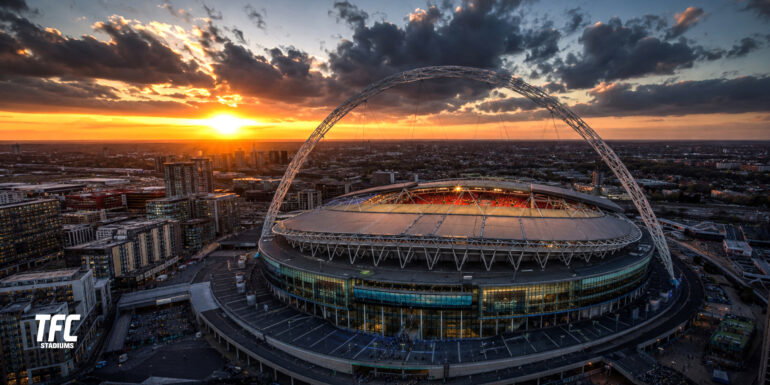
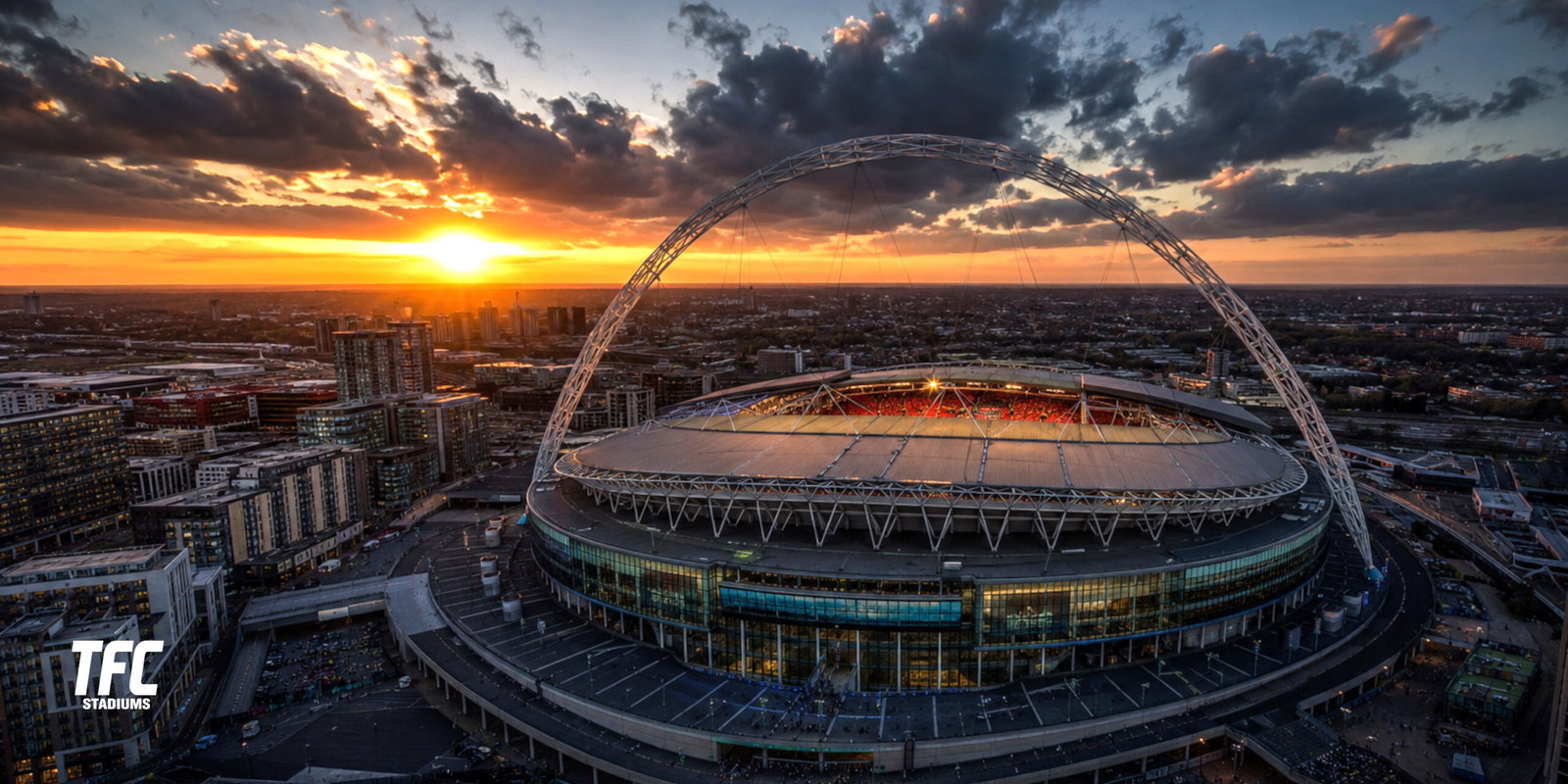
Today, the Arch has become every bit as recognisable as the old Towers.
Its numbers remain extraordinary.
| Feature | Measurement |
|---|---|
| Height | 133 metres |
| Span | 315 metres |
| Diameter | 7.4 metres |
| Weight | Approximately 1,750 tonnes |
Unlike many stadium arches, Wembley uses its arch as part of the roof support system.
It carries much of the retractable roof’s weight without requiring large internal columns that would obstruct spectators.
It was an engineering solution that also became a national landmark.
You can spot it from miles across London, often appearing unexpectedly above suburban rooftops like football’s version of Big Ben.
A Roof Unlike Any Other
Contrary to popular belief, Wembley does not have a fully retractable roof.
Instead, the roof permanently covers every spectator.
A movable section slides to allow greater sunlight onto the pitch while protecting supporters from rain.
Given Britain’s weather, this design decision has earned widespread appreciation.
Players still get soaked.
Fans generally do not.
Delays and Rising Costs
No discussion of Wembley would be complete without mentioning its difficulties.
The project suffered repeated delays.
Opening dates moved several times.
Construction challenges included:
- Steel fabrication issues
- Roofing delays
- Contractor disputes
- Escalating material costs
- Complex engineering requirements
The original budget continued climbing.
Estimated costs
| Stage | Approximate Cost |
|---|---|
| Early estimates | Around £326 million |
| Final construction cost | Approximately £757 million |
Financing combined private investment, loans and public support through Sport England.
The rising cost attracted significant criticism from politicians and the media.
Many questioned whether England’s national stadium had become unnecessarily expensive.
With hindsight, the venue has hosted hundreds of major sporting and entertainment events, helping generate substantial long term economic value.
Opening the New Stadium
The rebuilt Wembley officially opened in 2007.
The first FA Cup Final took place shortly afterwards between Chelsea and Manchester United.
Didier Drogba scored the winning goal in extra time.
It felt fitting that one of English football’s biggest modern stars christened its biggest new stage.
Since opening, Wembley has hosted:
- UEFA Champions League Finals
- UEFA European Championship matches
- Olympic football
- FA Cup Finals
- League Cup Finals
- NFL International Series
- Boxing world title fights
- Concerts attracting more than 90,000 spectators
Its calendar rarely stays empty for long.
Capacity and Modern Features
The rebuilt stadium significantly increased comfort while retaining its vast scale.
| Feature | Specification |
|---|---|
| Capacity | 90,000 |
| Hospitality seats | Around 15,000 |
| Levels | Three |
| Accessible viewing positions | Among Europe’s highest provisions |
| Roof coverage | All spectators protected |
Despite its size, sightlines remain excellent throughout the stadium.
Every seat was carefully modelled using advanced computer simulations before construction began.
Engineering Achievements
Several aspects of Wembley pushed construction technology forward.
Massive foundations
The stadium sits on thousands of reinforced concrete piles reaching deep beneath North West London.
Roof construction
The enormous roof required exceptional precision.
Individual steel components weighing hundreds of tonnes had to fit within tiny engineering tolerances.
Crowd movement
Wembley was designed to move nearly 90,000 spectators efficiently.
Wide concourses, multiple escalators and carefully planned staircases reduce congestion before and after events.
It remains one of Europe’s most carefully modelled examples of crowd management.
The Economic Impact
The rebuilt Wembley transformed more than football.
Regeneration around Wembley Park accelerated dramatically.
Since construction:
- Thousands of new homes have been built
- Hotels have expanded rapidly
- Retail development has flourished
- Restaurants and entertainment venues have multiplied
- Public transport infrastructure has improved
Major events now contribute hundreds of millions of pounds annually to London’s economy through tourism, hospitality and associated spending.
A single sold out concert weekend brings visitors from across Britain and overseas.
Was Demolishing the Old Wembley the Right Decision?
This debate still appears whenever football supporters become nostalgic.
The original Wembley possessed something impossible to recreate.
History.
No amount of modern architecture can manufacture memories built over eighty years.
Yet the rebuilt stadium delivers something equally important.
Function.
It meets modern safety standards, generates vital revenue, attracts world class events and provides facilities worthy of one of football’s biggest nations.
Interestingly, many younger supporters now feel the same attachment to the Arch that previous generations felt toward the Twin Towers.
Every generation adopts its own Wembley.
Legacy
Rebuilding Wembley was never going to satisfy everyone.
Replacing one of football’s most beloved stadiums with a modern arena carried enormous emotional weight. Delays and soaring costs only added fuel to the criticism.
Yet time has softened much of that debate.
The stadium has become a centrepiece of English sport once again. It has staged unforgettable football matches, welcomed millions of spectators and established itself as one of the world’s premier multi purpose venues. Its soaring Arch has become as recognisable on London’s skyline as the Twin Towers once were, proving that even the boldest architectural changes can eventually become part of the national story.
The old Wembley gave English football its greatest memories. The new Wembley provides the stage for creating the next generation of them. Few rebuilding projects carry such responsibility. Even fewer manage to live up to it quite so successfully.
About the Author