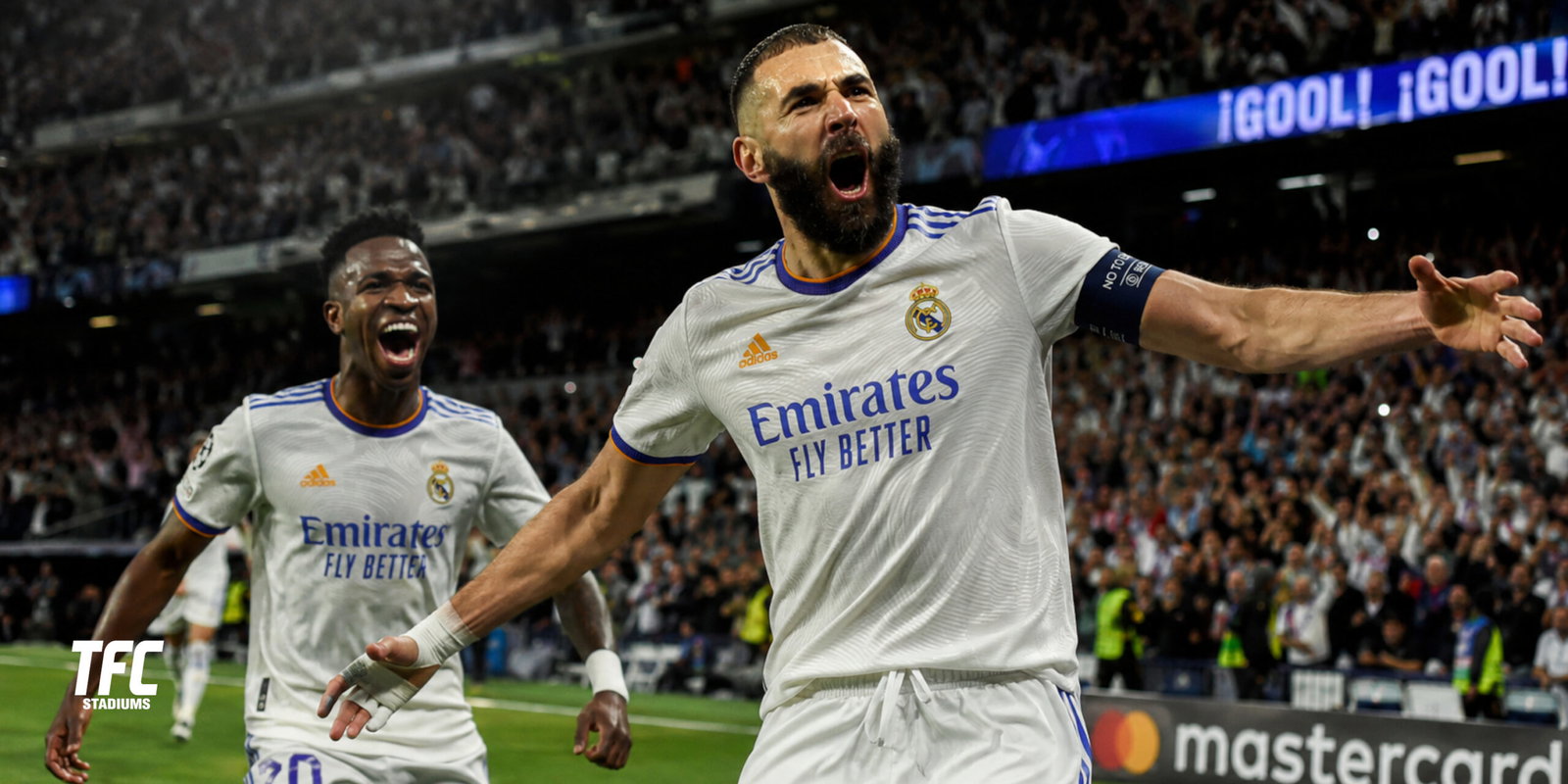
There are famous football stadiums, and then there is the Santiago Bernabéu on a European night.
Every club talks about belief. Real Madrid have somehow turned it into a business model. Time after time, opponents have walked into the Bernabéu with healthy leads, only to discover that the final whistle feels much further away than ninety minutes.
Part of it is talent. Part of it is history. Part of it is psychology. Once the crowd senses the possibility of another miracle, the stadium develops a strange momentum that has unsettled some of the greatest teams in football.
The numbers support the mythology. No club has won more European Cups or Champions League titles than Real Madrid, and many of those triumphs have relied upon dramatic recoveries rather than comfortable victories.
Here are the greatest Bernabéu comebacks that helped build football’s most intimidating home reputation.
Why the Bernabéu Is Different
The Bernabéu is one of football’s largest stages, holding over 78,000 supporters after its latest redevelopment.
Unlike many stadiums, the atmosphere rarely begins at full volume. Madrid supporters are demanding and expect excellence. Yet when their side senses vulnerability in an opponent, the entire stadium changes character.
Players often describe hearing an increase in noise after every attack, every tackle and every corner. The pressure becomes cumulative.
Statistics from UEFA competitions show Madrid consistently outperforming expected outcomes in knockout ties at home over the past decade. Some of that comes from elite players. Some comes from experience.
Some is simply the weight of history.
Every visiting team knows what has happened before.
That knowledge can become another opponent.
What Makes a Great Bernabéu Comeback?
Several ingredients appear repeatedly.
| Factor | Why It Matters |
|---|---|
| Early momentum | A quick goal immediately changes the psychology of the tie |
| Experienced leaders | Veterans remain calm while opponents begin to panic |
| Tactical aggression | Madrid commit numbers forward without losing structure |
| Crowd intensity | The stadium feeds every successful attack |
| Elite finishers | Madrid rarely need many chances once momentum swings |
Perhaps the most remarkable feature is timing.
Many famous comebacks arrive in the final fifteen minutes when logic suggests energy should be fading.
Instead, Madrid somehow seem to become stronger.
Manchester City, 2022
Champions League Semi Final
This remains one of football’s most astonishing recoveries.
Manchester City led the tie by two goals entering the closing stages.
With only minutes remaining, Carlo Ancelotti’s side appeared finished.
Then came chaos.
Rodrygo scored.
The Bernabéu erupted.
Seconds later Rodrygo scored again.
An impossible situation had become level.
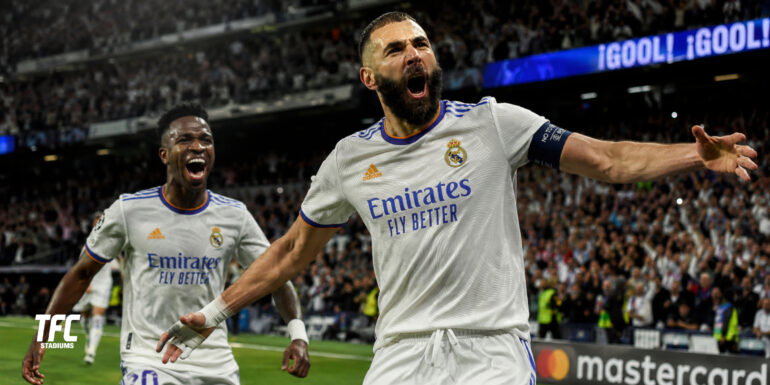
Extra time felt inevitable, but psychologically the contest had already swung. Karim Benzema converted the decisive penalty and Madrid completed one of the greatest escapes European football has ever witnessed.
Key Numbers
| Statistic | Total |
|---|---|
| Aggregate deficit overcome | Two goals |
| Rodrygo goals | 2 |
| Winning goal | Benzema penalty |
| Competition | Champions League |
The remarkable aspect was not simply the comeback.
It was how quickly it happened.
A tie that looked comfortably under City’s control disappeared in little more than five minutes.
Paris Saint Germain, 2022
Champions League Round of 16
For over 150 minutes across two legs, Paris Saint Germain looked comfortably superior.
Kylian Mbappé extended PSG’s aggregate advantage in Madrid.
The Bernabéu grew nervous.
Then Karim Benzema sensed uncertainty.
His pressing forced Gianluigi Donnarumma into an error.
Suddenly everything changed.
Benzema completed a hat trick within seventeen extraordinary minutes, sending Madrid through while PSG appeared completely shell shocked.
Football often talks about momentum.
This match practically invented a new definition.
Chelsea, 2022
Champions League Quarter Final
Chelsea travelled to Madrid trailing after the first leg.
Despite Benzema’s earlier heroics, Thomas Tuchel’s side dominated for long periods at the Bernabéu.
Chelsea eventually led on aggregate and looked ready to eliminate the Spanish giants.
Luka Modrić then produced one of the greatest assists in Champions League history.
His outside of the boot pass to Rodrygo was almost absurd in both execution and timing.
Rodrygo forced extra time.
Benzema completed another comeback with a trademark header.
The remarkable pattern continued.
Nobody ever seemed entirely safe against Madrid.
Bayern Munich, 2024
Champions League Semi Final
Harry Kane’s penalty had Bayern Munich within touching distance of the final.
Time continued disappearing.
Madrid continued attacking.
Joselu, a player few expected to become a European hero, scored twice in the dying minutes.
His first punished a goalkeeping mistake.
His second required a lengthy VAR review before the stadium exploded with relief.
Few substitutes have ever enjoyed fifteen minutes quite like it.
The comeback reinforced an increasingly familiar conclusion.
The match simply isn’t over until Madrid decide it is.
Derby County, 1975
European Cup Second Round
Long before modern Champions League drama, the Bernabéu was already producing famous recoveries.
Derby County had won the first leg 4-1 in England.
Few expected Madrid to overturn such a large deficit.
Instead they produced one of the classic European performances, winning 5-1 after extra time.
It remains one of the defining comeback victories in the club’s history and helped establish the Bernabéu’s reputation decades before social media clips could spread the legend.
Anderlecht, 1984
UEFA Cup
Real Madrid lost the first leg 3-0 in Belgium.
Back in Spain, the response bordered on spectacular.
Madrid won 6-1.
The attacking football was relentless and showcased the emerging generation that would soon dominate Spanish football.
For many supporters, this remains one of the finest comeback performances ever witnessed at the stadium.
Inter Milan, 1985
UEFA Cup Semi Final
Inter won the first leg 2-0 and appeared favourites.
The return leg became another unforgettable evening.
Madrid scored three without reply to reach the final.
These UEFA Cup campaigns during the mid 1980s became almost synonymous with impossible recoveries.
Opponents arrived with comfortable leads.
Most left wondering what had just happened.
Borussia Mönchengladbach, 1985
UEFA Cup Third Round
Another season.
Another seemingly impossible task.
After losing the first leg 5-1 in Germany, Madrid required something extraordinary.
The Bernabéu delivered.
A 4-0 victory sent Madrid through on away goals.
Even by Real Madrid standards, overcoming a four goal first leg deficit remains extraordinary.
Wolfsburg, 2016
Champions League Quarter Final
Perhaps the most famous Cristiano Ronaldo comeback at the Bernabéu.
Wolfsburg shocked Europe by winning the first leg 2-0.
Madrid needed a fast start.
Ronaldo delivered.
He scored twice within the opening twenty minutes before completing his hat trick from a brilliantly struck free kick in the second half.
The Bernabéu celebrated another European rescue mission.
When your emergency plan involves Cristiano Ronaldo scoring a hat trick, life tends to work out rather well.
The Common Thread
Looking across decades, remarkable similarities emerge.
| Characteristic | Seen Repeatedly |
|---|---|
| Fast opening after conceding | Yes |
| Star player delivering decisive moment | Yes |
| Crowd driving momentum | Yes |
| Opponent becoming increasingly passive | Yes |
| Late winning goal | Frequently |
Different managers.
Different generations.
Different competitions.
The pattern remains surprisingly consistent.
The Psychology Behind the Comebacks
Sports psychologists often describe momentum as a combination of confidence, decision making and emotional energy.
The Bernabéu amplifies each of those factors.
Madrid players become more aggressive.
Opponents begin protecting leads instead of chasing victory.
Simple passes become rushed.
Defenders stop stepping forward.
The crowd notices every hesitation.
This feedback loop creates pressure that statistics alone struggle to explain.
Former players from visiting clubs have frequently admitted that the stadium seems to shrink the longer Madrid continue attacking.
Whether that is psychological or something more mysterious depends on your point of view.
Madrid supporters already know the answer.
Carlo Ancelotti and the Modern Era
While Real Madrid have always possessed comeback DNA, Carlo Ancelotti deserves enormous credit for refining it.
Rather than abandoning structure, his teams remain patient.
Substitutions are carefully timed.
Experienced midfielders control tempo while attackers wait for openings.
That measured approach explains why Madrid often remain dangerous deep into matches rather than becoming increasingly desperate.
The best comebacks rarely feel chaotic from the bench, even if they certainly do from the stands.
How the Bernabéu Became Football’s Theatre of Hope
Many stadiums have famous atmospheres.
Few have built an identity around recovery.
Supporters no longer expect every comeback.
They simply refuse to believe defeat is final.
That belief transfers onto the pitch.
Generation after generation of Madrid players inherit the same expectation.
The shirt carries history.
The stadium demands courage.
Opponents know exactly what has happened before.
That knowledge alone creates pressure before the match has even started.
Takeaway
Real Madrid’s greatest Bernabéu comebacks are more than dramatic victories.
They are part of football’s collective memory.
Some relied upon moments of genius from Cristiano Ronaldo, Karim Benzema or Luka Modrić. Others came from unlikely heroes such as Joselu or Rodrygo. Every generation seems to produce its own miracle.
Perhaps that is why opponents never feel entirely comfortable in Madrid, regardless of the scoreline.
The Bernabéu has witnessed enough impossible nights that impossible no longer feels like the right word.
At Real Madrid, it simply feels like another Tuesday in Europe.
About the Author