Professional football fans spend most of their time looking at what happens between the white lines. Fair enough. That’s where the touchdowns, interceptions and dramatic fourth quarter collapses live. What most people never see is everything that happens before kickoff.
Behind the public concourses at Gillette Stadium lies a carefully designed ecosystem dedicated to preparing elite athletes. These facilities are not simply changing rooms with a few showers attached. They represent millions of dollars of investment in sports science, medicine, nutrition, psychology and recovery.
In today’s NFL, where careers can turn on fractions of a second and injuries cost franchises millions, every square foot matters.
Gillette Stadium reflects that reality.
More Than Just a Stadium
When Gillette Stadium opened in 2002, it immediately offered a significant upgrade over the old Foxboro Stadium. At the time, the NFL was entering an era where franchises increasingly competed through facilities as much as free agency.
The New England Patriots have continued investing ever since.
While the adjoining training headquarters houses the majority of daily football operations, Gillette Stadium itself includes extensive player-only areas that come alive on game days.
These spaces include:
- NFL locker rooms
- Coaches’ facilities
- Medical treatment areas
- Rehabilitation suites
- Equipment rooms
- Nutrition stations
- Recovery facilities
- Media interview spaces
- Secure family areas
- Officials’ rooms
Very little of this is visible to fans, yet every game day begins here.
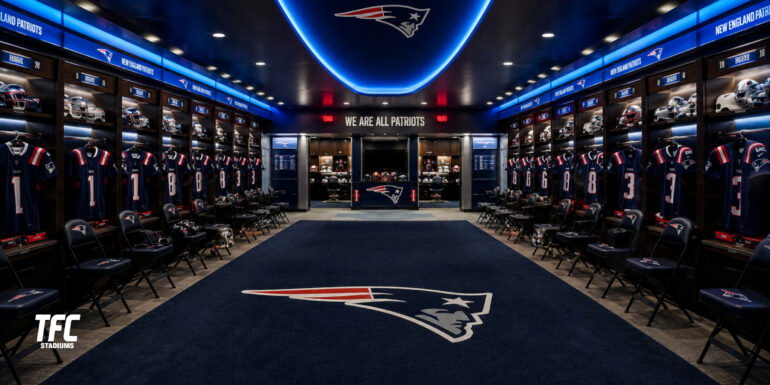
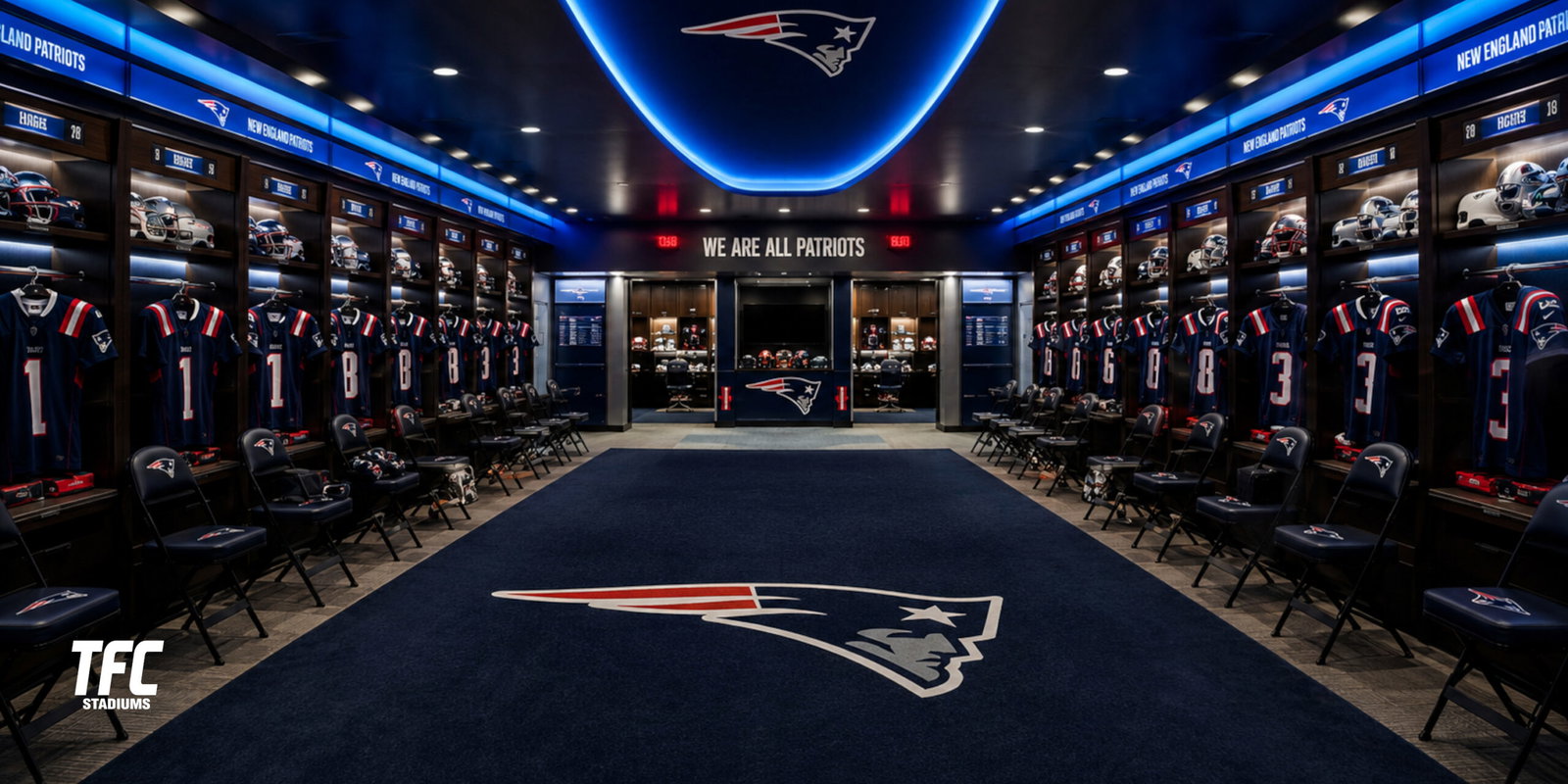
The Patriots Locker Room
The Patriots’ locker room has been renovated and modernised several times during Gillette Stadium’s history.
Unlike the crowded dressing rooms many fans imagine from old sports films, today’s NFL locker rooms function more like luxury workplaces.
Each player has an individual locker featuring:
- Personal storage
- Digital charging facilities
- Custom seating
- Ventilated equipment storage
- Nameplates and team branding
The room is intentionally spacious.
That might sound like a luxury until you remember there are over 70 players, plus coaches, trainers, medical staff, equipment personnel and support staff all preparing for kickoff at the same time.
Space reduces congestion and helps maintain efficient routines.
It also creates an environment where meetings can happen naturally before players move into formal briefing rooms.
Recovery Has Become as Important as Training
Twenty years ago, recovery often meant grabbing an ice pack and hoping for the best.
Today’s NFL treats recovery almost like another phase of training.
Gillette Stadium includes dedicated treatment areas equipped for immediate post game rehabilitation.
Facilities typically include:
| Recovery Feature | Purpose |
|---|---|
| Ice baths | Reduce inflammation |
| Compression therapy | Improve circulation |
| Hydrotherapy equipment | Muscle recovery |
| Massage treatment rooms | Soft tissue work |
| Stretching areas | Mobility and flexibility |
| Athletic training tables | Immediate assessment |
Some players spend longer recovering after games than they do actually playing.
Considering an average NFL game lasts over three hours while many starters play fewer than 70 snaps, that recovery time is a smart investment.
Sports Medicine Behind the Scenes
The medical department is one of the busiest parts of the stadium.
Doctors, physiotherapists, athletic trainers and rehabilitation specialists work throughout every home game.
The treatment rooms are equipped to handle:
- Muscle injuries
- Joint assessments
- Concussion evaluations
- Emergency trauma care
- Orthopaedic examinations
- Imaging support coordination
The NFL’s concussion protocols have expanded dramatically over the last decade, meaning dedicated neurological assessment spaces are now an essential part of every stadium.
Medical teams work alongside independent neurotrauma consultants during every game.
This level of medical oversight simply did not exist a generation ago.
Equipment Staff Keep Everything Running
If you’ve ever watched an NFL player change gloves four times during a drive, thank the equipment staff.
Behind the locker room sits a highly organised equipment department responsible for preparing hundreds of individual pieces of kit.
Game day responsibilities include:
- Helmet preparation
- Jersey management
- Football boot maintenance
- Replacement gloves
- Protective padding
- Sideline equipment
- Weather specific gear
- Emergency repairs
An NFL equipment room resembles a cross between a military logistics centre and a Formula One garage.
Everything has its place.
Everything has a backup.
Usually two backups.
Nutrition Never Stops
Modern NFL nutrition extends well beyond the pre game meal.
Players have access to carefully planned food and hydration throughout game day.
Available options often include:
- Lean protein meals
- Fresh fruit
- Recovery shakes
- Electrolyte drinks
- High carbohydrate snacks
- Individual nutrition plans
Some offensive linemen consume well over 5,000 calories per day during the season.
Meanwhile, wide receivers and defensive backs often follow completely different nutritional programmes designed around speed and explosiveness.
One size definitely does not fit all.
Technology Is Everywhere
Preparation inside Gillette Stadium has become increasingly data driven.
Video systems allow players to review footage before and after games.
Coaches can analyse formations almost immediately.
Tablet technology has replaced many traditional paper playbooks on the sidelines, while player tracking systems generate enormous volumes of performance data.
Teams now monitor metrics including:
- Sprint speed
- Player workload
- Distance covered
- Heart rate
- Acceleration
- Recovery markers
Sports science departments combine these numbers with GPS data collected during training at the Patriots’ adjacent football facilities.
Every decision becomes slightly more informed.
Sometimes those tiny advantages become the difference between winning the AFC East or watching someone else host playoff games.
Meeting Rooms Designed for Preparation
Preparation does not stop when players leave the practice facility.
Gillette Stadium contains dedicated meeting areas where coaches deliver final tactical adjustments before kickoff.
These rooms feature:
- Multiple video displays
- Interactive presentation systems
- Position group seating
- Play installation technology
- Communications equipment
The final meetings before players take the field are often among the shortest of the week.
By this point, everything has already been installed.
The focus shifts from learning to execution.
Family and Player Support Areas
Professional athletes often have families attending games.
Gillette Stadium includes secure player family areas away from public access.
These controlled spaces provide privacy before and after games while helping families avoid the crowds that naturally gather around NFL players.
Considering the attention that accompanies high profile athletes in New England, a little privacy is probably appreciated.
Especially after an emotional win.
Or a painful overtime defeat.
Visiting Team Facilities
NFL regulations require every stadium to provide suitable facilities for visiting teams.
Gillette Stadium includes separate locker rooms and preparation areas for opponents.
Although home teams naturally customise their own spaces, league standards ensure visiting players receive professional accommodation that includes:
- Locker facilities
- Medical treatment rooms
- Coaches’ offices
- Equipment storage
- Meeting space
No franchise wants accusations that visitors are preparing inside something resembling an abandoned PE changing room from 1984.
Professional standards benefit everyone.
How Gillette Compares Across the NFL
Facility quality has become one of the biggest competitive advantages in professional sport.
The NFL Players Association now surveys players annually about working conditions, grading everything from locker rooms to training staff, nutrition and treatment facilities.
While some franchises have faced criticism for outdated infrastructure, the Patriots have consistently invested in maintaining modern standards.
Gillette Stadium’s close integration with the adjacent training complex creates a seamless experience on game days.
Combined with continued upgrades across the wider Patriot Place campus, the organisation has avoided the trap of relying solely on the stadium’s original 2002 design.
Facilities that stand still quickly become outdated in the NFL.
Investment Beyond the Scoreboard
Elite player facilities rarely appear on highlight reels.
Fans remember game winning touchdowns, not hydrotherapy pools.
Yet franchises understand the connection.
Better recovery can reduce injury risk.
Better nutrition supports performance.
Better medical care speeds rehabilitation.
Better preparation improves consistency.
None of these guarantees championships, but together they create marginal gains that add up over a 17 game regular season and, ideally, a deep playoff run.
For much of the Patriots’ remarkable two decade run under Bill Belichick and Tom Brady, attention naturally focused on coaching, culture and execution. Those elements mattered enormously, but they were supported by an organisation willing to invest in every detail behind the scenes.
Takeaway
Gillette Stadium offers far more than a stage for NFL games. Behind the tunnels sits a sophisticated network of player facilities designed to support performance from the moment athletes arrive until long after the final whistle.
From spacious locker rooms and advanced medical suites to nutrition stations, recovery technology and equipment operations, every area has a clear purpose. Individually they may seem like small advantages. Together they form an environment where players can prepare, compete and recover at the highest level.
Fans come for the action under the lights. Players know that many of the most important moments happen long before they run onto the field. At Gillette Stadium, the work behind the scenes is every bit as professional as the football on the turf.
About the Author