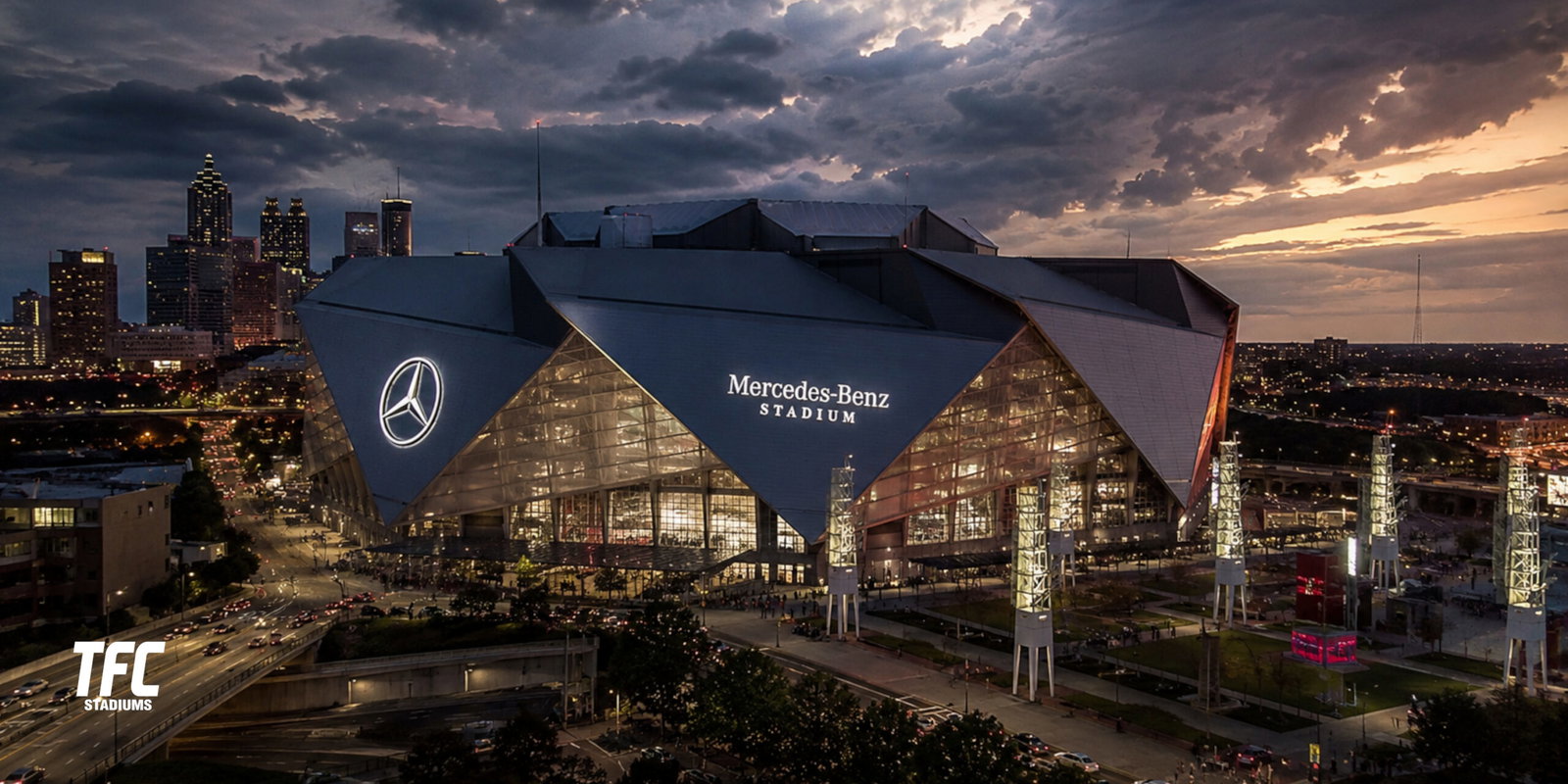
When people talk about Mercedes-Benz Stadium in Atlanta, the conversation usually starts with the spectacular retractable roof that opens like a camera shutter. Fair enough. It is one of the most recognisable stadium designs anywhere in the world.
What deserves just as much attention is everything happening behind the scenes.
Mercedes-Benz Stadium was designed with sustainability built into almost every major decision. From capturing rainwater and reducing energy use to encouraging public transport and cutting waste, the venue has become a benchmark for environmentally responsible stadium design.
It is easy to build something enormous. Building something enormous that uses fewer resources than many smaller venues is a much tougher challenge.
A Stadium Designed Around Sustainability
When Mercedes-Benz Stadium opened in 2017, it immediately made headlines by becoming the first professional sports stadium in the United States to achieve LEED Platinum certification under the US Green Building Council’s rating system.
LEED, short for Leadership in Energy and Environmental Design, evaluates buildings across several categories including:
- Energy efficiency
- Water conservation
- Sustainable construction
- Indoor environmental quality
- Materials and waste management
- Innovation in design
Platinum is the highest certification available.
That achievement did not happen because of one clever feature. It came from hundreds of design decisions working together throughout construction and daily operation.
Energy Efficiency Starts With Smart Design
The famous retractable roof is not just there to impress drone photographers.
Its eight triangular panels help maximise natural daylight across much of the stadium. During daytime events, this reduces the need for artificial lighting while creating a brighter, more enjoyable environment for spectators.
Large glass walls also allow natural light deep into concourses and public spaces.
The stadium complements this with LED lighting throughout the venue.
Compared with traditional lighting systems, LEDs consume significantly less electricity while lasting far longer before replacement becomes necessary.
Across a venue covering more than two million square feet, those savings quickly become substantial.
Solar Power Plays a Supporting Role
While Mercedes-Benz Stadium is not powered entirely by solar energy, renewable electricity still forms an important part of its sustainability strategy.
The venue includes solar panel installations capable of generating clean electricity on site.
Additional renewable energy partnerships help reduce dependence on conventional power sources across the wider operation.
Sport will always require significant energy. The goal is reducing demand wherever practical before replacing traditional sources with cleaner alternatives.
That philosophy runs throughout the stadium.
Water Conservation Is One of the Biggest Success Stories
One of the stadium’s most impressive environmental achievements is something fans rarely notice.
Rainwater.
Mercedes-Benz Stadium captures stormwater from its roof and surrounding areas before storing it in an underground cistern capable of holding approximately 680,000 gallons.
That collected water is then reused for several purposes, including:
- Landscape irrigation
- Cooling towers
- Toilet flushing
Atlanta experiences periods of both heavy rainfall and drought conditions.
Instead of treating rainwater as a drainage problem, the stadium treats it as a valuable resource.
The result is a dramatic reduction in demand for municipal drinking water.
Combined with ultra-efficient plumbing fixtures, Mercedes-Benz Stadium uses nearly half the water of a comparable conventional stadium.
For a venue welcoming millions of visitors every year, that represents an enormous long-term saving.
Native Landscaping Reduces Maintenance
The green spaces surrounding the stadium were carefully planned rather than simply decorated.
Many plants are native to Georgia, meaning they naturally tolerate local weather conditions without excessive watering or chemical treatments.
Benefits include:
- Lower irrigation requirements
- Reduced fertiliser use
- Improved biodiversity
- Lower maintenance costs
Sometimes sustainability is less about futuristic technology and more about choosing plants that actually belong there.
Nature occasionally provides the simplest engineering solution.
Sustainable Materials Throughout Construction
Constructing a stadium of this scale inevitably requires huge quantities of steel, concrete and glass.
The design team focused on sourcing materials responsibly wherever possible.
Construction incorporated:
| Sustainability Feature | Benefit |
|---|---|
| Recycled steel | Reduced demand for virgin materials |
| Regional suppliers | Lower transportation emissions |
| Recycled construction materials | Less landfill waste |
| Sustainable procurement standards | Improved environmental performance |
Construction waste was also diverted from landfill wherever practical through recycling and material recovery programmes.
Given the project’s scale, even modest improvements produced significant environmental benefits.
Encouraging Fans to Leave the Car at Home
Transportation often produces a larger carbon footprint than the stadium itself.
Mercedes-Benz Stadium addresses this through excellent public transport connections.
The venue sits within walking distance of multiple MARTA rail stations, giving supporters direct access from much of metropolitan Atlanta.
Additional features include:
- Bicycle parking
- Pedestrian-friendly routes
- Ride-share facilities
- Integrated public transport planning
Every supporter arriving by train instead of driving alone reduces congestion, fuel consumption and emissions around the venue.
Traffic may never become anybody’s favourite part of matchday, but reducing it certainly improves everyone’s experience.
Waste Reduction Behind the Scenes
Large sporting events generate astonishing quantities of waste.
Food containers, drink cups, packaging and promotional materials can quickly fill countless bins.
Mercedes-Benz Stadium tackles this through comprehensive recycling and composting initiatives alongside partnerships with concession operators.
Operational priorities include:
- Recycling paper, plastics and aluminium
- Composting suitable food waste
- Reducing single-use materials
- Educating visitors through clear signage
The aim is not perfection. It is continuous improvement as technology and waste management systems evolve.
Sustainability Supports Lower Operating Costs
Environmental responsibility often brings financial benefits.
Lower electricity use reduces utility bills.
Water recycling cuts long-term operating expenses.
Durable LED lighting lowers maintenance requirements.
Efficient heating and cooling systems reduce energy demand.
Over decades of operation, these savings can amount to many millions of dollars.
For stadium owners, sustainability is increasingly becoming good business rather than simply good public relations.
Setting a New Standard for Stadium Design
Mercedes-Benz Stadium influenced projects far beyond Atlanta.
Modern stadium developments increasingly include:
- Renewable energy systems
- Water recycling infrastructure
- High-efficiency building controls
- Low-carbon construction methods
- Improved public transport integration
Many newer venues have adopted similar principles because the long-term benefits are now well established.
Environmental performance has become another measure of stadium quality alongside capacity, atmosphere and architectural design.
The Fan Experience Still Comes First
The clever part is that most visitors barely notice the sustainability features.
Fans remember:
- The spectacular roof
- Massive video board
- Comfortable seating
- Open concourses
- Outstanding sightlines
Meanwhile, behind the scenes, sophisticated systems quietly reduce environmental impact every single day.
That may actually be the greatest compliment.
Good sustainable design should feel effortless rather than obvious.
Looking Ahead
As climate targets become increasingly ambitious, stadiums will face growing pressure to reduce emissions and resource consumption.
Mercedes-Benz Stadium has already shown what is possible when sustainability becomes part of the design process from day one rather than an afterthought.
There is still room for future improvements through expanded renewable energy, smarter building management systems and emerging technologies.
Yet even today, nearly a decade after opening, it remains one of the world’s leading examples of sustainable sports architecture.
It proves that a stadium can deliver unforgettable matchdays while using resources far more intelligently.
That is the sort of innovation worth cheering for. Even if your team just missed a last-minute field goal.
About the Author