Old Trafford has seen everything, late winners, title deciders, and the occasional meltdown that still gets argued about years later. Yet few moments tighten a stadium quite like a penalty. It is football reduced to its simplest, most unforgiving form. One kick, one guess, and tens of thousands holding their breath.
At Manchester United’s home, penalties have carried extra weight. History tends to lean heavily on those who step up to the spot here. Some walk away immortal. Others, less so.
Why Old Trafford Amplifies Pressure
There is a measurable edge to taking penalties at Old Trafford. The crowd sits close, the noise carries, and the expectation is rarely neutral.
Home advantage matters. Across Premier League data over the past decade, penalty conversion rates hover around 75 to 80 percent. At Old Trafford, United’s own takers have often outperformed that baseline, particularly during dominant eras. Visiting players, on the other hand, tend to dip slightly below average.
Psychology plays a part:
- The Stretford End creates a visual wall behind the goal
- Refereeing decisions are scrutinised heavily, increasing tension before the kick
- United’s history adds weight to every high stakes moment
It is not just a penalty. It feels like a judgement.
Famous Penalty Moments at Old Trafford
Cristiano Ronaldo vs Chelsea, 2008
This one came during a title race where every point mattered. Cristiano Ronaldo stepped up with his now familiar stuttered run up and delivered under pressure. It was not just the goal, it was the timing. United needed control, and he provided it.
Ronaldo’s penalty record at Old Trafford was strong during his first spell, sitting comfortably above league averages. He combined placement with unpredictability, often forcing keepers into early decisions.
Bruno Fernandes and the Art of the Pause
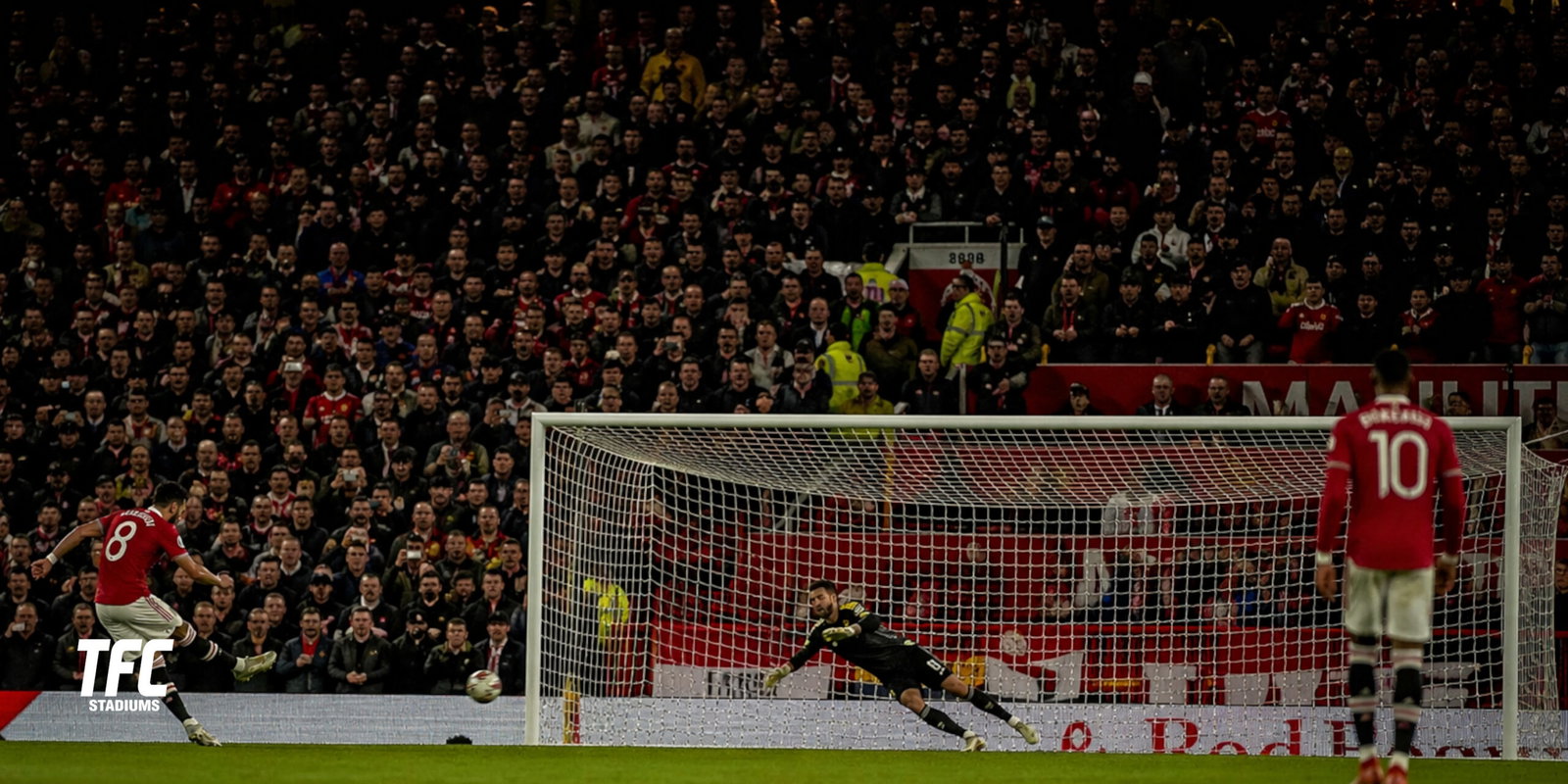
Bruno Fernandes brought a different kind of theatre. His hop before striking became a talking point across the league.
Statistically, Fernandes has been one of the most reliable penalty takers in Europe since arriving. His conversion rate has often exceeded 85 percent, well above average. The technique works because it shifts control. The goalkeeper commits first, Fernandes reacts second.
It looks casual. It is anything but.
Ruud van Nistelrooy’s Miss vs Arsenal, 2003
Few misses have echoed louder. Ruud van Nistelrooy hit the bar in stoppage time against Arsenal in a game already boiling over.
The fallout was immediate. Players clashed, tempers went, and the moment fed directly into one of the fiercest rivalries of the Premier League era. Statistically, Van Nistelrooy was elite from the spot. Which made this miss all the more striking.
Even the best crack under the right conditions.
Marcus Rashford Under the Spotlight
Marcus Rashford has taken penalties in moments that carry more than just football weight. As a homegrown player, the pressure multiplies.
His record has been solid rather than spectacular, sitting closer to league averages. What stands out is his willingness to step up during difficult periods. That alone earns a certain respect at Old Trafford.
Shootouts at Old Trafford
Penalty shootouts are rarer at club level in league play, but cup competitions have brought their share of drama.
Old Trafford shootouts tend to follow a familiar pattern:
- Early momentum swings based on the first two kicks
- Goalkeepers becoming central figures rather than background actors
- Crowd influence peaking with each save or miss
Historically, English clubs have hovered around a 50 percent success rate in shootouts. United’s record at home has been slightly better, though not dominant.
The takeaway is simple. Shootouts flatten reputations. Big names and squad players face the same 12 yards.
The Numbers Behind the Drama
A closer look at penalty trends at Old Trafford reveals a few patterns:
- Right footed players favour the keeper’s left side more often than expected
- Stuttered run ups have increased significantly in the past decade
- Conversion rates drop slightly in matches tied after 80 minutes
Pressure is not evenly distributed. Late penalties carry a measurable dip in success, often by 3 to 5 percent compared to early match situations.
Goalkeepers have adapted too. Modern analysis means many now study tendencies in detail. The era of guessing blindly is fading.
What Makes a Great Penalty Taker Here
Success at Old Trafford tends to come down to three things:
- Composure under noise and expectation
- A repeatable technique that holds up under pressure
- The ability to adapt if a goalkeeper reads the first option
Power alone rarely works consistently. Placement, timing, and confidence matter more.
Takeaway
Penalty drama at Old Trafford rarely feels routine. Even a straightforward conversion carries a sense of consequence. The stadium has a way of turning small moments into defining ones.
Some players thrive on that edge. Others find it less forgiving.
Either way, the next time the referee points to the spot here, it will not feel like just another kick. It never does.
About the Author