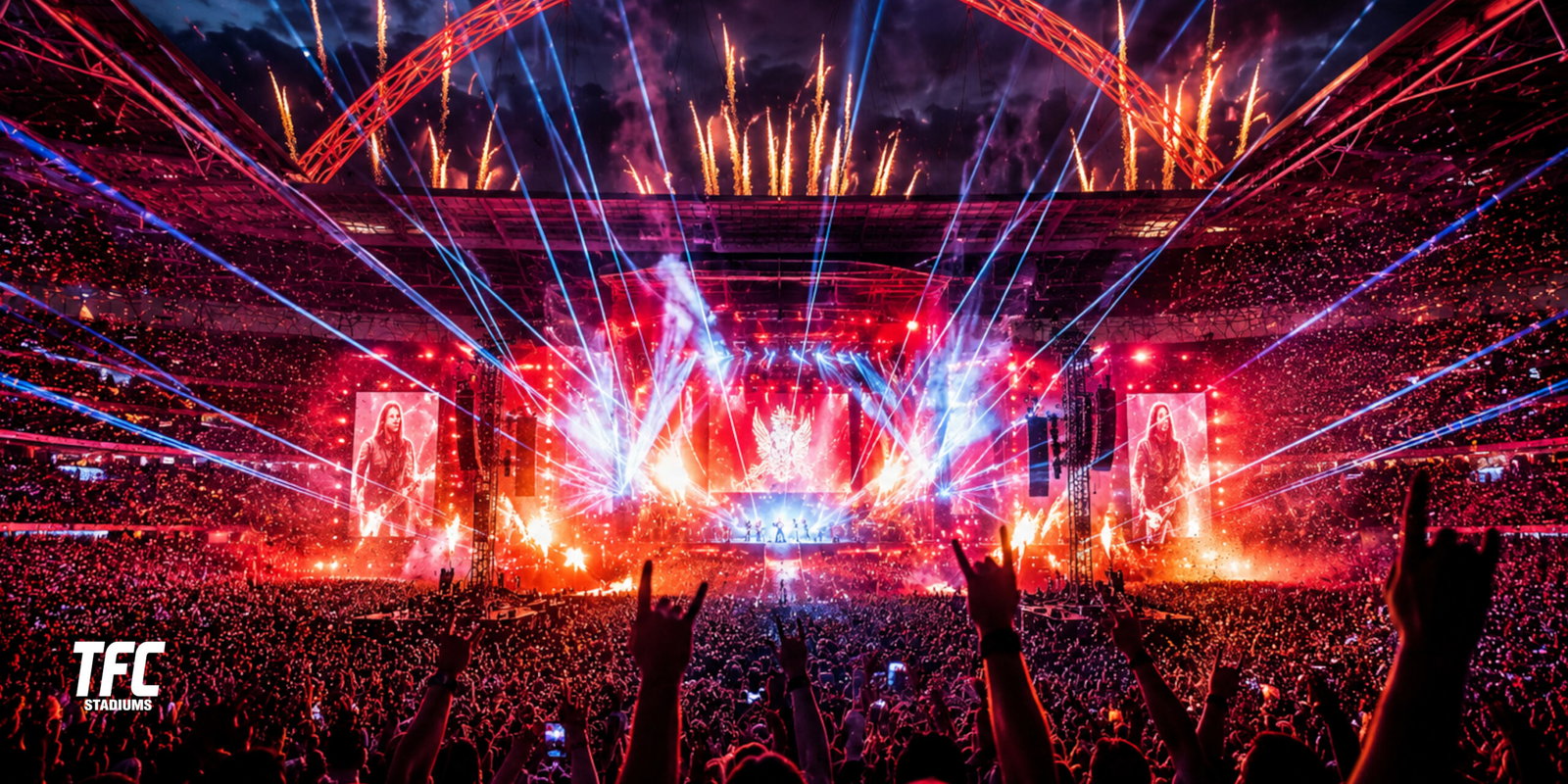
Few stadiums can claim to have witnessed sporting triumphs, royal occasions and some of the greatest concerts ever performed. Wembley Stadium sits comfortably in that rare category.
While football may be its primary identity, music has shaped Wembley just as profoundly. For generations of fans, the stadium represents unforgettable nights where legendary bands transformed an arena built for sport into something altogether different. The roar of 90,000 people singing together has become just as much a part of Wembley’s story as cup finals and international football.
The original stadium welcomed some of rock’s biggest names before closing in 2000. The modern Wembley, opened in 2007, has continued that tradition on an even larger scale with improved acoustics, spectacular staging and record-breaking ticket sales.
Why Wembley Became Rock’s Ultimate Stadium
Very few venues possess the reputation that Wembley enjoys.
Its enormous capacity allows artists to perform in front of crowds approaching 90,000 people, placing it among Europe’s largest concert venues. That scale gives performers opportunities few arenas can match.
Several factors explain why Wembley remains the destination every major touring artist hopes to headline.
- Capacity approaching 90,000 spectators
- Exceptional transport links across London
- International reputation
- Advanced staging and production facilities
- Global media attention
For artists, selling out Wembley has become something of a milestone. It signals that they have moved beyond arena tours into stadium superstardom.
Queen and Live Aid Changed Everything
No discussion of Wembley concerts can begin anywhere else.
On 13 July 1985, Queen delivered what many critics still consider the greatest live rock performance ever staged during the historic Live Aid charity concert.
Freddie Mercury had just over twenty minutes to command an audience that stretched far beyond the stadium itself. An estimated 1.5 billion viewers watched around the world.
The band’s setlist included:
| Song | Lasting Impact |
|---|---|
| Bohemian Rhapsody | Instant crowd participation |
| Radio Ga Ga | Famous synchronised clapping |
| Hammer to Fall | High energy rock performance |
| Crazy Little Thing Called Love | Audience singalong |
| We Will Rock You | Stadium anthem perfected |
| We Are the Champions | Iconic finale |
The famous “Ay-Oh” vocal exchange between Freddie Mercury and the Wembley crowd remains one of the defining images of live music.
It is remarkable how often performers still reference that performance today. Plenty of extraordinary concerts have followed, but Queen’s Live Aid appearance remains the benchmark.
The Original Wembley Hosted Rock Royalty
Before its demolition, the original stadium welcomed an extraordinary list of artists.
Among the biggest names were:
- Queen
- Michael Jackson
- U2
- Bon Jovi
- Genesis
- Dire Straits
- Elton John
- Tina Turner
- Pink Floyd
- Fleetwood Mac
The stadium’s twin towers became almost as recognisable in concert photography as they were during football matches.
For many British fans growing up in the 1980s and 1990s, seeing those towers behind a giant concert stage became part of popular culture.
The New Wembley Raised the Bar
When the stadium reopened in 2007, expectations were enormous.
Could the replacement match the atmosphere of the original?
For music fans, the answer arrived quickly.
Modern sound systems, larger stages, improved sightlines and vastly enhanced backstage facilities transformed Wembley into one of the world’s finest concert venues.
Today’s productions often involve:
- LED screens larger than apartment buildings
- Hundreds of moving lights
- Massive pyrotechnic displays
- Drone cameras
- Complex hydraulic stages
- Fireworks visible across London
The stadium effectively became a giant outdoor theatre.
Artists Who Have Defined Modern Wembley
Since reopening, Wembley has hosted almost every global superstar imaginable.
Some of the biggest names include:
Oasis
Few British bands generate quite the same atmosphere. Wembley crowds know every lyric, often creating an almost football-like intensity.
U2
Their spectacular 360° Tour demonstrated how Wembley could handle some of the most ambitious concert productions ever attempted.
Foo Fighters
Dave Grohl and company have repeatedly turned Wembley into a giant rock festival, delivering marathon sets packed with fan favourites.
Coldplay
Perhaps no modern British band has embraced Wembley quite like Coldplay. Their colourful productions combine lasers, fireworks, wristbands and audience interaction on a remarkable scale.
Taylor Swift
Although not strictly rock, Taylor Swift’s record-breaking Eras Tour demonstrated the stadium’s ability to host enormous multi-night residencies, attracting hundreds of thousands of fans across several dates.
AC/DC
Few bands suit Wembley better than AC/DC. Giant bell props, towering speaker stacks and explosive finales feel perfectly at home inside such a vast venue.
The Biggest Concert Attendances
Concert attendance varies depending on stage layout, safety zones and production requirements.
Typical figures include:
| Event Type | Approximate Attendance |
|---|---|
| Football Match | 90,000 |
| Large Rock Concert | 80,000 to 90,000 |
| Multi-day Residency | Over 500,000 across several nights |
Artists increasingly book multiple consecutive shows.
Instead of one massive performance, many now sell out four, five or even eight nights, creating attendance figures that rival entire music festivals.
More Than Just Rock
Although rock remains central to Wembley’s musical identity, the venue has evolved alongside changing tastes.
Today’s calendar regularly features:
- Pop
- Indie
- Heavy metal
- Country
- Hip hop
- Electronic music
- K-pop
This diversity reflects how stadium entertainment has changed over the past two decades.
Rock may have built Wembley’s concert reputation, but the venue now represents the very highest level of live music regardless of genre.
What Makes Wembley Different for Fans?
Ask regular concertgoers and similar themes emerge.
The arrival beneath the famous arch creates anticipation long before the show begins.
Inside, the sheer scale is impossible to ignore. Even experienced concert fans often pause when they first step into the seating bowl. Seeing tens of thousands of people gradually filling every seat creates an atmosphere that few venues can replicate.
The collective singalongs are particularly memorable. Whether it’s Queen, Coldplay or Oasis, Wembley crowds rarely need encouragement.
Sometimes it feels less like watching a concert and more like joining one.
The Economic Impact of Wembley Concerts
Large concerts bring significant economic benefits to London.
Hotels, restaurants, pubs and transport operators all experience increased demand during major events.
A single sold out stadium show can generate millions of pounds in local spending, while multi-night residencies provide sustained economic activity over several days.
For Wembley Park itself, concerts have become an important part of the area’s ongoing regeneration, helping support businesses throughout the year rather than only during football season.
The Future of Rock at Wembley
Rock music continues to evolve, but Wembley remains its spiritual home in Britain.
Established legends still return for farewell tours, anniversary celebrations and reunion shows, while new generations of artists continue to dream of selling out the stadium.
Technology will undoubtedly change the concert experience through enhanced visuals, immersive lighting and ever more ambitious productions. Yet the essential appeal remains remarkably simple.
A great band. A huge crowd. One unforgettable night.
That formula has worked for decades, and there is little reason to think it will change anytime soon.
Wembley and Rock Music Are Forever Connected
Many stadiums host concerts.
Only a handful become woven into music history.
Wembley has achieved that distinction through decades of unforgettable performances that extend far beyond entertainment. Queen’s triumph at Live Aid, Oasis filling the stadium with roaring choruses, Foo Fighters delivering marathon rock sets and countless other landmark shows have given Wembley a cultural identity that rivals its sporting achievements.
For musicians, headlining Wembley remains a career-defining achievement. For fans, it remains one of those rare places where memories are measured not just in songs, but in moments shared with tens of thousands of others beneath London’s famous arch.
About the Author