Old Trafford has always demanded excellence. It is a stadium where legends are expected to deliver, where pressure arrives early, and where thousands of supporters can spot genuine talent within minutes. That is what makes teenage debuts here so fascinating.
Some young players arrive because of injuries. Others are simply too talented to ignore. A handful become club legends, while others never quite fulfil the promise that once had an entire stadium buzzing.
Manchester United’s history is filled with extraordinary young footballers. From the Busby Babes to today’s academy graduates, Old Trafford has repeatedly provided one of football’s biggest stages for teenagers chasing their dream.
Why Manchester United Trust Young Players
Few elite clubs have embraced youth as consistently as Manchester United.
Sir Matt Busby built his greatest team around homegrown youngsters in the 1950s. Decades later, Sir Alex Ferguson continued the philosophy with the Class of 92 before introducing another wave of academy graduates throughout his reign.
The tradition has become part of the club’s identity.
Manchester United have fielded an academy graduate in every first team matchday squad for well over 4,000 consecutive games, one of the most remarkable records in world football. That culture means supporters often celebrate a debut almost as much as a victory.
Old Trafford expects stars to emerge.
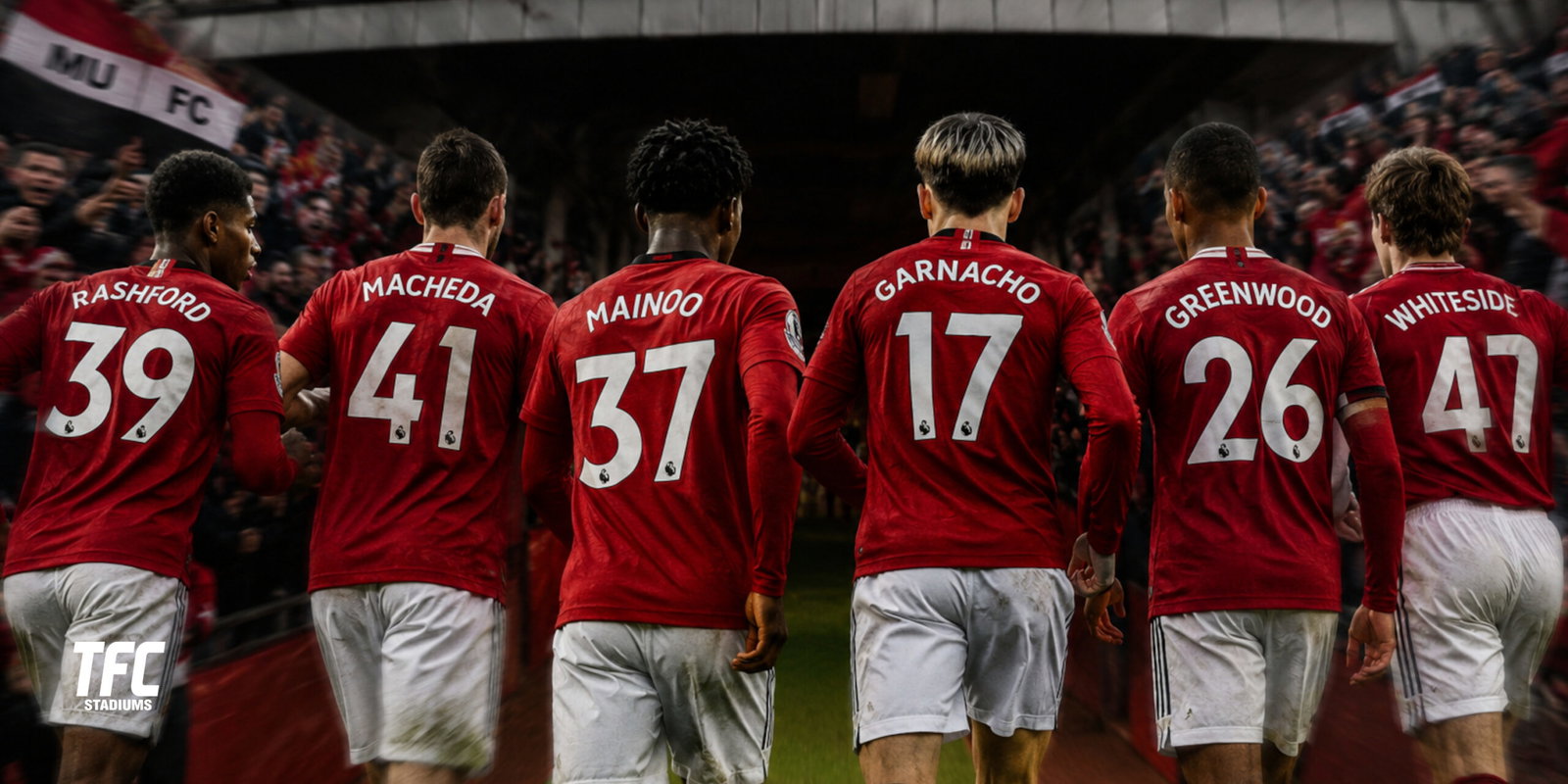
The Youngest Players to Appear at Old Trafford
| Player | Age on Home Debut | Position | Season |
|---|---|---|---|
| Duncan Edwards | 16 years, 185 days | Midfielder | 1952 |
| Norman Whiteside | 16 years, 323 days | Forward | 1982 |
| Federico Macheda | 17 years | Forward | 2009 |
| Marcus Rashford | 18 years | Forward | 2016 |
| Mason Greenwood | 17 years | Forward | 2019 |
| Alejandro Garnacho | 18 years | Winger | 2022 |
| Kobbie Mainoo | 17 years | Midfielder | 2023 |
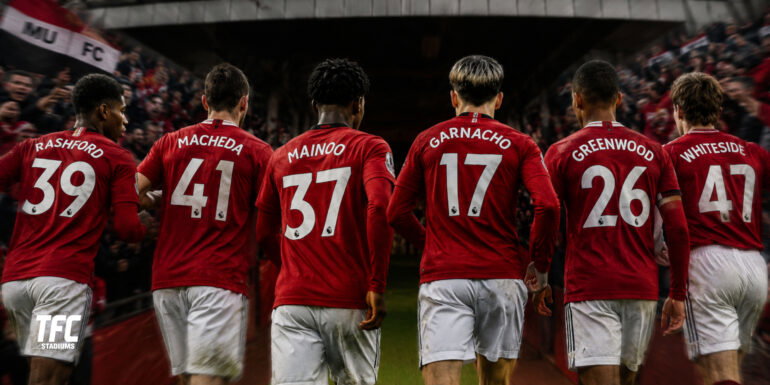
While not every player set an age record, each represented the club’s continuing willingness to trust youth in front of more than 70,000 supporters.
Duncan Edwards, The Original Wonderkid
Long before social media and endless highlight reels, Duncan Edwards had already become football’s teenage phenomenon.
Making his debut as a 16 year old in 1952, Edwards combined immense physical strength with extraordinary technical ability. Former teammates often remarked that he looked like a fully developed international while still at school.
His maturity allowed Busby to accelerate his development faster than almost anyone before him.
Many historians still believe Edwards could have become one of the greatest footballers in history had the Munich Air Disaster not tragically claimed his life in 1958.
Even today, comparisons with Edwards remain rare because so few teenagers have possessed such complete ability.
Norman Whiteside Broke Records Across Europe
When Norman Whiteside emerged in the early 1980s, Manchester United supporters immediately sensed something different.
The Northern Irish forward became the youngest player to appear at the FIFA World Cup in 1982 before establishing himself at Old Trafford.
Despite being only 16, Whiteside played with remarkable confidence. Rather than relying purely on pace, he used intelligent movement, strength and composure that made him appear several years older.
His development showed that age mattered far less than football intelligence.
Federico Macheda and One Perfect Night
Not every teenage debut becomes famous.
Sometimes it only takes one moment.
Federico Macheda’s unforgettable winner against Aston Villa in 2009 instantly became one of Old Trafford’s great modern memories.
Receiving the ball inside the penalty area, the Italian teenager turned beautifully before curling a finish beyond Brad Friedel.
The stadium erupted.
For a brief period, many believed United had discovered another superstar striker. Although his career ultimately followed a different path, few young players have ever produced such an unforgettable first impression.
Marcus Rashford’s Dream Beginning
Football rarely writes stories as perfect as Marcus Rashford’s breakthrough.
Initially promoted because of an injury crisis, Rashford scored twice on his European debut before repeating the feat days later during his Premier League debut against Arsenal.
Old Trafford immediately embraced one of its own.
His speed, movement and calm finishing suggested remarkable maturity, but perhaps even more impressive was his composure under enormous expectation.
Rashford would go on to score more than 130 goals for Manchester United, proving that sensational teenage debuts can become long and successful careers.
Kobbie Mainoo Shows the Modern Academy at Its Best
If Rashford represented explosive attacking talent, Kobbie Mainoo demonstrated technical control beyond his years.
Mainoo’s performances have consistently displayed qualities usually associated with experienced midfielders.
He receives possession under pressure without panic, understands space exceptionally well and rarely looks rushed.
Data from his breakthrough season highlighted impressive passing accuracy, progressive carries and ball retention despite operating in one of football’s most demanding midfield roles.
Supporters often comment that Mainoo plays like someone approaching 30 rather than someone still in his teens.
That calmness is perhaps his greatest strength.
Alejandro Garnacho Brings Excitement Back to the Wing
Few young players have electrified Old Trafford quite like Alejandro Garnacho.
His direct running immediately encouraged supporters to lean forward in anticipation. Defenders rarely know whether he will cut inside, attack the byline or shoot from distance.
Modern football increasingly rewards players willing to take risks in one against one situations.
Garnacho embodies that philosophy.
Although consistency naturally develops with experience, his willingness to attack defenders reflects the confidence Manchester United have traditionally encouraged in academy graduates and young signings alike.
What Makes a Teenage Debut Successful?
Playing at Old Trafford is very different from making appearances elsewhere.
The expectation is immense.
Every touch is analysed. Every mistake becomes headline news. Every promising performance invites comparisons with club legends.
Several qualities often separate successful young players from those who struggle.
- Tactical intelligence before physical maturity.
- Confidence without arrogance.
- Decision making under pressure.
- Emotional resilience after setbacks.
- The willingness to keep learning.
Technical ability earns the opportunity.
Mental strength usually determines the career.
The Numbers Behind Manchester United’s Youth Tradition
Manchester United’s commitment to youth is supported by decades of evidence.
Across the Premier League era, the club has consistently ranked among England’s leaders for minutes given to academy graduates.
Old Trafford has witnessed teenage goals, assists, trophies and title celebrations across multiple generations.
While many elite clubs invest heavily in expensive transfers, Manchester United continue to view the academy as an essential part of their identity rather than simply a backup option.
That philosophy has produced world class footballers across every decade since the Second World War.
Very few clubs anywhere can make the same claim.
Why These Debuts Mean More at Old Trafford
There is something uniquely compelling about watching a teenager walk onto the Old Trafford pitch for the first time.
Supporters know they might be witnessing the beginning of a legendary career.
Sometimes they are.
Sometimes they are watching a player who will become a club icon, captain England or lift league titles.
Other times, football takes a different path.
That uncertainty is exactly what makes these moments so memorable. Every debut carries possibility. Every young player steps onto the same grass once occupied by Charlton, Best, Robson, Giggs, Scholes, Rooney and countless other greats.
For a few precious minutes, anything feels possible.
And occasionally, history begins with a teenager who looks entirely unfazed by the size of the stage.
About the Author