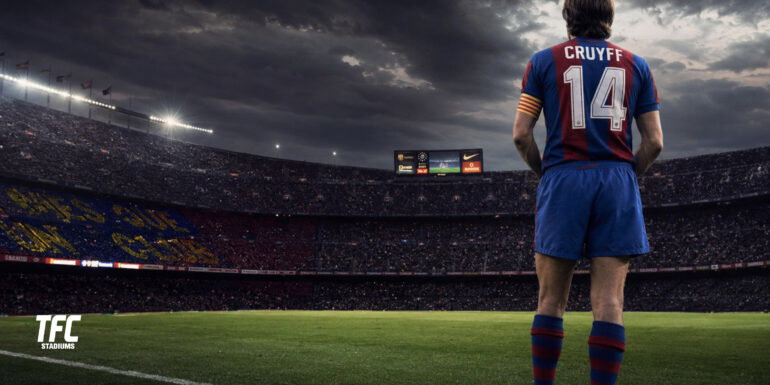
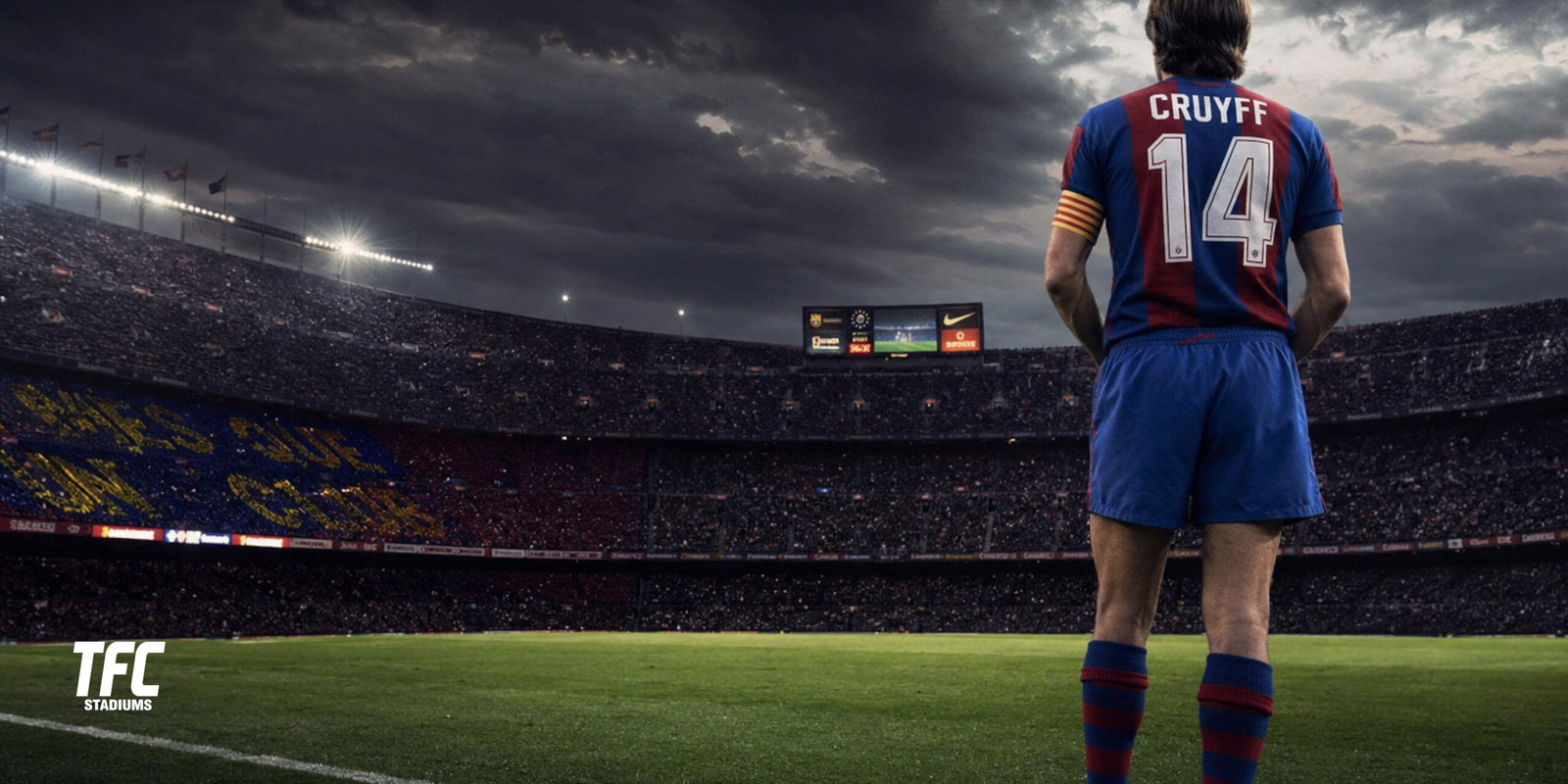
Few people have shaped a football club as profoundly as Johan Cruyff shaped Barcelona. While Camp Nou has witnessed countless trophies, legendary players, and unforgettable nights under the lights, perhaps its greatest story is not a single match. It is the transformation of an entire football philosophy.
Cruyff did far more than win games. He changed how Barcelona played, how it developed young players, how supporters understood the sport, and ultimately how the club viewed itself. His fingerprints remain visible across Camp Nou decades after he first arrived.
Even as the stadium undergoes its modern redevelopment, the ideas Cruyff introduced continue to define what many supporters believe Barcelona should represent.
Before Cruyff, Barcelona Was Still Searching
When Johan Cruyff arrived as a player in 1973, Barcelona was one of Spain’s biggest clubs but lacked sustained European dominance.
Real Madrid had established themselves as the continent’s benchmark, while Barcelona often struggled with inconsistency despite possessing enormous support and financial power.
Cruyff immediately changed expectations.
His arrival coincided with one of Barcelona’s most memorable league triumphs. The club won La Liga in 1973-74, ending a fourteen-year title drought. Even more symbolic was the famous 5-0 victory over Real Madrid at the Santiago Bernabéu, a result that remains one of the defining moments in Barcelona history.
For many supporters, that season demonstrated something new. Barcelona could not only win, they could dominate.
Camp Nou quickly became synonymous with attractive attacking football rather than simply successful football.
The Coach Who Rebuilt Everything
Cruyff returned as manager in 1988 during one of Barcelona’s more turbulent periods.
Instead of making minor adjustments, he rebuilt the club from top to bottom.
His philosophy rested on several principles:
- Possession should control matches.
- Players should constantly create passing angles.
- Technical ability mattered more than physical size.
- Youth development should become the foundation of the club.
- Every team should play the same style from academy to first team.
Today these ideas feel familiar.
In the late 1980s they were revolutionary in Spanish football.
Rather than chasing short-term success through expensive transfers alone, Cruyff focused on creating an identity that would survive individual players.
The Dream Team Changed European Football
Between 1991 and 1994, Cruyff’s famous “Dream Team” became one of Europe’s great sides.
Barcelona won four consecutive La Liga titles.
Just as importantly, they captured their first European Cup in 1992 by defeating Sampdoria at Wembley through Ronald Koeman’s unforgettable extra-time free kick.
Camp Nou became one of Europe’s most intimidating venues.
Opponents often spent long periods chasing possession while Barcelona patiently controlled the tempo through quick passing and intelligent movement.
The football felt different.
Rather than relying on moments of individual brilliance, every player contributed to a carefully structured system.
The Dream Team included stars such as Ronald Koeman, Michael Laudrup, Hristo Stoichkov, Pep Guardiola and Romário, but the collective always mattered more than the individual.
Camp Nou Became the Home of Positional Football
One of Cruyff’s greatest tactical contributions was popularising positional play.
Every player occupied specific spaces rather than simply fixed positions.
The objective was to stretch opponents, create passing triangles and ensure the ball always had multiple options.
Watching Barcelona at Camp Nou became an education in movement.
Supporters learned to appreciate:
- Intelligent off-the-ball runs.
- Quick one-touch passing.
- Patient build-up play.
- Pressing immediately after losing possession.
- Goalkeepers acting as additional outfield players.
Many of these concepts are now common across elite football.
Three decades ago, Barcelona stood almost alone in applying them so consistently.
La Masia Became the Club’s Greatest Investment
Perhaps Cruyff’s most lasting achievement came away from the first team.
He believed Barcelona should produce footballers rather than simply buy them.
His influence transformed La Masia into one of football’s greatest academies.
The academy eventually produced:
- Lionel Messi
- Xavi Hernández
- Andrés Iniesta
- Sergio Busquets
- Gerard Piqué
- Carles Puyol
- Victor Valdés
Together, these players formed the core of Barcelona’s most successful era.
Their technical education reflected Cruyff’s philosophy from childhood.
Instead of adapting to Barcelona’s style after signing, academy graduates already understood every tactical principle before reaching Camp Nou.
Few clubs in world football have ever benefited from such continuity.
Pep Guardiola Took the Philosophy Even Further
If Cruyff built the foundations, Pep Guardiola perfected the structure.
Having played under Cruyff, Guardiola inherited many of the same principles when becoming first-team manager in 2008.
The similarities were obvious.
Both valued:
- Technical excellence.
- Intelligent positioning.
- High pressing.
- Youth development.
- Possession as a defensive weapon.
Guardiola’s Barcelona, featuring Messi, Xavi and Iniesta, produced some of the finest football ever witnessed at Camp Nou.
The club won two Champions League titles, three La Liga championships, and completed an historic sextuple in 2009.
Many tactical analysts view Guardiola’s team as the natural evolution of Cruyff’s original blueprint.
Without Cruyff, that era almost certainly never happens.
More Than Trophies
Cruyff’s record as Barcelona manager remains impressive.
During his eight-year reign the club won:
| Competition | Titles |
|---|---|
| La Liga | 4 |
| European Cup | 1 |
| Copa del Rey | 1 |
| Spanish Super Cup | 3 |
| European Super Cup | 1 |
| Cup Winners’ Cup | 1 |
Yet numbers alone fail to explain his influence.
Managers often leave behind trophies.
Cruyff left behind an identity.
Even today, Barcelona coaches are judged partly on whether they remain faithful to the footballing ideals he introduced.
That level of influence is exceptionally rare.
Why Supporters Still Speak About Cruyff
Ask long-time Barcelona supporters about Cruyff and the conversation rarely begins with statistics.
Instead they describe how football felt.
Camp Nou became a place where fans expected bravery with the ball.
Even during difficult seasons, supporters continued demanding attractive football because Cruyff had shown them it was possible to combine beauty with success.
That expectation has become both a blessing and a challenge.
Managers who abandon the philosophy often struggle to win over the Camp Nou crowd, regardless of results.
Very few individuals continue shaping supporter expectations decades after leaving.
Cruyff remains one of them.
His Legacy Lives Beyond the Stadium
Camp Nou itself is changing.
The redevelopment will introduce modern facilities, increased hospitality, improved accessibility and upgraded technology while preserving the stadium’s place at the heart of Barcelona.
Yet bricks and steel are only part of a football ground’s identity.
Cruyff’s influence survives in every academy session built around possession, every midfielder encouraged to receive under pressure, and every young player taught that intelligence matters as much as athleticism.
Football evolves constantly.
Styles come and go.
Managers arrive and depart.
Cruyff’s ideas continue to endure because they are woven into Barcelona’s DNA.
Takeaway
Many football legends are remembered for spectacular goals or famous victories. Johan Cruyff certainly delivered both, but his greatest achievement was changing how an entire club thought about football.
Walk into Camp Nou and you are entering more than one of Europe’s largest stadiums. You are stepping into the home of a football philosophy that has influenced clubs, coaches and players around the world.
That may be Cruyff’s greatest triumph. Not simply that Barcelona became successful under his guidance, but that generations of football supporters now expect the game to be played with imagination, courage and intelligence because they first saw it flourish at Camp Nou.
About the Author