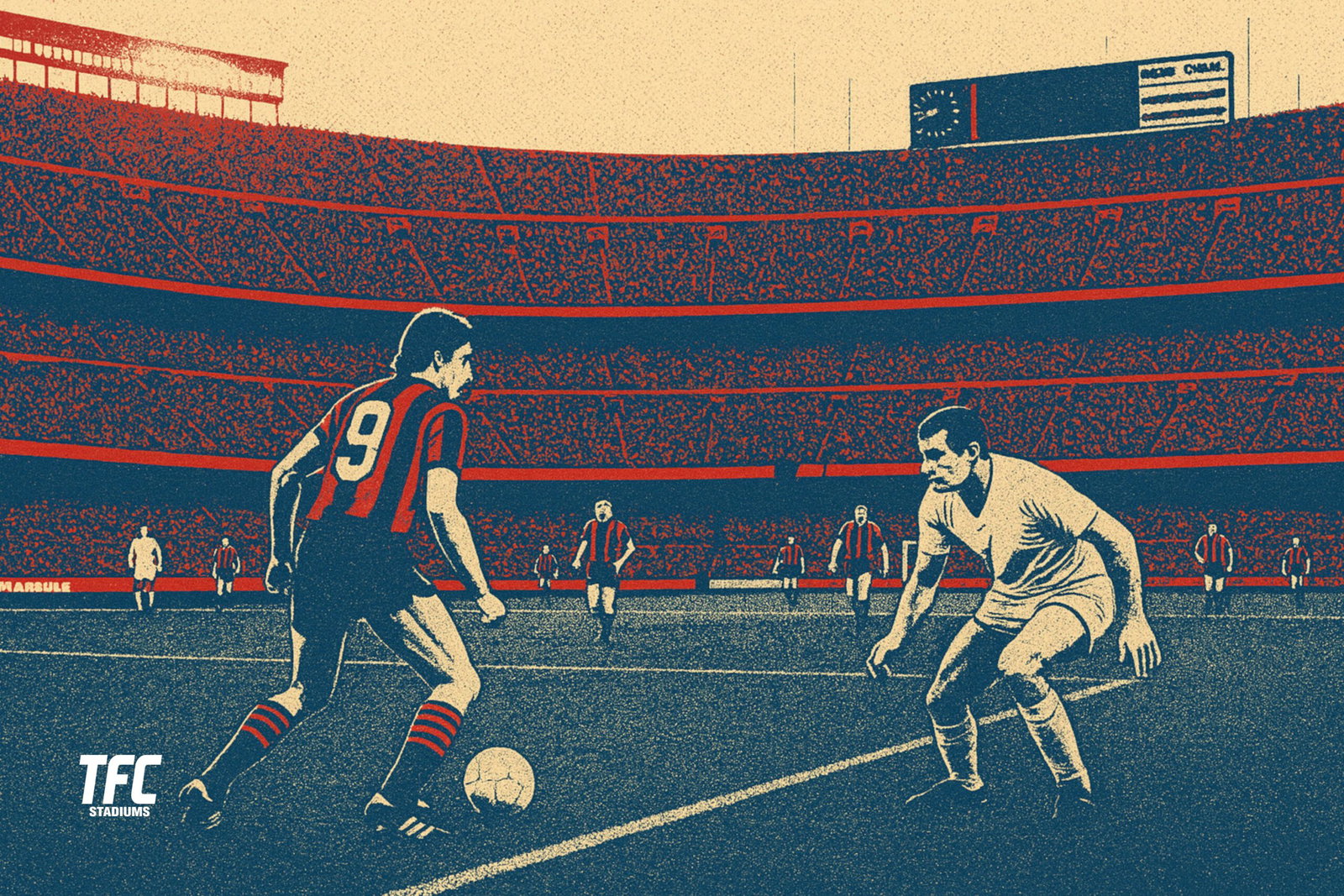
The Johan Cruyff era at Barcelona reshaped not only the team but also the meaning of Camp Nou as a footballing stage. It became a place where ideas mattered as much as results, where style was elevated to something close to a creed.
Cruyff’s Arrival and Philosophy
When Cruyff took over as manager in 1988, Camp Nou was already one of Europe’s great stadiums. Yet, it lacked the identity that would later define Barcelona. Cruyff brought with him a philosophy shaped by his time as a player with Ajax and Barça, grounded in possession, spacing, and a refusal to compromise on creativity.
At Camp Nou, his ideas had the perfect stage. The wide, expansive pitch encouraged ball circulation and fluid movement. For Cruyff, this was a classroom as much as a stadium.
The Dream Team
The so-called Dream Team was forged on that grass. Players like Pep Guardiola, Ronald Koeman, Michael Laudrup, Hristo Stoichkov, and later Romário turned Camp Nou into a theatre of attacking football. The sightlines of the vast arena meant supporters could see patterns forming before goals arrived, which added to the sense that they were witnessing something carefully constructed rather than improvised chaos.
Matches at Camp Nou during this period often carried a sense of inevitability. Opponents knew they would be stretched and suffocated by possession, and the crowd sensed when the breakthrough was about to come.
Atmosphere and Support
The Cruyff years created a bond between stadium and supporters that felt different from before. The crowd embraced the identity he imposed, even when it came with risks. There was impatience at times, but Cruyff’s charisma and sheer conviction brought people with him.
Camp Nou became not only a fortress but a symbol of a style of football that locals began to consider their own cultural inheritance. Watching from the steep stands, fans could feel that this was not just about winning leagues and cups, but about proving a point to the wider footballing world.
Key Matches at Camp Nou Under Cruyff
| Year | Match | Significance |
|---|---|---|
| 1989 | Barcelona 2–0 Sampdoria (Cup Winners’ Cup Final, hosted at Camp Nou) | Cruyff’s first European triumph as manager, a sign of what was to come. |
| 1991 | Barcelona 3–1 Atlético Madrid (La Liga decider) | A dominant win that showed the Dream Team’s rise to power in Spain. |
| 1992 | Barcelona 2–1 Kaiserslautern (European Cup Semi-final, second leg) | Koeman’s free-kick sealed the Wembley final, sending the Camp Nou into delirium. |
| 1993 | Barcelona 1–0 Real Madrid (La Liga) | Guardiola dictated midfield in one of the most controlled Clásicos of the era. |
| 1994 | Barcelona 4–0 Manchester United (Champions League group stage) | A masterclass of attacking football, admired even by neutral fans. |
These nights captured the essence of Cruyff’s Barcelona: bold, dominant, and unapologetically committed to playing the game their way.
Legacy of the Cruyff Era at Camp Nou
Cruyff left Barcelona in 1996, but his imprint on Camp Nou has never faded. The stadium became the birthplace of a philosophy that would later be perfected by Guardiola and carried into the modern age with players like Xavi, Iniesta, and Messi.
Every corner of Camp Nou seems tied to Cruyff’s vision. The high press, the short passing triangles, the belief that a team can dictate rather than react. Even as the stadium itself has moved toward redevelopment, the echoes of that period remain in the chants, the murals, and the collective memory of supporters.
About the Author