Some stadiums host rivalries. Signal Iduna Park seems almost built for one.
Home to Borussia Dortmund, Germany’s largest football stadium becomes something completely different when the Revierderby arrives. Matches against Schalke 04 are about more than league position or trophies. They are rooted in regional pride, working-class identity and more than a century of football culture in Germany’s Ruhr region.
The stadium already has one of the strongest reputations in world football, but derby day adds another layer. The noise is sharper, the banners are bigger and every challenge on the pitch feels like it carries decades of history.
With a capacity of more than 81,000 for domestic matches, Signal Iduna Park creates a scale of support that few European venues can match.
The Revierderby: Why Dortmund vs Schalke Matters
The rivalry between Borussia Dortmund and Schalke 04 is known as the Revierderby, named after the Ruhr industrial region both clubs call home.
The rivalry is built on:
- Local pride between Dortmund and Gelsenkirchen
- Generations of family football traditions
- Mining and industrial heritage
- Competition for regional dominance
The distance between the two stadiums is only around 35 kilometres, making this one of Europe’s most intense local rivalries.
Unlike some modern rivalries driven by commercial success, Dortmund and Schalke’s history comes from communities where football clubs became part of everyday life.
A victory means bragging rights at work, at school and among families. A defeat can linger for months.
The Yellow Wall on Derby Day
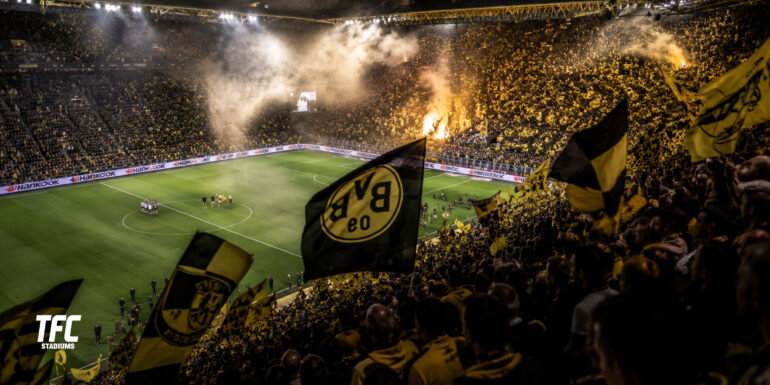
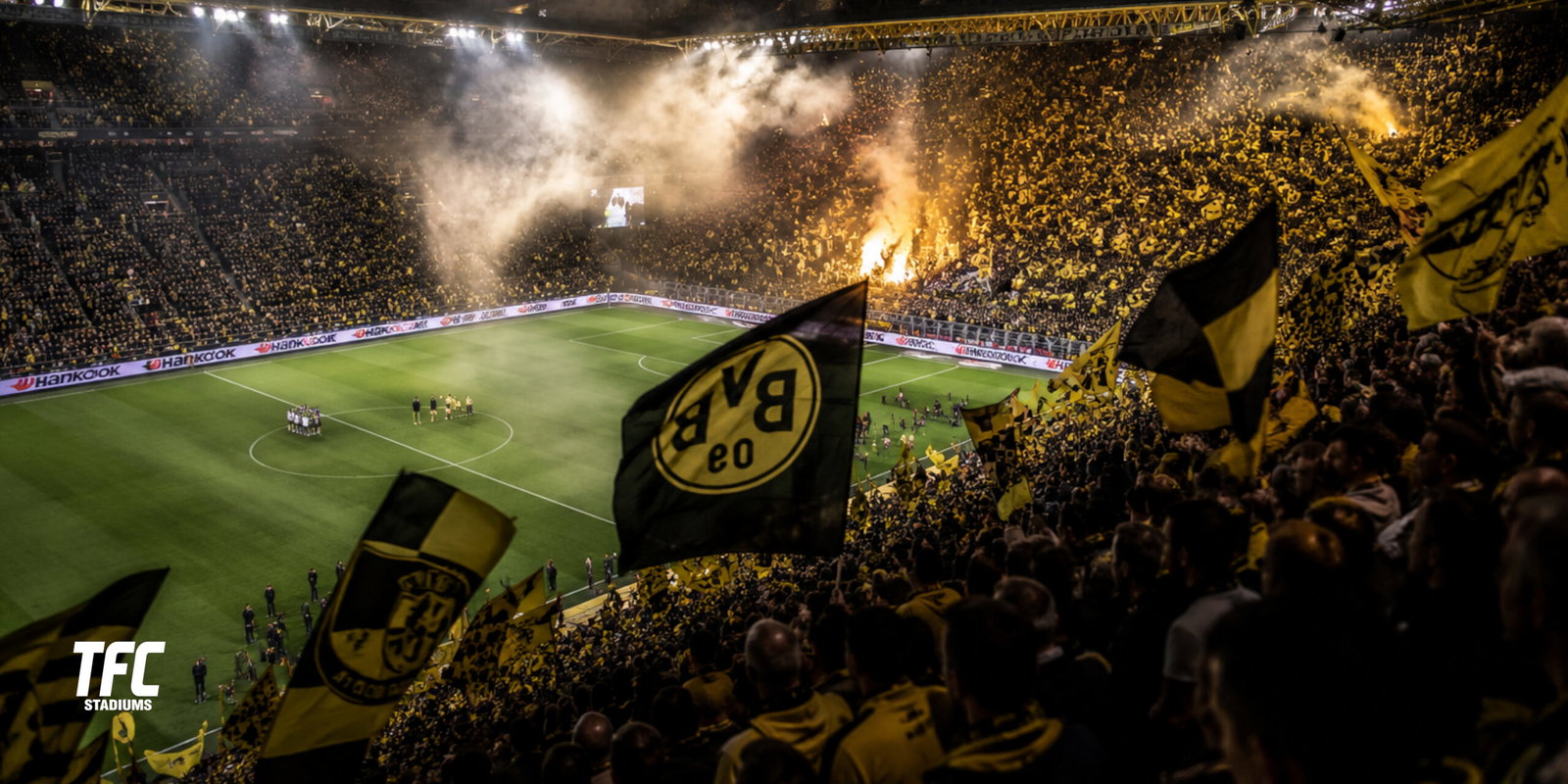
The Südtribüne, better known worldwide as the Yellow Wall, is the heartbeat of Signal Iduna Park.
Holding around 25,000 standing supporters for Bundesliga matches, it is the largest single-tier terrace in European football.
On derby day, the Yellow Wall becomes a performance of its own:
- Huge choreographed displays
- Continuous chanting
- Flags covering entire sections
- Coordinated supporter movements
- Intimidating noise during opposition attacks
Television rarely captures the physical impact of the stand. Inside the stadium, the sound does not simply travel from one direction. It seems to roll around the arena.
For visiting teams, the psychological pressure is real. Dortmund’s home advantage has historically been among the strongest in German football.
Matchday Build-Up Around Dortmund
Derby day begins long before kick-off.
Hours before the match, Dortmund changes colour. Streets around the stadium fill with yellow shirts, scarves and supporters walking towards the ground.
Popular gathering areas include:
- The Strobelallee stadium approach
- Local beer gardens and fan zones
- Dortmund city centre
- Supporter pubs around the city
German football culture plays a major role. Affordable standing areas, fan ownership traditions and supporter involvement have helped preserve a matchday experience that feels connected to local communities.
How Loud Does Signal Iduna Park Get?
Signal Iduna Park has developed a reputation as one of football’s loudest arenas.
Several factors contribute:
| Feature | Impact |
|---|---|
| Steep stand design | Keeps supporters close to the pitch |
| Roof structure | Helps contain crowd noise |
| Large standing terrace | Allows coordinated support |
| Full capacity crowds | Creates constant pressure |
The stadium regularly attracts some of the highest average attendances in world football, frequently exceeding 80,000 spectators per Bundesliga match.
The noise is not constant chaos though. The best part of Dortmund’s atmosphere is timing. The crowd senses moments. A counterattack, a heavy tackle or a late corner can instantly raise the volume.
Famous Derby Moments at Signal Iduna Park
Dortmund 2-0 Schalke, 1997
During Dortmund’s Champions League-winning season, derby victory added another highlight to an unforgettable campaign. The team went on to defeat Juventus in the European final, creating one of the greatest years in club history.
Dortmund 4-4 Schalke, 2017
One of the most remarkable derbies ever played.
Dortmund raced into a 4-0 lead inside 25 minutes. Most stadiums would consider the match finished.
Schalke somehow fought back and completed an incredible comeback, scoring a stoppage-time equaliser through Naldo.
For Dortmund fans, it remains painful. For neutral supporters, it was everything that makes derby football impossible to predict.
Dortmund 4-0 Schalke, 2020
Played without supporters because of pandemic restrictions, this match proved something important about Signal Iduna Park.
The football was still there. The rivalry was still there.
But without the Yellow Wall, something essential was missing.
Security and Away Support
The Revierderby is considered a high-risk fixture because of the intensity between supporters.
Planning involves:
- Increased police presence
- Separated supporter routes
- Controlled away fan movements
- Additional stadium security
Despite the rivalry’s fierce reputation, the overwhelming majority of supporters see derby day as a celebration of football culture.
The emotion is what makes it special.
How Signal Iduna Park Compares With Other Derby Stadiums
| Stadium | Derby | Capacity | Atmosphere Style |
| Signal Iduna Park | Dortmund vs Schalke | 81,000+ | Massive terrace culture and choreography |
| Celtic Park | Celtic vs Rangers | 60,000+ | Historic rivalry and vocal support |
| La Bombonera | Boca Juniors vs River Plate | 50,000+ | Intense South American passion |
| San Siro | AC Milan vs Inter | 75,000+ | Shared stadium rivalry |
| Red Star Stadium | Red Star vs Partizan | 50,000+ | Ultra-led atmosphere |
Different stadiums create different experiences, but Signal Iduna Park’s combination of size, design and supporter organisation makes it one of football’s great derby venues.
The Future of Derby Days in Dortmund
Modern football has changed rapidly, but Signal Iduna Park remains one of the strongest examples of traditional supporter culture surviving at the highest level.
Commercial growth, international attention and modern stadium expectations have not removed the identity of the place.
The challenge for Dortmund is protecting what makes it special. The Yellow Wall works because it feels authentic. It represents generations of supporters rather than a manufactured spectacle.
Takeaway
A Revierderby at Signal Iduna Park is football stripped back to its most emotional form.
The stadium itself is impressive, but the people inside it create the reputation. Architecture provides the stage. Dortmund’s supporters provide the personality.
Whether it is a last-minute winner, a painful collapse or simply 80,000 voices before kick-off, derby day in Dortmund remains one of the closest experiences football has to controlled chaos.
About the Author