MetLife Stadium has one of the strangest jobs in American sport. It has to convince two completely different fanbases that the same building belongs entirely to them.
For the New York Giants, it needs to feel like a continuation of decades of tradition, championships and old-school NFC football. For the New York Jets, it needs to become a modern green fortress filled with a completely different identity.
The clever part is that the stadium was designed for this exact challenge. Unlike traditional shared stadiums where one tenant often feels like a guest, MetLife Stadium uses lighting, digital displays and interchangeable branding to effectively change personality overnight.
It is less a stadium with two teams and more a giant theatrical set with an NFL field in the middle.
Why MetLife Stadium Needed a Flexible Design
When MetLife Stadium opened in 2010, it replaced Giants Stadium, a venue that carried one team’s name despite being shared by both franchises from 1984 onwards.
That created a clear problem. The Jets wanted a genuine home, not another generation playing inside a building associated with their rivals.
The solution was a neutral stadium.
Key facts:
| Feature | Details |
|---|---|
| Opened | 2010 |
| Location | East Rutherford, New Jersey |
| Capacity | Around 82,500 |
| Main tenants | New York Giants and New York Jets |
| Construction cost | Approximately $1.6 billion |
| Ownership | Jointly owned by both franchises |
The design team deliberately avoided permanent blue or green features. The stadium’s exterior, seating and public areas were created as a blank canvas that could change depending on who was playing.
The Exterior Lighting System
The most obvious transformation happens before fans even enter.
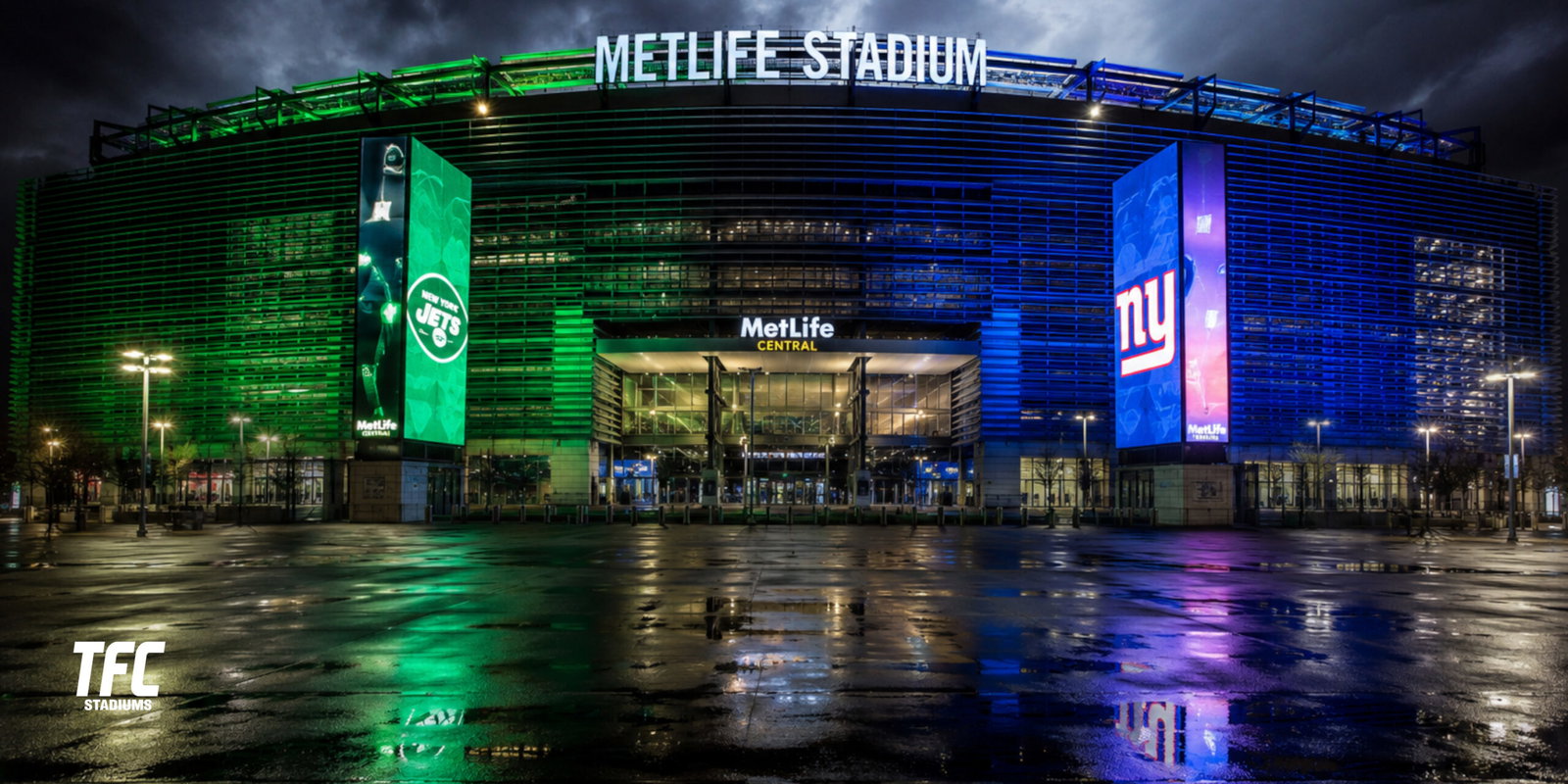
MetLife Stadium’s outer shell is covered in aluminium louvers that interact with a programmable lighting system. On game days, the entire building can shift colour.
For Giants games:
- Blue lighting dominates the exterior
- Giants logos appear across digital areas
- Team imagery focuses on franchise history and Super Bowl success
- The atmosphere leans towards tradition and legacy
For Jets games:
- Green lighting takes over the stadium
- Jets branding replaces Giants material
- The presentation highlights energy, noise and fan culture
- The stadium feels completely different despite using the same structure
At night, the effect is particularly strong. The building almost works like a giant NFL mood ring, which sounds ridiculous until you remember that football fans absolutely notice these things.
Digital Screens Create a New Identity
One of MetLife Stadium’s smartest design choices was reducing permanent signage.
Instead, it relies heavily on digital displays.
These include:
- Video boards
- Ribbon displays
- Entrance screens
- Concourse graphics
- Advertising panels
Within hours, the entire visual experience can be swapped.
A fan arriving on Sunday for a Jets game might see:
- Jets legends
- Green graphics
- Team slogans
- Current player imagery
A Giants fan the following week experiences:
- Giants championship moments
- Blue graphics
- Historic players
- Different music and presentation
The concrete, steel and seats stay the same. The story being told changes completely.
How the Field Changes Between Teams
The playing surface is another major part of the transformation.
MetLife Stadium uses removable field branding, allowing crews to replace:
- End zone designs
- Midfield logos
- Sideline branding
- Team-specific graphics
A typical changeover includes:
| Area | Change Required |
| Field | New logos and markings |
| Video systems | Team graphics uploaded |
| Stadium lighting | Colour settings changed |
| Locker rooms | Team-specific preparation |
| Merchandise areas | Retail switched |
| Signage | Temporary branding replaced |
When the NFL schedule creates back-to-back Giants and Jets home games, stadium crews sometimes have less than 24 hours to complete the switch.
Inside the Stadium Experience
The transformation goes beyond colours.
Audio, entertainment and fan traditions also change.
A Giants game often feels connected to older NFL culture:
- Championship history
- Defensive legends
- Long-established season ticket families
- Traditional presentation style
A Jets game has a different rhythm:
- Louder modern presentation
- Younger fan identity
- Different chants and traditions
- Stronger emphasis on creating a separate home atmosphere
The stadium technology helps, but the supporters complete the transformation.
Why the Seats Are Neutral Colours
One of the most debated choices at MetLife Stadium is the seating.
Instead of blue Giants seats or green Jets seats, the venue uses a neutral grey colour scheme.
The reason is simple:
Neither team wanted to feel like the secondary tenant.
Neutral seating means:
- The Giants are not playing in a Jets stadium
- The Jets are not playing in a Giants stadium
- Concerts and international events have a cleaner backdrop
- The building works beyond NFL Sundays
Some fans argue this removes character, but from a design perspective it solves a very difficult problem.
How Fast Can MetLife Stadium Switch Teams?
A full Giants to Jets conversion can happen remarkably quickly.
A large operations team works through:
- Removing previous branding
- Installing new team materials
- Updating digital systems
- Preparing hospitality spaces
- Changing retail displays
- Adjusting field presentation
The process involves thousands of small changes. Even something as simple as a wall graphic matters when two fanbases are watching for signs that the stadium belongs more to the other team.
NFL rivalry can turn interior decorating into a competitive sport.
Comparison With Other Shared Stadiums
| Stadium | Teams | Approach |
| MetLife Stadium | Giants and Jets | Full colour and branding transformation |
| SoFi Stadium | Rams and Chargers | Digital-heavy identity switching |
| Crypto.com Arena | Lakers and Clippers | Court, banners and presentation changes |
| San Siro | AC Milan and Inter Milan | Shared history with separate matchday branding |
MetLife remains one of the most extreme examples because both teams play the same sport, in the same league, with fanbases from the same market.
Does the Colour Change Actually Work?
From a technical perspective, yes. MetLife Stadium is one of the best examples of a flexible sports venue.
From an emotional perspective, opinions are mixed.
The positives:
- Both teams receive equal treatment
- Modern technology allows quick changes
- Major events fit naturally into the building
- No franchise feels like a visitor
The criticisms:
- Some fans feel the stadium lacks permanent personality
- Neutral design can seem less intimidating
- Historic venues often have stronger identity
That is the trade-off. A stadium built for everyone risks feeling less personal, but MetLife Stadium handles a nearly impossible challenge better than most shared venues.
Takeaway
MetLife Stadium’s colour-changing design is one of the most fascinating experiments in modern sports architecture.
The Giants and Jets may share the same address, but the stadium works hard to create two separate worlds. Through lighting, digital technology, branding and clever planning, one building becomes two homes.
It might never have the old-school character of a stadium built for a single team, but watching an 82,000-seat venue completely change identity overnight is impressive. Somewhere behind the scenes, an exhausted operations crew probably deserves its own Super Bowl ring.
About the Author