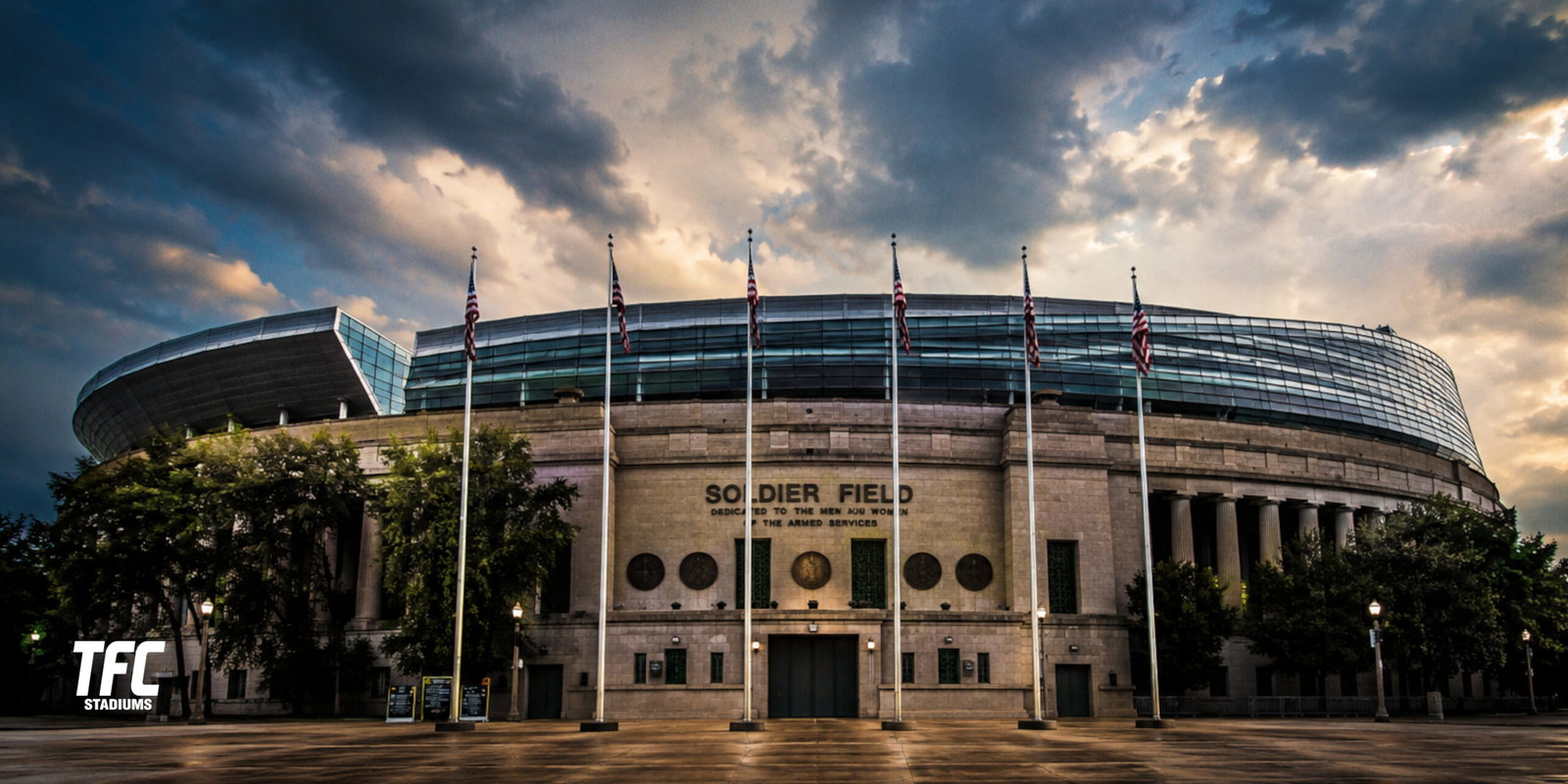
Few stadiums create debate quite like Soldier Field. Sitting beside Lake Michigan, it is both a preserved civic monument and a modern NFL venue squeezed inside a historic shell. Depending on who you ask, the redesign was either a clever piece of architectural survival or the moment Chicago placed a spaceship inside a Roman temple.
The truth sits somewhere between those extremes.
Originally opened in 1924 as Municipal Grant Park Stadium, Soldier Field was built as a grand public arena inspired by classical architecture. Nearly a century later, its 2003 reconstruction transformed it into one of the most unusual sporting venues in the world.
Today it represents a clash of eras: limestone columns, neoclassical symmetry and civic grandeur wrapped around exposed steel, glass and contemporary engineering.
The Original 1924 Design: Chicago Builds a Monument
Soldier Field was designed by the Chicago architectural firm Holabird & Roche, a company deeply involved in shaping the city’s early 20th century skyline.
The stadium reflected the Neoclassical architectural movement, borrowing ideas from ancient Greek and Roman public buildings. This was common for major civic projects of the period, when cities wanted structures that projected permanence, democracy and strength.
Key original features included:
| Feature | Architectural Purpose |
|---|---|
| Doric-style colonnades | Created a classical monument appearance |
| Limestone exterior | Connected the stadium visually with Chicago civic buildings |
| Large open bowl design | Maximised crowd capacity and sightlines |
| Symmetrical layout | Reflected traditional civic architecture |
| Lakeside positioning | Connected the building with Grant Park’s public landscape |
The original capacity exceeded 70,000 and could expand beyond 100,000 for special events, making it one of America’s great public arenas.
Its purpose was broader than football. Soldier Field hosted boxing, political events, military ceremonies, college football, concerts and international sporting occasions.
Why Soldier Field Looks Like a Roman Arena
The comparison with ancient amphitheatres is not accidental.
The original designers took inspiration from structures such as the Colosseum in Rome. The huge exterior columns were intended to make the stadium feel timeless rather than simply functional.
The name Soldier Field, adopted in 1925, reinforced that purpose. It became a memorial dedicated to American soldiers who served in the First World War.
The architecture was part of the message. Visitors were meant to feel they were entering a place of remembrance and civic importance, not just buying a ticket for a game.
The 2003 Renovation: One of the Most Controversial Stadium Redesigns Ever
By the late 20th century, Soldier Field had a problem. It was historically important, but it was falling behind modern NFL standards.
Older stadium designs prioritised maximum attendance. Modern venues required:
- More luxury suites
- Better player facilities
- Improved accessibility
- Wider concourses
- More premium seating
- Modern broadcasting infrastructure
Rather than demolish Soldier Field completely, architects Wood + Zapata and Lohan Caprile Goettsch Architects designed a radical reconstruction.
The project cost approximately $632 million and reopened in 2003.
The approach was unusual:
Keep the historic exterior.
Remove most of the old seating bowl.
Insert a completely new stadium inside.
It was architectural surgery on a massive scale.
The “Spaceship” Debate
The renovation immediately divided opinion.
Supporters argued that it preserved an important landmark while allowing Chicago to keep an NFL team in the city centre. The modern seating bowl created better sightlines and brought fans closer to the action.
Critics argued that the new structure overwhelmed the historic stadium.
The biggest complaint was visual contrast. The futuristic steel seating bowl rises above the old limestone walls, creating the famous “spaceship landing inside Soldier Field” comparison.
Even by architectural standards, where people can argue for hours about a window frame, the reaction was intense.
The controversy eventually contributed to Soldier Field losing its status as a National Historic Landmark in 2006.
Architectural Breakdown: Old Soldier Field vs Modern Soldier Field
| Category | Original Stadium | Modern Stadium |
|---|---|---|
| Main style | Neoclassical | Contemporary sports architecture |
| Primary materials | Limestone, concrete | Steel, glass, concrete |
| Design influence | Roman amphitheatres | Modern NFL venues |
| Capacity focus | Huge public crowds | Premium experience and sightlines |
| Seating | Large oval bowl | Compact football-focused bowl |
| Atmosphere | Monumental civic arena | Louder, tighter NFL environment |
The redesign sacrificed some historical purity but created a much more intense football setting.
Engineering Challenges
Rebuilding Soldier Field was far more complicated than constructing a new stadium on empty land.
Engineers had to:
- Preserve historic exterior sections
- Build within strict site limitations near Lake Michigan
- Support a new structure inside the old footprint
- Improve accessibility without removing key architectural elements
- Upgrade facilities beneath existing areas
The result is almost a stadium within a stadium.
From an engineering perspective, it is impressive. From an architectural conservation perspective, it remains controversial.
The Smallest Stadium in the NFL
One surprising result of the renovation was reduced capacity.
Soldier Field’s current NFL capacity is approximately 61,500, making it the smallest stadium in the league.
That seems unusual for a team like the Chicago Bears, one of the NFL’s most historic franchises.
However, the reduction came with benefits:
- Improved sightlines
- Seats closer to the field
- Better hospitality areas
- More modern facilities
It followed a wider stadium trend where experience and revenue per seat became more important than simply fitting in the largest possible crowd.
Location: Soldier Field’s Greatest Architectural Advantage
Whatever people think of the renovation, Soldier Field has one feature many NFL stadiums cannot match: its setting.
The stadium sits within Chicago’s Museum Campus beside:
- Lake Michigan
- Grant Park
- The Field Museum
- The Chicago skyline
Many modern NFL stadiums are surrounded by huge car parks. Soldier Field remains integrated into the city.
The approach towards the stadium, with the old columns against the skyline, is still one of American sport’s most recognisable entrances.
How Soldier Field Compares With Other Historic Stadiums
| Stadium | Opened | Architectural Approach |
|---|---|---|
| Soldier Field | 1924 | Historic exterior with modern interior |
| Lambeau Field | 1957 | Continuous expansion while retaining identity |
| Los Angeles Memorial Coliseum | 1923 | Modern upgrades within historic structure |
| Rose Bowl | 1922 | Preservation-focused improvements |
| Yankee Stadium | 2009 | New stadium inspired by historic predecessor |
Soldier Field took the most aggressive approach. It did not simply restore history. It placed a new era directly on top of the old one.
Legacy: Brilliant Reinvention or Architectural Mistake?
Soldier Field is difficult to judge because both arguments have merit.
The original stadium was a beautiful civic monument that deserved protection. The renovation changed its character dramatically and removed much of the historic bowl that made it special.
At the same time, without major redevelopment, the stadium may have become unsuitable for modern professional sport.
The building that remains is strange, bold and sometimes awkward. Yet it is also unmistakable. Many stadiums built in the last few decades are efficient but forgettable. Nobody forgets Soldier Field.
In a city famous for architecture, perhaps the biggest compliment is that people are still arguing about it. Great buildings usually cause a little trouble. Soldier Field has been causing plenty for over 100 years.
About the Author