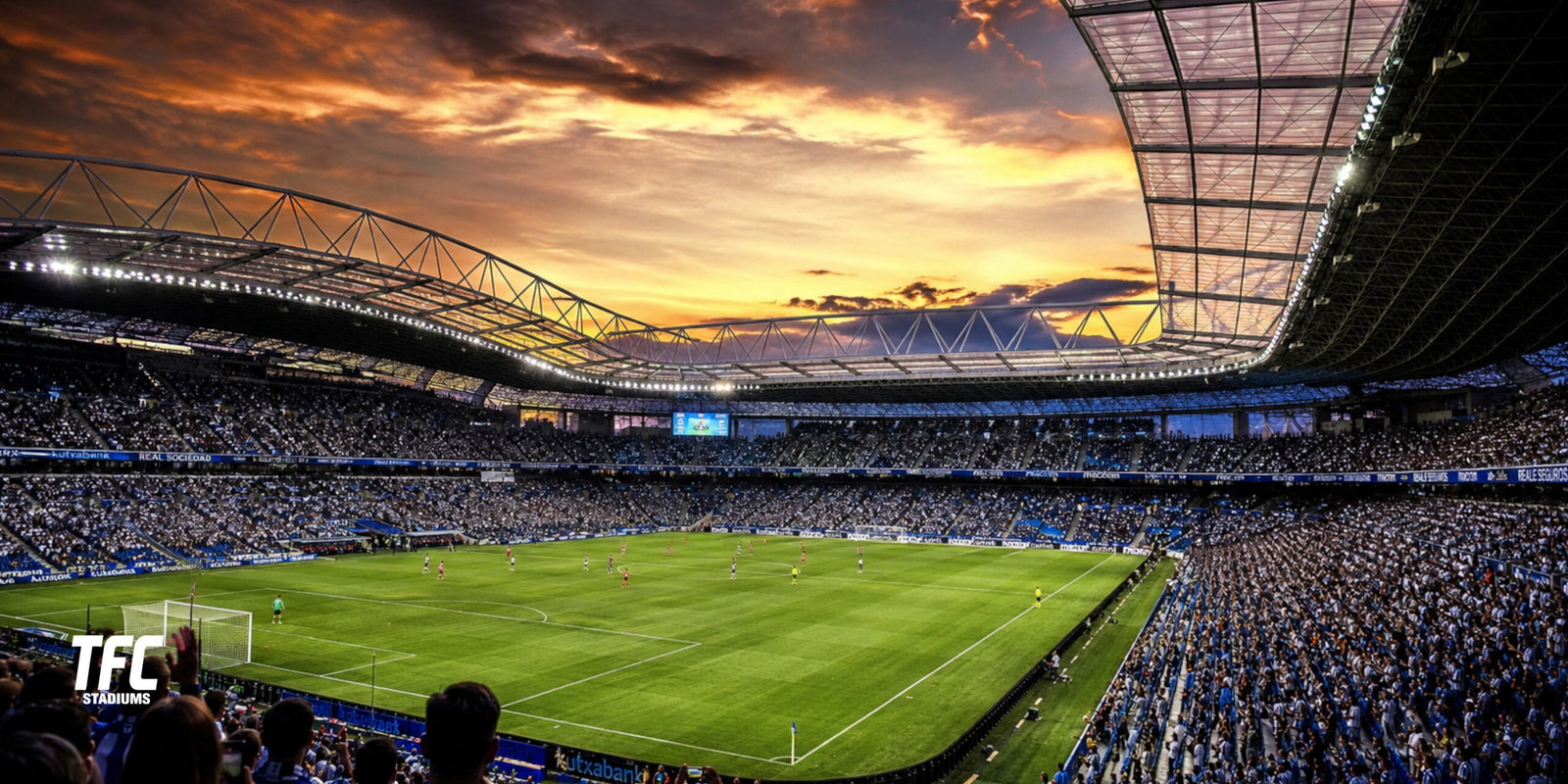
There are bigger stadiums in Spain. Louder ones too. But when it comes to sensible modern sustainability, Anoeta Stadium has become surprisingly interesting.
Officially known as Reale Arena for sponsorship reasons, the home of Real Sociedad sits in San Sebastián with a kind of understated confidence that feels very Basque. It is modern without looking sterile. Commercial without becoming gaudy. Efficient without turning supporters into laboratory subjects armed with reusable quinoa containers.
That balance matters.
Modern stadium sustainability is often reduced to solar panels and vague corporate statements about “green futures”. Anoeta feels more practical than that. The stadium’s redevelopment fundamentally changed how the venue interacts with the city around it, how supporters travel, and how resources are managed on matchdays.
It is not perfect. Few stadiums are. But compared with many older European grounds trying to retrofit environmental policies onto crumbling infrastructure, Anoeta started with a cleaner slate.
The Transformation of Anoeta
Anoeta’s major redevelopment, completed in phases between 2017 and 2019, reshaped the stadium into a more compact and efficient football venue.
The old athletics track disappeared, supporters moved closer to the pitch, and the overall structure became far more integrated and enclosed. While the headlines focused on atmosphere and sightlines, sustainability benefits quietly emerged alongside the rebuild.
Key redevelopment improvements included:
| Area | Sustainability Impact |
|---|---|
| Modern roofing and structure | Improved insulation and weather protection |
| Better crowd flow | Reduced congestion and transport strain |
| Updated utilities | Lower operational waste and energy inefficiencies |
| Improved seating design | Increased capacity efficiency without sprawling expansion |
| Urban integration | Less need for extensive external parking infrastructure |
A lot of stadium sustainability comes down to efficiency rather than spectacle. Anoeta reflects that idea rather well.
Urban Location Helps More Than People Realise
One of Anoeta’s biggest environmental advantages is not technological at all.
It is location.
The stadium sits within San Sebastián rather than stranded on the outskirts beside a giant sea of tarmac and fast-food drive-throughs. That alone changes the environmental footprint dramatically.
Supporters can access the ground through:
- Public buses
- Local rail connections
- Cycling routes
- Walkable city infrastructure
Spanish cities generally perform better than many British or American counterparts in this area. Fans arriving by foot or public transport is not treated as some heroic ecological sacrifice. It is simply normal urban behaviour.
That matters because transport emissions are often the largest contributor to a stadium’s matchday carbon footprint.
Anoeta benefits enormously from supporters not needing to drive twenty miles to buy a £9 hot dog under fluorescent lighting beside a dual carriageway.
Energy Efficiency Inside the Stadium
Real Sociedad and stadium operators modernised much of the venue’s internal infrastructure during redevelopment.
This included:
- Improved lighting systems
- More efficient electrical distribution
- Modern ventilation systems
- Reduced maintenance-heavy materials
- Better water management systems
LED floodlighting has become increasingly common across European football, and Anoeta follows that broader trend. Modern LED systems consume significantly less electricity while also improving broadcast quality.
That last point matters commercially. Sustainability tends to move faster when television contracts are involved.
The stadium’s enclosed design also improves energy retention and weather protection. Older open bowl stadiums often leak heat, water, and maintenance costs with impressive enthusiasm. Anoeta’s updated structure is far more controlled operationally.
Matchday Waste and Resource Management
Waste management is rarely glamorous, but it tells you a great deal about how serious a stadium actually is.
Most clubs advertise sustainability initiatives. Far fewer are willing to tackle the deeply chaotic reality of tens of thousands of football supporters consuming beer, snacks, plastic packaging, and emotional damage over a two-hour period.
Anoeta has increasingly aligned itself with broader European stadium standards involving:
- Recycling collection systems
- Reduced single-use plastics
- Better concourse waste separation
- More efficient cleaning operations
- Sustainable procurement initiatives
Spanish football still has room for improvement here. Some stadiums remain frustratingly inconsistent depending on the event or competition. But Anoeta generally presents itself as part of a newer generation of venues attempting to reduce visible waste without turning the fan experience into an environmental lecture.
Which is probably wise.
Football supporters will tolerate many things. Being scolded beside the pie stand is not usually one of them.
The Role of Real Sociedad
Real Sociedad’s wider identity helps shape the sustainability conversation around the stadium.
The club has long projected a relatively grounded image compared with some of Europe’s larger financial heavyweights. There is a strong regional identity tied to Basque culture, local development, and community integration.
That philosophy naturally overlaps with sustainability in several ways:
| Club Approach | Environmental Effect |
|---|---|
| Strong academy focus | Reduced dependence on constant transfer churn |
| Local community integration | Lower travel demands and stronger regional engagement |
| Long-term planning | More stable infrastructure investment |
| Controlled commercial growth | Less aggressive overexpansion |
It would be naïve to pretend football clubs suddenly become environmental charities because they install recycling bins near Gate 4. Football remains heavily commercial.
Still, Real Sociedad often feels more measured than clubs pursuing endless expansion without much regard for long-term urban or environmental impact.
How Anoeta Compares to Other European Stadiums
Anoeta is probably best viewed as part of Europe’s “smart modern stadium” tier rather than the ultra-expensive futuristic category occupied by venues like:
- Tottenham Hotspur Stadium
- Allianz Arena
- Johan Cruyff Arena
Those venues often dominate headlines with advanced renewable systems, smart energy grids, and large-scale carbon reduction programmes.
Anoeta operates at a slightly more restrained level.
Its strengths come from:
- Efficient redevelopment
- Strong public transport links
- Compact urban integration
- Modern infrastructure
- Reasonable operational scale
In many ways, that may prove more sustainable long term than endlessly escalating architectural extravagance.
A stadium does not necessarily need to resemble a spaceship to function responsibly.
The Financial Reality of Stadium Sustainability
This is the part clubs rarely advertise.
Sustainability projects only survive if they make financial sense.
Energy-efficient systems reduce operating costs. Better transport planning reduces infrastructure strain. Modern maintenance systems lower repair expenditure. Compact design improves revenue density.
Anoeta’s redevelopment was expensive, but modernisation often becomes cheaper than endlessly patching outdated infrastructure.
Many older stadiums across Europe now face that exact dilemma. They can either modernise intelligently or spend the next thirty years fixing leaking roofs while pretending nostalgia is an energy policy.
The Fan Experience Still Matters
One reason Anoeta’s sustainability efforts work reasonably well is because they do not dominate the experience.
The stadium still feels like a football ground first.
Atmosphere improved dramatically after the redevelopment removed the athletics track. Crowd proximity increased. Acoustics sharpened. Matchdays became more intense and visually cohesive.
That matters because sustainable stadiums only succeed if supporters actually enjoy using them.
Nobody wants football reduced to a sterile corporate sustainability seminar interrupted occasionally by corners and yellow cards.
Anoeta largely avoids that trap.
TFC Takeaway
Anoeta Stadium represents a quieter version of modern football sustainability.
There are no giant publicity stunts or extravagant eco-branding exercises. Instead, the stadium benefits from sensible redevelopment choices, strong transport integration, efficient infrastructure, and a club culture that generally values long-term thinking.
In truth, the stadium’s greatest environmental advantage may simply be restraint.
It modernised without becoming absurdly oversized. It improved infrastructure without abandoning urban connectivity. It embraced efficiency without sacrificing atmosphere.
That combination is rarer in modern football than clubs would probably like to admit.
About the Author