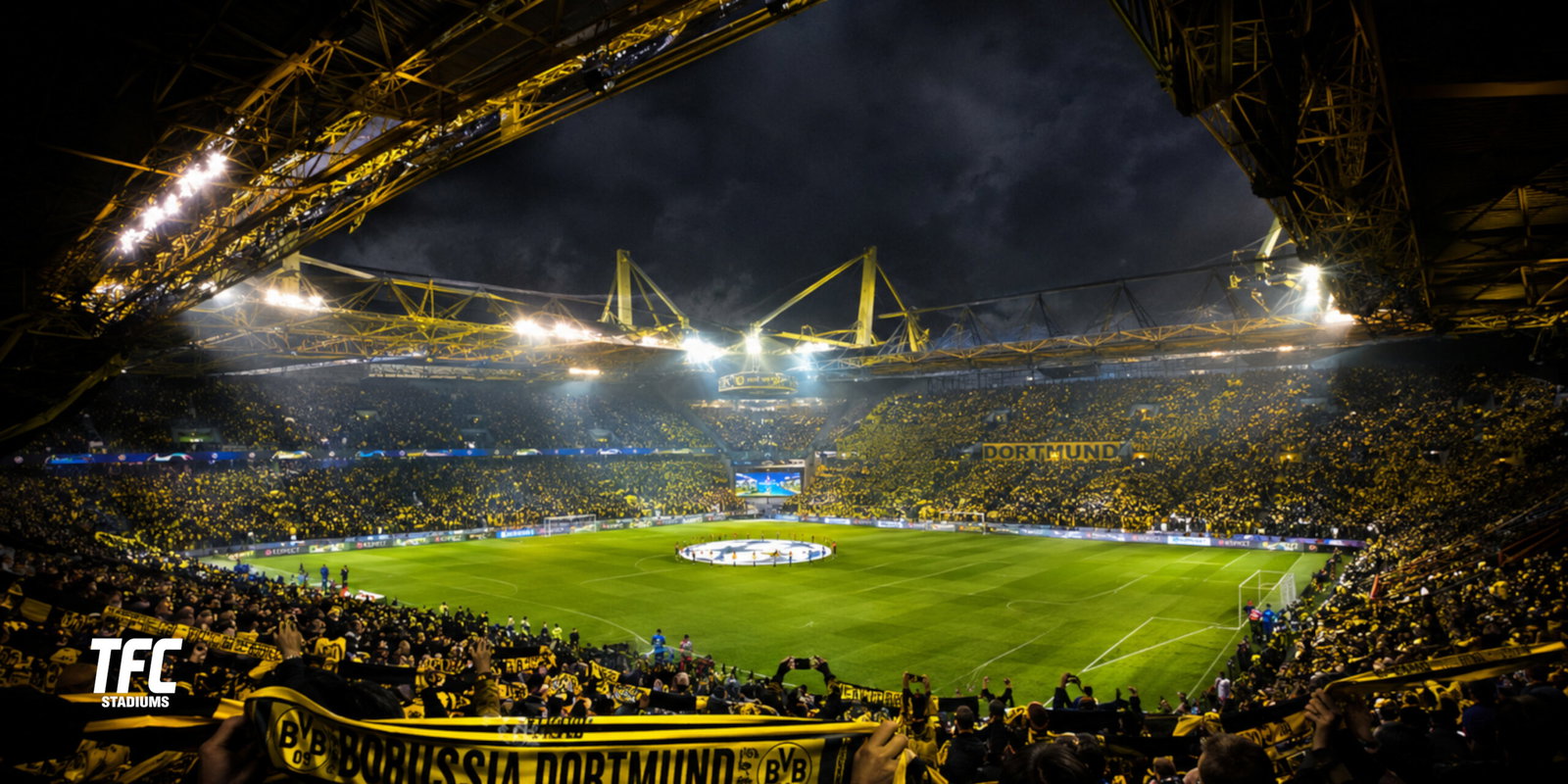
Few stadiums generate an atmosphere quite like Signal Iduna Park. Home to Borussia Dortmund and its famous Yellow Wall, it has become one of football’s true cathedrals. While it regularly stages Bundesliga classics and Champions League nights, it has also welcomed some of the biggest UEFA finals ever played.
As a football fan, there is something special about watching a neutral final in Dortmund. Even without Borussia on the pitch, the stadium somehow refuses to become quiet. The stands seem to carry decades of European memories, and the supporters, whether local or travelling from across the continent, rarely disappoint.
Although it has not hosted as many European finals as Wembley or the San Siro, every UEFA showpiece played here has produced its own story.
UEFA Finals at Signal Iduna Park
| Year | Competition | Winners | Runners-up | Score | Attendance |
|---|---|---|---|---|---|
| 2001 | UEFA Cup | Liverpool | Alavés | 5-4 (after extra time) | 47,998 |
2001 UEFA Cup Final
Liverpool 5, Alavés 4 (after extra time)
If ever there was a final that deserved the phrase “you had to see it to believe it”, this was it.
Liverpool arrived chasing an extraordinary cup treble under Gérard Houllier. Deportivo Alavés, meanwhile, were the surprise package from Spain, making their first appearance in a major European final.
Liverpool appeared to have complete control.
Goals from Markus Babbel, Steven Gerrard and Gary McAllister helped establish a commanding lead, while Robbie Fowler added another after half time. Alavés simply refused to disappear, fighting back again and again in one of European football’s greatest displays of resilience.
The match eventually reached extra time at 4-4.
Under the golden goal rule, the next goal would immediately end the contest. Ironically, it came via an own goal by Alavés defender Delfí Geli following a McAllister free kick, handing Liverpool the UEFA Cup in heartbreaking fashion for the Spanish club.
It remains one of the highest scoring European finals ever played.
Match Statistics
| Statistic | Liverpool | Alavés |
|---|---|---|
| Final Score | 5 | 4 |
| Extra Time | Yes | Yes |
| Golden Goal | Yes | Own Goal |
| Goals Scored | Babbel, Gerrard, McAllister (pen), Fowler, Geli (OG) | Moreno, Javi Moreno, Magno, Jordi Cruyff |
Why Dortmund Was Chosen
UEFA selected Dortmund because the Westfalenstadion had already built a reputation for handling major international fixtures.
By 2001 the stadium offered:
- Excellent transport connections
- Proven crowd management
- Modern media facilities
- Strong security infrastructure
- One of Europe’s most intimidating football atmospheres
Although attendance was below today’s capacity because of the stadium’s configuration at the time, the venue proved an outstanding choice.
The Stadium’s European Reputation
Signal Iduna Park has hosted far more than domestic football.
Major international fixtures have included:
- FIFA World Cup matches in 1974 and 2006
- UEFA European Championship matches
- UEFA Champions League semi finals
- UEFA Nations League fixtures
- Numerous Germany internationals
Few stadiums consistently create an atmosphere that visiting players remember years later.
Even opposition managers frequently describe Dortmund as one of the loudest venues in world football.
How It Compares With Other UEFA Final Venues
| Stadium | UEFA Club Finals Hosted |
|---|---|
| Wembley Stadium | Multiple European Cup and Champions League Finals plus UEFA Euro finals |
| San Siro | Multiple European Cup and Champions League Finals |
| Olympiastadion Munich | Multiple European Cup and Champions League Finals |
| Signal Iduna Park | UEFA Cup Final |
Dortmund’s relatively short list reflects UEFA’s rotation of major finals rather than any limitation of the venue itself. Many supporters continue to argue that Europe’s best atmosphere deserves more continental showpieces.
Memorable Moments From the 2001 Final
- Nine goals were scored across normal and extra time.
- The match was decided by the golden goal rule.
- Liverpool completed a remarkable cup treble during the 2000 to 01 season.
- Alavés came within moments of one of football’s greatest underdog victories.
- It remains one of the most entertaining UEFA finals ever played.
Attendance and Economic Impact
Hosting a UEFA final delivered significant benefits for Dortmund.
Thousands of supporters travelled from England and Spain, filling hotels, restaurants, pubs and local attractions throughout the city. International television coverage showcased both the stadium and Dortmund itself to millions of viewers.
Events like these have become increasingly valuable for host cities. Modern UEFA finals now generate tens of millions of pounds in visitor spending, tourism exposure and temporary employment.
The 2001 final helped reinforce Dortmund’s standing as one of Germany’s premier sporting destinations.
Why the 2001 Final Still Matters
Football has produced plenty of tactical masterclasses, but sometimes chaos is far more memorable.
Liverpool versus Alavés delivered constant momentum swings, dramatic goals and genuine uncertainty until the very final kick. It remains a favourite whenever supporters debate the greatest UEFA Cup or Europa League finals.
Personally, it is the kind of match I recommend to anyone who thinks older football was slower or less entertaining. Nine goals, relentless attacking and a golden goal finish make for an unforgettable spectacle. Modern finals often become tense tactical battles. This one felt like two teams refusing to stop throwing punches.
Signal Iduna Park was the perfect stage for such a remarkable evening.
Could Signal Iduna Park Host Another UEFA Final?
Absolutely.
Following extensive modernisation, the stadium remains among Europe’s elite venues. With a capacity exceeding 81,000 for domestic matches and outstanding transport links, it continues to feature prominently whenever UEFA considers future major events.
The stadium’s atmosphere is arguably its strongest selling point. Neutral finals often struggle to generate genuine intensity, but Dortmund rarely has that problem. The city’s football culture almost guarantees a memorable occasion regardless of who reaches the final.
If UEFA wants another final remembered for both the football and the atmosphere, Signal Iduna Park remains an excellent candidate.
UEFA Finals at Signal Iduna Park at a Glance
| Category | Details |
|---|---|
| Stadium | Signal Iduna Park (Westfalenstadion) |
| City | Dortmund, Germany |
| UEFA Club Finals Hosted | 1 |
| Most Famous Final | UEFA Cup Final 2001 |
| Memorable Feature | Liverpool’s 5-4 victory after extra time |
| Defining Moment | Golden goal own goal by Delfí Geli |
| Legacy | One of the greatest UEFA Cup finals ever played |
About the Author