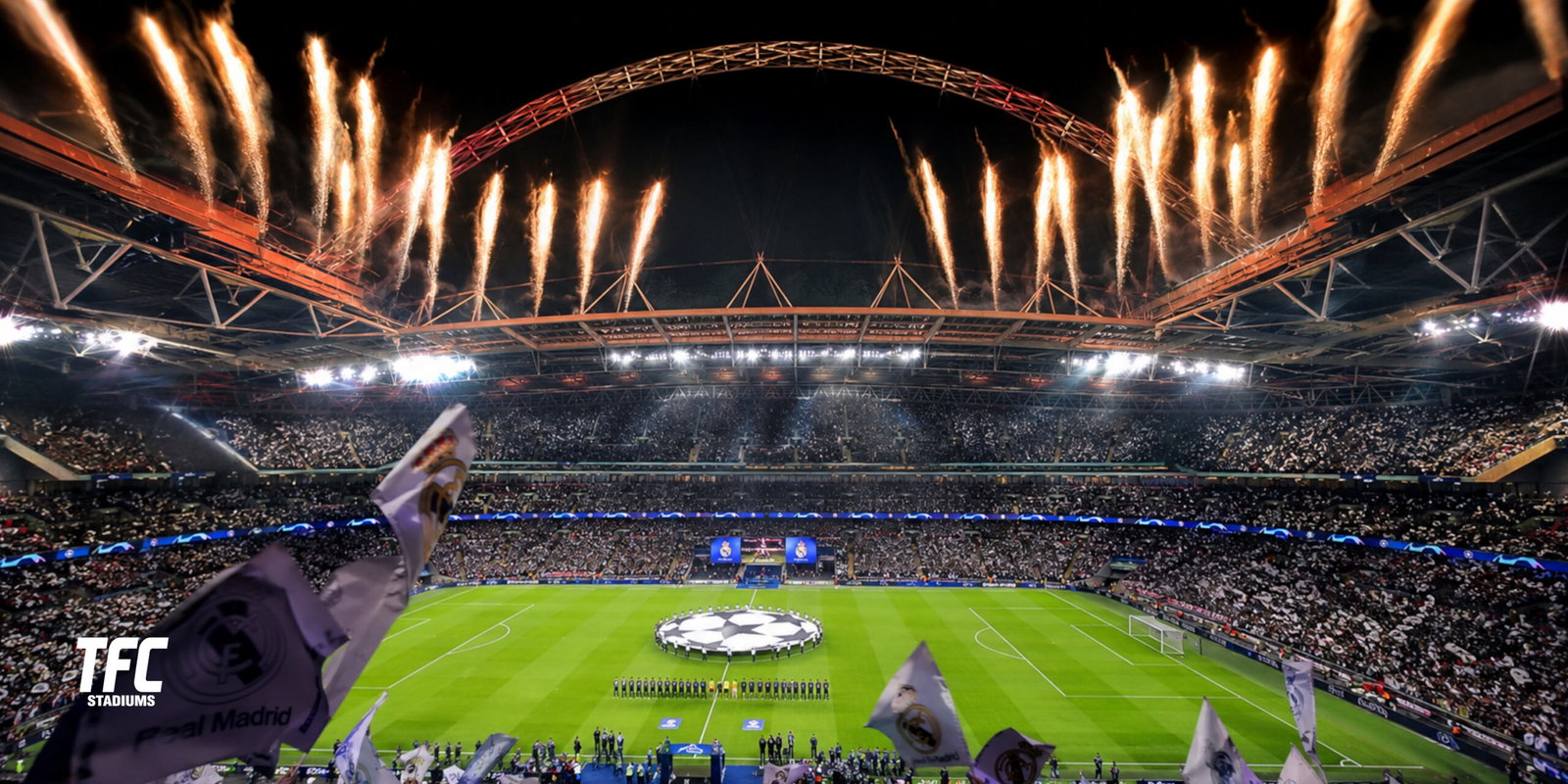
Few stadiums carry the weight of expectation quite like Wembley. Some grounds are famous because of the clubs that live there. Wembley is different. It belongs to moments.
For nearly a century, it has been the place where careers are defined, trophies are lifted and supporters experience either the best day of their lives or a very long journey home wondering why their striker tried a clever penalty.
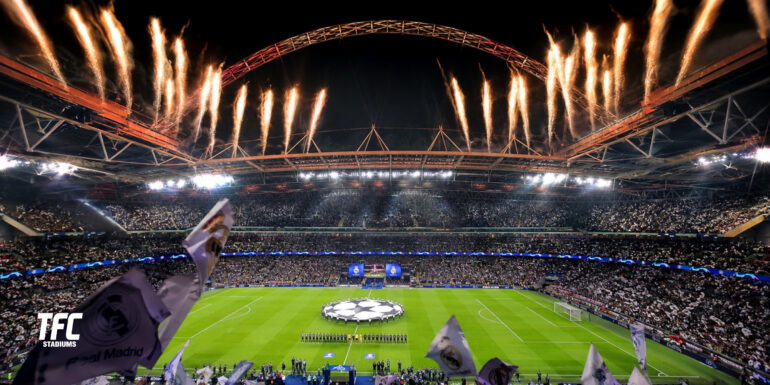
The modern Wembley Stadium, opened in 2007, continued the legacy of the original 1923 venue and quickly re-established itself as one of Europe’s most important football arenas. With a capacity of around 90,000, world-class facilities and a history attached to almost every blade of grass, it remains a preferred destination for UEFA’s biggest events.
From Champions League finals to European Championships, Wembley is not simply England’s national stadium. It is one of football’s global theatres.
From The Twin Towers To The Wembley Arch
The original Wembley opened in 1923 and immediately became part of football culture with the famous “White Horse Final” between Bolton Wanderers and West Ham United.
For decades, the Twin Towers represented English football. The stadium hosted:
- The 1966 FIFA World Cup Final
- The 1996 European Championship final
- Multiple European Cup finals
- Countless FA Cup finals and international fixtures
When the old stadium closed in 2000, there was concern that rebuilding would remove some of the magic. The new Wembley had to balance nostalgia with the requirements of modern football.
The answer was a stadium built for the modern era:
- Capacity: approximately 90,000
- Cost: around £800 million
- Opened: 2007
- Signature feature: 133-metre-high Wembley Arch
- Retractable roof sections
- 2,600 toilets, famously solving a very British matchday problem
The Twin Towers were gone, but the idea remained. Big matches still felt bigger at Wembley.
Wembley And The Champions League
Wembley has become one of UEFA’s favourite locations for the Champions League final.
The old and new stadiums combined have hosted several European Cup and Champions League finals, placing Wembley among the most frequently selected venues in the competition’s history.
Major finals include:
| Year | Match | Significance |
|---|---|---|
| 1963 | AC Milan 2-1 Benfica | Milan became the first Italian winners |
| 1968 | Manchester United 4-1 Benfica | First English European Cup victory |
| 1971 | Ajax 2-0 Panathinaikos | Beginning of Ajax’s European dominance |
| 1978 | Liverpool 1-0 Club Brugge | Liverpool strengthened English dominance |
| 1992 | Barcelona 1-0 Sampdoria | Barcelona’s first European Cup |
| 2011 | Barcelona 3-1 Manchester United | Guardiola’s Barcelona at its peak |
| 2013 | Bayern Munich 2-1 Borussia Dortmund | First all-German final |
| 2024 | Real Madrid 2-0 Borussia Dortmund | Madrid extended their European record |
The 2011 final is often remembered as one of the finest club performances ever seen at Wembley. Barcelona’s midfield control through Xavi, Andrés Iniesta and Sergio Busquets turned the stadium into a football classroom, unfortunately for Manchester United.
Why UEFA Keeps Returning To Wembley
European football has many iconic stadiums, including the Bernabéu, San Siro and Allianz Arena, but Wembley offers something unique.
Its advantages include:
Capacity
With 90,000 seats, Wembley generates enormous ticket revenue. A Champions League final requires huge allocations for supporters, sponsors, media and UEFA partners.
Location
London remains one of Europe’s best-connected cities, with multiple airports and extensive transport links.
Commercial Value
Wembley provides:
- Premium hospitality
- Large media facilities
- Major sponsorship opportunities
- Global recognition
Football is romantic, but UEFA finals are also huge commercial operations. Wembley delivers both.
Wembley And The Premier League’s Global Image
Although Wembley does not have a permanent Premier League club tenant, its influence on the league is enormous.
The stadium represents the final destination for English football:
- FA Cup Final
- League Cup Final
- Community Shield
- Play-off finals
The Championship play-off final is often described as football’s richest single match, with promotion to the Premier League potentially worth well over £100 million depending on future survival and broadcast income.
For many clubs, reaching Wembley is a turning point. A single afternoon can reshape finances, recruitment and history.
Wembley And The 2026 Premier League Landscape
The 2026 Premier League era highlights how important Wembley remains as English football’s showcase venue.
With the league continuing to dominate global broadcasting revenues, Wembley acts as the stage where domestic achievement becomes a worldwide event.
The Premier League’s international growth has been driven by:
- Global television audiences
- International ownership
- Elite managers and players
- Increased commercial partnerships
A Wembley final involving leading Premier League sides is now watched far beyond England. Matches involving clubs such as Manchester City, Arsenal, Liverpool, Chelsea, Tottenham Hotspur and Manchester United attract audiences across Europe, Asia, North America and Africa.
The stadium has become a symbol of the league’s financial power. Winning at Wembley is still about history, but it is also about brand strength, global reach and commercial momentum.
Wembley And Future Champions League Finals Beyond 2026
After hosting the 2024 Champions League final, Wembley reinforced its position as one of UEFA’s safest choices for major events.
Looking ahead beyond 2026, it remains a strong candidate for future finals because UEFA increasingly values venues that can handle the enormous demands of modern tournaments.
A modern Champions League final requires:
- Advanced security operations
- Fan zones
- Broadcast infrastructure
- VIP and sponsor facilities
- Transport capacity for tens of thousands of travelling fans
Wembley’s biggest competition comes from Europe’s other elite venues, but very few combine size, history and commercial appeal in the same way.
England’s European Championship Legacy
Wembley’s importance is not limited to club football.
At international level, it has staged some of Europe’s biggest moments.
Major events include:
- Euro 1996 matches, including the final
- Euro 2020 semi-finals and final
- England’s major tournament knockout matches
The Euro 2020 final between England and Italy became one of the most watched football events in British television history.
Although England lost on penalties, because apparently football tradition demands occasional emotional damage, the tournament showed Wembley’s unmatched ability to create atmosphere.
The Matchday Experience
Wembley is not universally loved by every supporter. Some fans argue that the corporate areas reduce atmosphere compared with traditional club stadiums.
The criticism is understandable. Wembley is polished, huge and designed for major events rather than weekly tribal chaos.
However, when the occasion is right, few venues compare.
The walk down Wembley Way remains one of football’s great rituals:
- Fans arriving in club colours
- Flags covering the approach
- Generations of families attending together
- The arch visible from miles away
Football grounds are about memory, and Wembley has collected more than most.
Wembley Compared With Europe’s Elite Stadiums
| Stadium | Capacity | Strength |
|---|---|---|
| Wembley Stadium | 90,000 | Finals, history, global recognition |
| Camp Nou | 100,000+ after redevelopment | Club identity and scale |
| Santiago Bernabéu | 80,000+ | Prestige and technology |
| San Siro | 75,000+ | Atmosphere and heritage |
| Allianz Arena | 75,000 | Modern design and efficiency |
Wembley’s biggest advantage is neutrality. It is not defined by one club. It belongs to the occasion.
Final Thoughts: Why Wembley Still Matters
Modern football changes quickly. Stadium names change, sponsorship grows, competitions expand and traditions are constantly tested.
Yet Wembley has managed to remain relevant because it represents something simple. The biggest games need somewhere that feels worthy of them.
The original stadium gave football the Twin Towers. The modern version gave it the arch. Across both eras, the idea has remained the same.
When players walk out at Wembley, it feels different.
That is why Europe keeps coming back.
About the Author