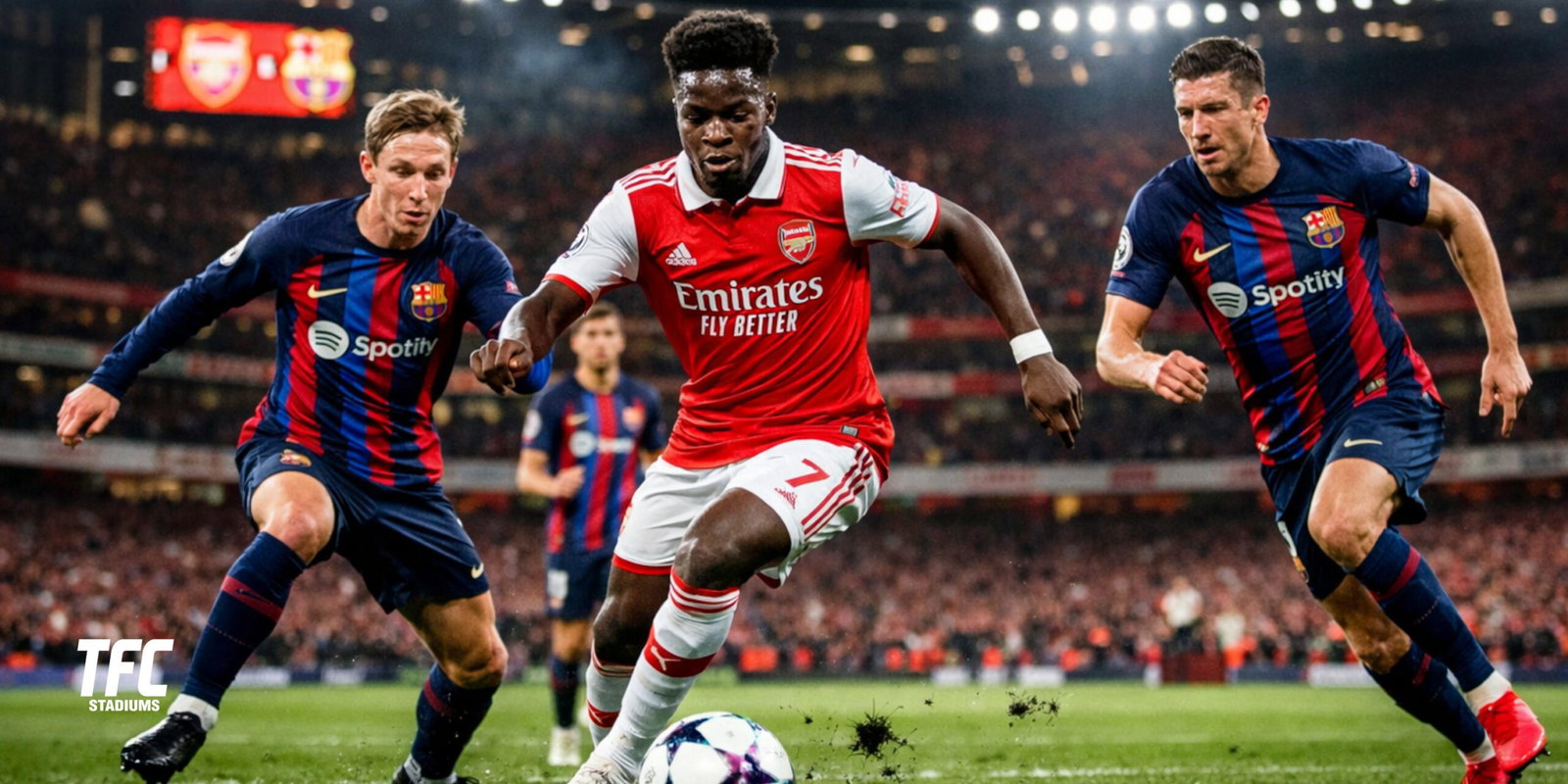
Arsenal against Barcelona always feels a little bigger than an ordinary European night. Perhaps it is the contrast. One club built on technical precision and possession, the other often at its best when mixing elegance with a bit of chaos and a refusal to know when it is beaten.
At the Emirates Stadium, that contrast has produced some of the most memorable nights in Arsenal’s modern history. There have been moments of brilliance, moments of frustration, and at least one occasion when Lionel Messi appeared to have wandered into North London merely to remind everyone that football can occasionally be unfair.
Barcelona have often had the upper hand overall, but Arsenal have still produced a few evenings at the Emirates that supporters speak about with the sort of misty-eyed reverence usually reserved for title-winning sides and pubs that no longer exist.
Arsenal vs Barcelona Head-to-Head
Arsenal and Barcelona have met regularly in European competition since the late 1990s, usually in the Champions League and usually with at least one world-class player doing something mildly ridiculous.
Overall, Barcelona hold the advantage in the rivalry.
| Competition Record | Arsenal | Barcelona | Draws |
|---|---|---|---|
| All Meetings | 9 wins | 11 wins | 4 |
At the Emirates Stadium itself, the record is far tighter.
| Arsenal vs Barcelona at Emirates Stadium | Result |
| March 31, 2010 | Arsenal 2-2 Barcelona |
| February 16, 2011 | Arsenal 2-1 Barcelona |
| February 23, 2016 | Arsenal 0-2 Barcelona |
That leaves Arsenal with one win, one draw and one defeat against Barcelona at the Emirates. Not exactly domination, but certainly better than many clubs can claim against the Catalans.
The First Meeting at the Emirates, Arsenal 2-2 Barcelona, 2010
The first time Barcelona visited the Emirates, they arrived as the reigning European champions and arguably the best club side in the world.
Pep Guardiola’s Barcelona contained Xavi, Andrés Iniesta, Sergio Busquets, Gerard Piqué and a certain Lionel Messi. Arsenal, meanwhile, were talented but stretched thin by injuries. Arsène Wenger was forced into using a back line that looked rather like it had been assembled from whoever happened to be standing nearest the dressing room.
For much of the first half, Barcelona were sensational. They pressed aggressively, kept the ball almost permanently and tore through Arsenal repeatedly. By half-time, the only reason the score was not 4-0 was because Manuel Almunia had produced one of the best performances of his Arsenal career.
Barcelona eventually went 2-0 up through Zlatan Ibrahimović, who finished twice with the sort of coolness that suggested he had spent the afternoon mildly inconvenienced rather than challenged.
Then the match turned.
Theo Walcott raced clear to make it 2-1, the Emirates woke up, and suddenly Barcelona looked uncertain. Late on, Cesc Fàbregas won and converted a penalty after being brought down by Carles Puyol.
The 2-2 draw felt like a victory for Arsenal, even if the second leg in Barcelona rather spoiled the mood.
Arsenal’s Great Emirates Night, Arsenal 2-1 Barcelona, 2011
If there is one Arsenal versus Barcelona match at the Emirates that supporters still talk about with a grin, it is February 2011.
Barcelona arrived again as favourites. They had Messi at his peak, Xavi still pulling strings as if he had access to a different sport entirely, and David Villa stretching defences with clever movement.
Arsenal, though, produced one of the finest European performances of the Wenger era.
Villa put Barcelona ahead after a beautifully weighted pass from Messi. For long periods, it looked as though Arsenal would spend the evening chasing shadows and occasionally applauding politely whenever Barcelona completed another sequence of 37 passes.
Instead, Wenger’s side stayed in the game. Jack Wilshere was superb in midfield, playing with the confidence of someone who had apparently decided that facing Xavi and Iniesta at the age of 19 sounded perfectly reasonable.
Robin van Persie equalised from a tight angle after a quick Arsenal move caught Barcelona out. Then came the moment that turned the Emirates into bedlam.
In the closing minutes, Samir Nasri surged down the right and crossed low for Andrey Arshavin, who swept home the winner.
The stadium erupted. Wenger punched the air. Arshavin looked delighted and faintly surprised. Barcelona, for perhaps the first time in years, looked rattled.
Barcelona Strike Back, Arsenal 0-2 Barcelona, 2016
By 2016, the dynamic between the clubs had changed.
Arsenal were still regular Champions League participants, but Barcelona had assembled perhaps the most devastating front three in modern football. Lionel Messi, Luis Suárez and Neymar were not merely talented, they were absurd.
For an hour, Arsenal were excellent. Petr Čech made several important saves and the home side defended with discipline.
Then Arsenal pushed forward in search of a winner, leaving space behind. Against Barcelona, this is generally a bit like deciding to leave your front door open during a thunderstorm and hoping for the best.
Messi broke the deadlock after a counter-attack involving Neymar and Suárez. Late on, he added a penalty after Mathieu Flamini fouled him.
Barcelona won 2-0 and effectively ended the tie. It was also Messi’s first goals against Čech, which seemed almost statistically impossible given how long both men had been around.
The Tactical Battle
What has always made Arsenal versus Barcelona so fascinating is that the matches have rarely been simple clashes between attack and defence.
Arsenal have often tried to meet Barcelona on their own terms. Under Wenger especially, there was a belief that Arsenal could outplay anyone if they moved the ball quickly enough and trusted their attacking players.
That produced entertaining football, but it also created problems.
Barcelona’s midfield often dominated possession:
- Xavi controlled tempo and passing angles.
- Iniesta carried the ball through midfield.
- Busquets quietly disrupted Arsenal attacks before most people had even noticed there had been an attack.
Arsenal’s best moments usually came when they attacked Barcelona quickly after winning possession.
In 2011, Arsenal caused problems by using the pace of Walcott and the movement of Nasri and Van Persie on the break. Barcelona pushed high up the pitch, leaving space behind their defence. Arsenal exploited it brilliantly.
By contrast, in 2010 and 2016, Arsenal spent long periods pinned back, unable to escape Barcelona’s press.
The Players Who Defined the Rivalry
Arsenal
- Thierry Henry, who later committed the deeply awkward act of joining Barcelona.
- Cesc Fàbregas, who somehow managed to play for both clubs and divide opinion in both cities.
- Robin van Persie, scorer in the famous 2011 victory.
- Jack Wilshere, whose display in 2011 remains one of the finest performances by an Arsenal midfielder in Europe.
- Theo Walcott, whose pace repeatedly unsettled Barcelona.
Barcelona
- Lionel Messi, who scored nine goals against Arsenal across the rivalry.
- Xavi, who controlled matches with alarming calm.
- Andrés Iniesta, perhaps the most graceful player Arsenal ever faced.
- Neymar and Luis Suárez, who turned the 2016 tie decisively in Barcelona’s favour.
- Zlatan Ibrahimović, whose brief spell in the rivalry included two superb goals at the Emirates.
Why the Rivalry Still Matters
Arsenal versus Barcelona at the Emirates has never been a traditional rivalry in the geographical sense. Nobody is arguing over motorway service stations or insisting one city has better weather. Barcelona win that one comfortably.
Instead, the rivalry matters because it represents a recurring test for Arsenal. Time and again, Arsenal have been measured against one of the greatest sides in football history.
Sometimes they came up short. Sometimes they were outclassed. But occasionally, especially on that unforgettable night in 2011, they showed they belonged on the same stage.
For Arsenal supporters, the image of Arshavin sliding away in celebration remains one of the defining moments of the Emirates era. For Barcelona supporters, there is always the comforting memory that Messi generally had the final word.
That, perhaps, is why these matches endure. They were dramatic, skilful, occasionally chaotic, and full of players who seemed capable of deciding a game with a single touch.
In other words, they were exactly what European nights are supposed to be.
About the Author