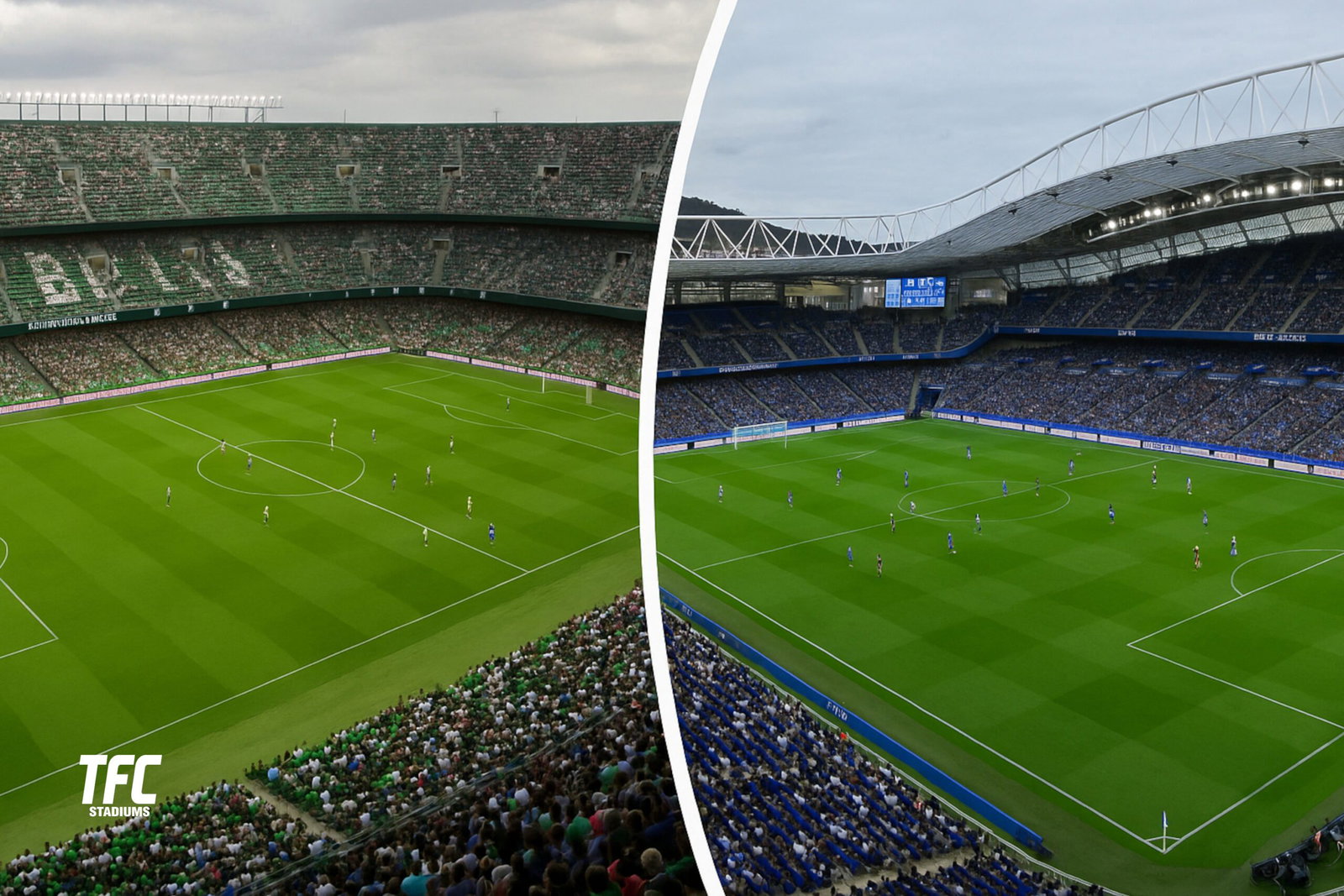
The Estadio Benito Villamarín in Seville and the Reale Arena (commonly still called Anoeta) in San Sebastián are two distinct stadiums that reflect the culture and ambitions of their clubs. Real Betis and Real Sociedad are historic institutions in Spanish football, and both grounds have been central to their identity for decades. Looking closely at the two reveals differences in scale, architecture, atmosphere, and how each city approaches the matchday experience.
Capacity and Scale
- Benito Villamarín: Around 60,720 seats. It is the fourth-largest stadium in Spain, behind Camp Nou, Santiago Bernabéu, and Metropolitano. This size makes it a natural choice for international fixtures and major tournaments.
- Reale Arena (Anoeta): Roughly 39,500 seats after its redevelopment. While smaller, it is one of the most modern mid-sized stadiums in Spain and often sells out for La Liga and European fixtures.
The difference of over 20,000 seats highlights the contrasting ambitions. Villamarín is designed for mass gatherings and headline events, while Anoeta balances capacity with intimacy and atmosphere.
Design and Architecture
- Benito Villamarín was originally opened in 1929 as Estadio de Heliópolis for the Ibero-American Exposition. It has since undergone expansions in the 1950s, 1970s, and most recently in 2017 when the south stand was completely rebuilt. The design is steep and traditional, ensuring good sightlines, but its exterior is still more functional than architectural. Plans exist to modernise the entire ground into a unified bowl with a striking facade.
- Reale Arena (Anoeta) opened in 1993 and was initially criticised for the inclusion of an athletics track that left fans detached from the pitch. The €50 million redevelopment between 2017 and 2019 removed the track, lowered the playing surface, and built new stands closer to the action. The new roof design also traps sound, making the ground far louder and more atmospheric than its early years. Its curved rooflines and modern facade make it one of the most visually appealing stadiums in Spain.
Atmosphere and Support
- Benito Villamarín: The size of the stadium, combined with Real Betis’ fanbase, creates one of the most intense atmospheres in Europe. Known for their passion, Betis supporters often fill the ground even in mid-table seasons. The derby against Sevilla FC, known as the Seville Derby, is considered one of the fiercest rivalries in world football. Chants, mosaics, and coordinated displays underline the role of Villamarín as a fortress.
- Reale Arena (Anoeta): While smaller, the ground now channels noise far better after renovation. Real Sociedad’s supporters are deeply tied to Basque culture, and the stadium provides an intimate environment where fans are close to the pitch. Matches against Athletic Club in the Basque Derby are especially charged, with flags, chants, and tifos reflecting regional pride.
Location and Accessibility
- Benito Villamarín: Located in the Heliópolis district of southern Seville, it sits within a lively area of the city with bars and restaurants nearby. Matchdays bring heavy congestion due to the sheer number of fans, but Seville’s tram and bus networks provide good access. The hot Andalusian climate adds its own character, particularly to evening games.
- Reale Arena (Anoeta): Found in the Amara district of San Sebastián, a short distance from the River Urumea. The ground benefits from the city’s compact size, with fans often walking to the stadium. It is well served by buses and suburban trains, and the coastal location adds to its appeal for visiting supporters. Its surroundings are more relaxed compared to the high-energy setting of Villamarín.
Legacy and Modernisation
- Benito Villamarín has hosted Spain national team fixtures and will play a role in Euro 2030 if Spain, Portugal, and Morocco’s joint bid goes ahead. Its legacy is tied to decades of Betis history, from promotion celebrations to European nights. The club is pushing plans for a new facade and commercial areas to make it a destination beyond matchdays.
- Reale Arena (Anoeta) has transformed its reputation. Once seen as one of the least atmospheric top-flight stadiums, it is now a model of how renovation can change a ground’s character. The redevelopment strengthened Real Sociedad’s financial position by increasing matchday revenue and creating better hospitality sections. The stadium is now among the most admired modern arenas in Spain.
Key Stats Comparison
| Feature | Benito Villamarín | Reale Arena (Anoeta) |
|---|---|---|
| Club | Real Betis | Real Sociedad |
| City | Seville, Andalusia | San Sebastián, Basque Country |
| Year Opened | 1929 (as Estadio de Heliópolis) | 1993 (renovated 2017–2019) |
| Capacity | ~60,720 | ~39,500 |
| Notable Renovations | 1958, 1971, 2017 (south stand) | Full redevelopment 2017–2019 |
| Atmosphere | Passionate, fiery, large-scale | Intimate, modern, Basque pride |
| Famous Fixtures | Seville Derby, Spain NT matches | Basque Derby, Champions League nights |
| Architectural Style | Traditional with planned upgrades | Modern, curved rooflines |
TFC Takeaway
Benito Villamarín and the Reale Arena represent two different approaches to stadium culture in Spain. One is vast, traditional, and built to showcase passion on a grand scale. The other is modern, intimate, and carefully redesigned to prioritise the fan experience. Together they highlight how Spanish football blends heritage with modernisation, shaped by the regions and cities they call home.
About the Author