Germany has no shortage of iconic football stadiums. Berlin hosts finals. Dortmund creates noise that borders on geological activity. Hamburg has history. Stuttgart has charm.
Yet when the German national team steps onto the pitch at Allianz Arena in Munich, it somehow feels different.
Perhaps it is the stadium itself. Perhaps it is Bayern Munich’s long association with the core of many German squads. Or perhaps it is simply because Allianz Arena has witnessed some of the national team’s biggest victories, hardest defeats and most emotionally charged nights since opening in 2005.
For almost two decades, Munich has become one of Germany’s true football homes, hosting World Cup classics, European Championship fixtures and countless international qualifiers.
Why Allianz Arena Matters to Germany
Opened in 2005, Allianz Arena quickly became one of Europe’s defining football venues.
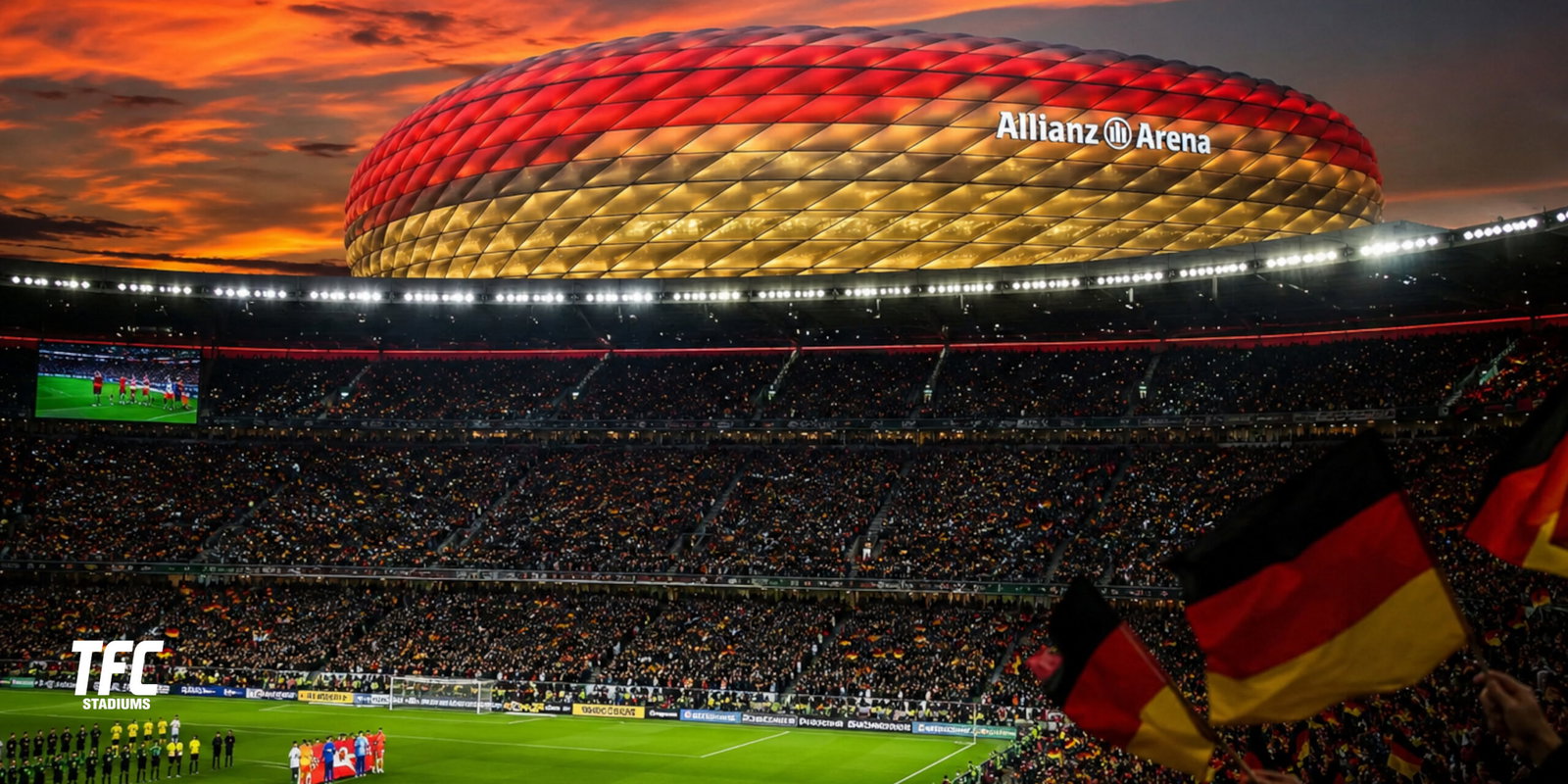
With a capacity of around 75,000 for domestic matches and slightly reduced for UEFA competitions, it combines exceptional sightlines with one of football’s most recognisable exteriors. Those illuminated panels have become almost as famous as the football played inside.
For Germany, Munich offers several advantages.
- Huge football culture
- Excellent transport infrastructure
- Modern facilities
- Passionate crowds
- A city deeply connected with German football
The German Football Association regularly selects Munich for its highest-profile fixtures because the stadium consistently delivers both atmosphere and organisation.
Germany’s Record at Allianz Arena
Germany has played dozens of international matches at Allianz Arena across friendlies, FIFA World Cup games, UEFA European Championship matches and qualification campaigns.
Overall, their record has been impressive.
Key trends include:
| Statistic | Record |
|---|---|
| First international | 2005 |
| Tournament matches hosted | World Cup 2006, Euro 2020, Euro 2024 |
| Typical attendance | 65,000 to 75,000 |
| Most common result | German victory |
| Biggest strength | Strong attacking performances at home |
Historically Germany have won comfortably more matches than they have lost in Munich, making Allianz Arena one of the national team’s happier hunting grounds.
That said, football has a habit of ignoring history whenever it feels like causing drama.
The First Germany Match at Allianz Arena
Germany’s first international at Allianz Arena arrived shortly after the stadium opened.
It immediately showcased everything the venue had been built for.
The acoustics amplified every chant.
The steep stands kept supporters close to the action.
Even television viewers could sense the difference compared with Germany’s older stadiums.
The Allianz Arena had announced itself as a genuine international football venue rather than simply Bayern Munich’s new home.
A Centrepiece of the 2006 FIFA World Cup
If one tournament established Allianz Arena on the world stage, it was the 2006 FIFA World Cup.
Germany hosted several major matches in Munich, including fixtures involving the host nation.
The atmosphere throughout the tournament remains one of the defining memories of modern German football.
Supporters from around the world transformed Munich into a month-long football festival, with fan parks overflowing from morning until well after midnight.
For Germany, the World Cup restored national pride following difficult years on the international stage.
Although eventual champions Italy ended German hopes in that unforgettable semi-final in Dortmund, Munich helped launch the country’s football renaissance.
Euro 2020 in Munich
Although delayed until 2021 because of the pandemic, UEFA Euro 2020 brought another major tournament to Allianz Arena.
Germany played all three group matches there.
The standout occasion came against Portugal.
After opening with defeat to France, Germany produced one of their finest attacking displays in recent years to defeat Portugal 4-2.
It was vintage German tournament football.
Fast transitions.
Relentless pressing.
Constant width.
Clinical finishing.
The victory completely revived Germany’s campaign and reminded Europe that writing off the Mannschaft rarely ends well.
Euro 2024 and Home Expectations
Hosting UEFA Euro 2024 brought enormous anticipation.
Munich again became one of the tournament’s flagship venues, welcoming both Germany matches and knockout football.
The city embraced the competition with characteristic Bavarian enthusiasm.
Beer gardens filled with supporters wearing every conceivable national shirt.
Football conversations became unavoidable.
Even ordering a coffee often turned into tactical analysis.
Germany’s performances reflected a team rebuilding under Julian Nagelsmann, blending experienced leaders with an exciting younger generation.
Memorable Germany Matches at Allianz Arena
Several fixtures stand out above the rest.
Germany 4 Portugal 2
One of Germany’s most complete performances of the modern era.
Attacking football returned, confidence surged and supporters rediscovered belief.
Germany vs France
Whether in tournament football or Nations League competition, Germany versus France rarely disappoints.
Munich has hosted several fiercely contested meetings between Europe’s two traditional heavyweights.
These matches often resemble tactical chess played at sprinting speed.
World Cup Group Stage Matches
Germany’s World Cup fixtures in Munich showcased the optimism of an entire nation during the summer of 2006.
The atmosphere inside Allianz Arena remains among the most celebrated of that tournament.
Bayern Munich’s Influence on the National Team
For decades, Bayern Munich has supplied the backbone of Germany’s national side.
Players including:
- Philipp Lahm
- Bastian Schweinsteiger
- Thomas Müller
- Manuel Neuer
- Joshua Kimmich
- Jamal Musiala
have all represented Germany while calling Allianz Arena home.
That familiarity matters.
International football offers very little preparation time.
Playing major internationals in a stadium where many squad members compete every other week provides a subtle but genuine advantage.
The dressing rooms feel familiar.
The tunnel feels familiar.
Even the bounce of the pitch feels familiar.
Footballers are creatures of habit, perhaps more than they would ever admit publicly.
The Atmosphere During Germany Matches
Bayern supporters generate plenty of noise every weekend.
Germany matches create a different atmosphere altogether.
Instead of one club’s fanbase, supporters travel from every corner of the country.
Families mix with ultras.
Young children attend their first internationals.
Older supporters recall World Cups stretching back half a century.
The result is a crowd that feels distinctly national rather than regional.
When more than 70,000 people sing Deutschlandlied before kick-off, it creates one of international football’s most powerful pre-match moments.
Tactical Trends in Munich
Germany’s home performances at Allianz Arena have often reflected broader tactical eras.
Under Joachim Löw, possession football dominated.
The emphasis centred on technical midfielders controlling games through intelligent movement and patient passing.
More recently, Germany have shifted towards greater intensity, quicker transitions and direct attacking play under Julian Nagelsmann.
The stadium has therefore become a fascinating snapshot of German football’s tactical evolution.
Home Advantage by the Numbers
Germany traditionally enjoys one of Europe’s strongest home records.
Munich contributes significantly to that success.
Several factors help explain why:
- Familiar surroundings
- Excellent playing surface
- Consistently large crowds
- Minimal travel demands
- Strong historical confidence
Sports psychology repeatedly demonstrates that elite athletes often perform better in familiar environments.
International football is no exception.
Famous Goals Scored in Munich
Allianz Arena has seen goals from many of Germany’s modern stars.
Thomas Müller has thrilled supporters with his trademark intelligent movement.
Miroslav Klose added to his remarkable international legacy.
Mario Gómez regularly found the net on his Bayern home ground.
More recently, Jamal Musiala has emerged as one of the stadium’s brightest attractions, combining extraordinary balance with fearless creativity.
Watching him glide through defenders sometimes feels unfair.
If defenders could file formal complaints, they probably would.
Germany’s Biggest Challenges at Allianz Arena
Even football’s strongest home records contain difficult nights.
Germany has experienced painful defeats and frustrating draws in Munich.
Elite international football rarely allows comfortable evenings against Europe’s strongest nations.
Matches against France, England, Spain and Italy frequently become finely balanced tactical contests decided by tiny margins.
That uncertainty is precisely what makes international football so compelling.
Allianz Arena’s Place in German Football History
Nearly twenty years after opening, Allianz Arena has secured its place among Germany’s greatest football venues.
It has hosted:
- FIFA World Cup matches
- UEFA European Championship fixtures
- Nations League games
- World Cup qualifiers
- European Championship qualifiers
- International friendlies
Very few modern stadiums have accumulated such an impressive catalogue of major occasions in such a relatively short period.
Looking Ahead
Germany’s future remains closely tied to Allianz Arena.
As Bayern Munich continues producing elite talent and Munich remains one of Europe’s premier football cities, the stadium is certain to host many more defining international nights.
Future generations may remember Musiala, Florian Wirtz and Germany’s emerging stars in much the same way previous supporters remember Lahm, Schweinsteiger and Müller.
That is how great football venues endure.
The players change.
The tactics evolve.
The floodlights stay exactly where they are.
Takeaway
Allianz Arena has become far more than Bayern Munich’s home. It is now woven into the story of Germany’s national team.
From the optimism of the 2006 World Cup to unforgettable victories over elite opposition and the excitement of hosting another European Championship, Munich has repeatedly provided the stage for defining moments.
Few international venues combine architectural brilliance, passionate support and footballing significance quite like Allianz Arena. For Germany, it represents confidence, expectation and occasionally a little pressure. When the Mannschaft walk out beneath those glowing white panels, the sense of occasion is unmistakable. Whether history favours them on the night is another matter entirely, but few places make international football feel quite so grand.
About the Author