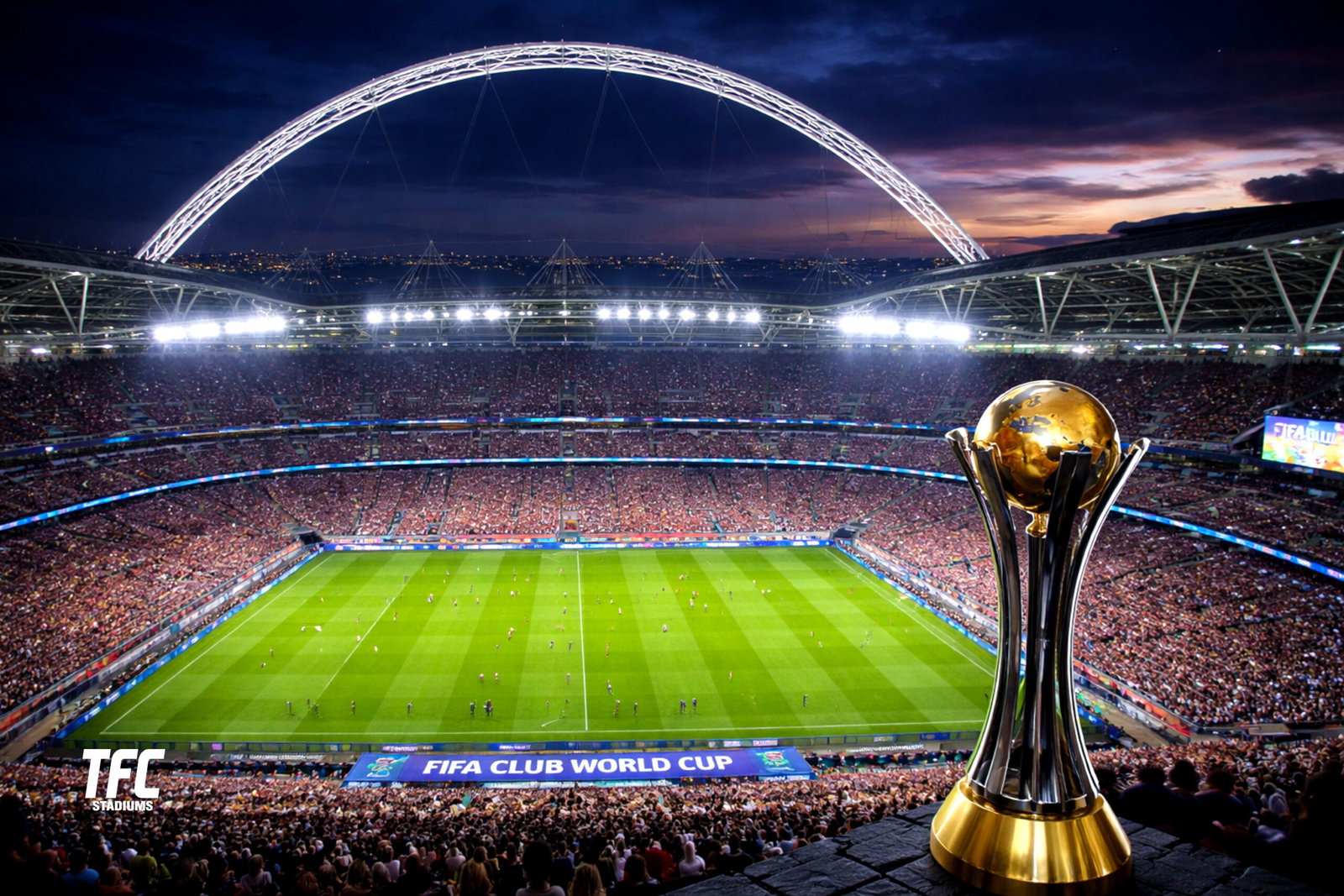
Wembley Stadium sits in a curious place within global football. It is iconic, neutral, commercial, and deeply English all at once. When conversations turn to the FIFA Club World Cup, especially in its expanded modern form, Wembley is never far from the discussion. Sometimes as a serious contender, sometimes as a symbolic option, and sometimes as a reminder of football’s shifting centre of gravity.
This is not a story of tournaments already played under the arch, but of why Wembley keeps being mentioned whenever the Club World Cup looks for scale, prestige, and a global stage.
Wembley’s Global Pull
Few stadiums carry Wembley’s instant recognition. For FIFA, venue choice is about more than capacity or pitch quality. It is about broadcast appeal, sponsorship confidence, and the ability to sell an event as something bigger than the matches themselves.
Wembley offers all of that. A 90,000 seat capacity, proven experience hosting international finals, and infrastructure designed for global media operations make it an obvious candidate whenever FIFA explores hosting options outside traditional football regions. London’s transport links, hotel capacity, and commercial reach only strengthen that appeal.
For a competition like the Club World Cup, which has long wrestled with visibility and prestige outside South America, Wembley represents instant legitimacy.
The Club World Cup’s Changing Identity
The Club World Cup has rarely stood still. It has shifted formats, schedules, and ambitions, moving from a short invitational event to a proposed global tournament designed to rival the Champions League in scale.
As the competition expanded, so did the list of potential hosts. FIFA’s vision leaned towards neutral venues with strong commercial markets rather than purely football driven locations. That shift naturally brought cities like London into the conversation.
Wembley’s appeal fits neatly with this newer identity. It is less about local club loyalty and more about presenting football as a global entertainment product. In that sense, Wembley aligns perfectly with the modern Club World Cup, even if it clashes slightly with traditional fan instincts.
Why Wembley Has Never Hosted It
Despite the logic, Wembley has never staged a Club World Cup final or tournament. Timing plays a major role. The stadium calendar is crowded with domestic finals, internationals, concerts, and NFL games. Finding space for a multi week FIFA tournament has never been simple.
There is also politics. England’s clubs compete fiercely in European competitions, and hosting a Club World Cup at Wembley raises awkward questions about neutrality, ticket allocation, and domestic priorities. FIFA has often preferred hosts where it can exert more direct control over scheduling and commercial terms.
Finally, there is the question of atmosphere. Wembley can feel electric for finals, but early round neutral fixtures risk looking sparse on television. That is something FIFA is keenly aware of.
The Expanded Club World Cup and Renewed Interest
The announcement of a larger Club World Cup brought Wembley back into focus. A tournament featuring elite clubs from Europe, South America, and beyond demands stadiums that feel appropriately grand. Wembley ticks that box immediately.
London also offers something increasingly valuable, global tourism appeal. Fans travelling from multiple continents are more likely to commit to a trip that includes one of the world’s most recognisable cities. From FIFA’s perspective, that matters as much as local football culture.
While the United States has emerged as a favoured host for commercial reasons, Wembley remains a credible alternative or partner venue should FIFA push the competition deeper into Europe in future editions.
What It Would Mean for English Football
Hosting the Club World Cup at Wembley would be a double edged sword. On one hand, it reinforces England’s place at the heart of the global game, even without a domestic club playing under the arch. It would bring attention, revenue, and a rare chance for fans to see elite non European clubs on English soil.
On the other, it risks reinforcing the idea of Wembley as a corporate venue rather than a national home. English supporters are protective of the stadium’s identity, and a FIFA run club tournament could feel distant from domestic traditions.
That tension is part of why the idea remains compelling and controversial in equal measure.
The Likely Future
Wembley and the Club World Cup feel destined to intersect at some point, even if the timing has never quite aligned. As FIFA continues to reshape the tournament and chase global audiences, neutral super stadiums will only grow in importance.
Whether as a final venue, a showcase host, or part of a multi country European edition, Wembley remains on the shortlist. It may not need the Club World Cup to reinforce its status, but the competition could certainly benefit from the weight of history and spectacle that comes with football under the arch.
For now, it remains an idea that refuses to go away. In modern football, that usually means it is only a matter of time.
About the Author