Penalty shootouts at Wembley rarely feel normal. Even neutral fans somehow end up gripping the sofa like they are about to take the fifth kick themselves. The place has a strange gravity to it. A missed penalty there does not just feel like a missed penalty. It becomes part of football folklore within minutes.
Some stadiums are loud. Some are historic. Wembley manages to be theatrical. That matters when a game reaches the most psychologically brutal ending football has invented.
Why Wembley Feels Different
Modern Wembley opened in 2007, replacing the old Twin Towers stadium that had already built decades of football mythology. The new version is larger, louder, and architecturally cleaner, but the emotional weight never disappeared.
With a capacity of around 90,000, it remains one of the biggest football venues in Europe. Finals played there already carry enormous pressure before penalties even arrive. Add exhaustion, noise, expectation, and national narratives, and players are suddenly trying to place a football into a net while millions of people silently prepare to judge them forever.
That sounds dramatic. Because it is.
The long walk from the centre circle to the penalty spot at Wembley genuinely looks longer on television than almost anywhere else. Sports psychologists have spoken for years about “spotlight pressure”, where athletes become hyper-aware of the moment itself. Wembley amplifies that feeling.
You are not just taking a penalty. You are taking a penalty at Wembley.
England’s Complicated Relationship With Wembley Shootouts
For England supporters, Wembley and penalty shootouts are tied together with equal parts hope and dread.
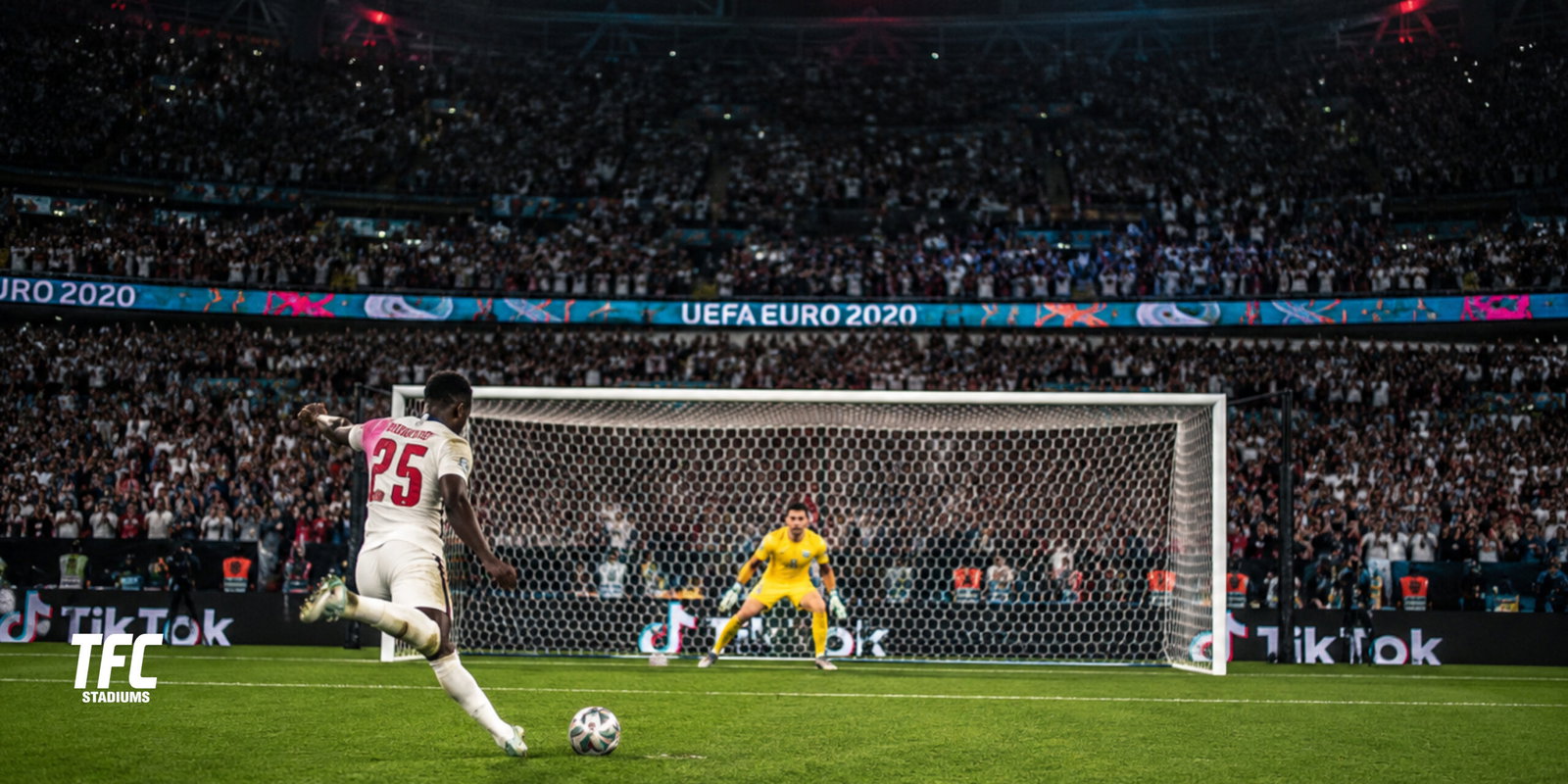
The most famous example remains the UEFA Euro 2020 final against Italy, played at Wembley in July 2021 after the tournament delay. England led early through Luke Shaw before the match drifted into a tense stalemate. The shootout defeat that followed became another painful chapter in the national story.
The visual memory remains vivid. Gianluigi Donnarumma spreading himself wide. Bukayo Saka’s run-up. The silence after the save. Wembley suddenly feeling enormous and empty at the same time.
England’s penalty record across major tournaments has improved somewhat in recent years, particularly after the 2018 World Cup win over Colombia, but Wembley still carries emotional baggage from decades of near misses.
Fans often joke that England supporters enter penalty shootouts already emotionally preparing for disaster. Gallows humour is practically part of the pre-match ritual at this point.
Famous Wembley Penalty Shootouts
Euro 2020 Final, Italy vs England
Possibly the most emotionally charged shootout Wembley has hosted in the modern era.
England were one kick away from ending decades of hurt. Instead, Italy completed the turnaround and silenced the stadium. The aftermath became a defining football moment across Europe.
Key details:
| Category | Detail |
|---|---|
| Competition | UEFA Euro 2020 Final |
| Date | 11 July 2021 |
| Venue | Wembley Stadium |
| Result | Italy won 3-2 on penalties |
| Attendance | Around 67,000 due to restrictions |
| Defining moment | Donnarumma saving Saka’s penalty |
Chelsea vs Bayern Munich, 2012 Champions League Final
Technically not a Wembley shootout involving England, but certainly one of the most dramatic.
Chelsea survived wave after wave of Bayern pressure before dragging the match into penalties. Didier Drogba converted the winning kick after previously conceding a late penalty in extra time. Typical Drogba really, chaotic and heroic in equal measure.
For Chelsea supporters, Wembley became a place of redemption and immortality in the same night.
FA Cup Final Shootouts
Wembley has hosted numerous domestic cup finals settled by penalties, including League Cup and FA Trophy finals. These often lack the global spotlight of international football but can be equally tense.
One interesting pattern is how often supposedly “smaller” clubs appear calmer during shootouts. Underdogs frequently play with less psychological burden, while favourites tighten up under expectation.
Football history is full of technically superior teams suddenly forgetting how to strike a stationary ball.
The Numbers Behind Wembley Shootouts
Penalty shootouts are often described as lotteries. The data suggests otherwise.
Studies across professional football consistently show patterns:
| Factor | General Trend |
|---|---|
| Teams kicking first | Win more often |
| Confident body language | Correlates with conversion rates |
| Delayed run-ups | Slightly lower success rates |
| Goalkeepers moving early | Increases save potential but risks retakes |
| Younger players | Often face heavier pressure in decisive kicks |
At Wembley specifically, the pressure environment seems to exaggerate emotional swings.
Large crowds and major finals create sharper momentum changes during shootouts. One save can completely alter crowd energy within seconds. Players absolutely notice that.
There is also the visual element. Wembley’s steep stands and enclosed bowl design create a wall of sound behind the goal. During shootouts, that atmosphere becomes almost claustrophobic.
Some players thrive on it. Others visibly shrink.
Why Wembley Shootouts Produce So Many Iconic Images
Certain stadiums create memorable photographs almost by accident. Wembley specialises in them.
Partly, it is the scale. Partly, the lighting. Partly, the sheer emotional contrast between ecstasy and devastation. Penalty shootouts compress football emotion into tiny bursts.
One frame can define careers.
Think about these images:
- A goalkeeper sprawling across the goalmouth
- Players unable to watch from the halfway line
- Fans with hands over faces
- One player sprinting away in celebration while another collapses
Wembley gives those moments a cinematic quality that television directors absolutely love. Occasionally too much. There is always one dramatic slow-motion replay that feels like it belongs in a Christopher Nolan film.
The Psychology of Taking a Penalty at Wembley
The mental side matters more than supporters often realise.
Elite players rehearse penalties constantly, yet shootouts remain wildly unpredictable because pressure alters decision-making. Heart rate increases. Focus narrows. Muscle tension changes.
At Wembley, players are also carrying historical weight.
England internationals know they are stepping into decades of narrative. Club players know highlights from Wembley finals will follow them forever. Miss there, and the clip lives online indefinitely. Modern footballers do not just fear failure. They fear becoming a meme.
That sounds superficial until you remember how online football culture works. One missed penalty can generate jokes for years.
Managers increasingly prepare for this through sports psychology, rehearsal routines, and pre-selected penalty orders. Some even analyse preferred goalkeeper movement patterns in advance.
Still, once the whistle blows, much of it comes down to nerve.
And nerve is difficult to quantify.
Wembley’s Reputation Among Players
Many former players describe Wembley as uniquely intimidating.
Not necessarily hostile, just immense. The scale of the occasion feels unavoidable. At smaller grounds, players can sometimes mentally detach from the crowd. Wembley makes that almost impossible.
Yet plenty of footballers also describe it as addictive.
Scoring the winning penalty there places players into football history immediately. Those moments replay for decades across highlight reels, documentaries, and pub conversations.
For every player haunted by Wembley, another becomes immortal because of it.
Will Wembley Continue Producing Penalty Drama?
Almost certainly.
The stadium remains central to English football and European finals. Major tournaments, domestic cups, playoff finals, and showpiece matches will keep returning there.
As football becomes more data-driven and tactically refined, penalties may actually become even more important. Tight matches between elite sides increasingly come down to tiny margins.
Which means Wembley will continue hosting football’s strangest emotional ritual. Twenty-two exhausted professionals watching one player stand alone from twelve yards.
Simple in theory. Completely terrifying in practice.
TFC Takeaway
Wembley and penalty shootouts feel inseparable because both are built around pressure. The stadium magnifies expectation, and shootouts expose nerves like nothing else in football.
That combination creates unforgettable theatre.
Supporters remember where they were for famous Wembley penalties because the emotional swings are so extreme. One kick creates legends. Another creates years of regret. Occasionally both happen in the same shootout.
Football probably should not be decided this way. Yet nobody can look away when it happens.
Which is why Wembley under floodlights, during a penalty shootout, remains one of the most gripping sights in sport.
About the Author