For decades, Valencia CF supporters have lived in a strange footballing limbo. Every season begins with excitement on the pitch and another round of questions off it. Will this finally be the year Nou Mestalla opens? Will the club really leave the famous old Mestalla? Or will one of Europe’s longest-running stadium sagas somehow find another twist?
It is a story that has everything. Ambitious planning, financial collapse, changing ownership, political involvement and one unfinished concrete shell that became an unlikely landmark on Valencia’s skyline.
Now, after years of uncertainty, the project is moving again. Construction has restarted, deadlines have been set and there is genuine momentum behind what could become one of Spain’s most modern football venues.
The challenge is obvious. Replacing an iconic stadium is never simply about pouring concrete. It is about preserving identity while building for the future.
Why Mestalla Still Matters
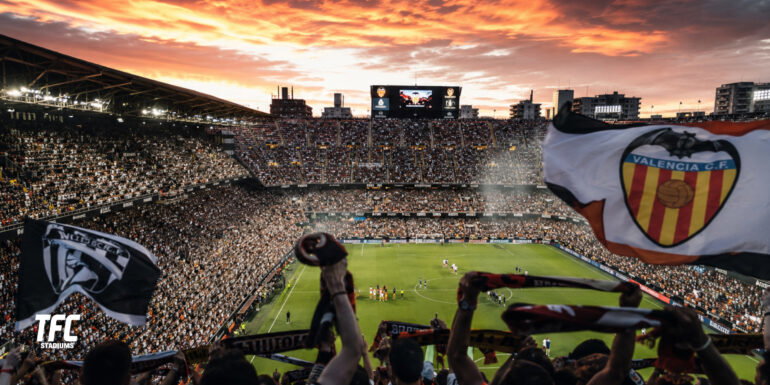
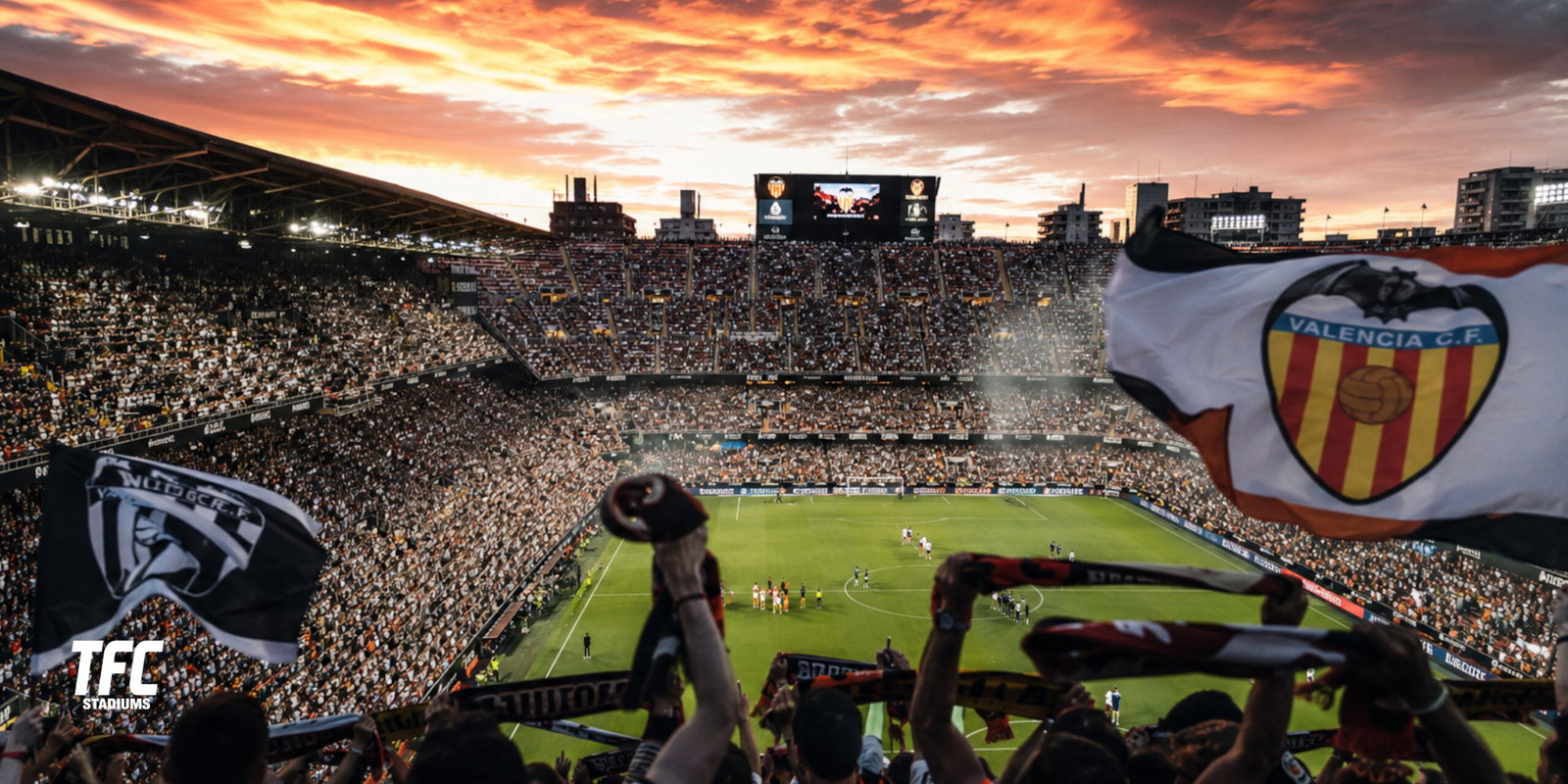
Opened in 1923, Mestalla remains one of European football’s most distinctive stadiums.
Its steep stands create one of the most intimidating atmospheres in La Liga. Visiting supporters often describe the sensation of being almost on top of the pitch, while television cameras struggle to capture just how vertical parts of the stadium really are.
With a capacity of around 49,000, Mestalla has hosted:
- Valencia CF home matches for more than a century
- FIFA World Cup fixtures in 1982
- Major international matches for Spain
- Copa del Rey finals
- Champions League nights against Europe’s elite
Unlike many modern stadiums, it has grown organically across generations. Every renovation solved one problem while creating another, resulting in a wonderfully irregular structure that somehow still works.
That uniqueness is precisely what makes replacing it so emotionally difficult.
Why Valencia Wanted a New Stadium
By the early 2000s, club officials recognised that Mestalla was becoming increasingly difficult to modernise.
Several challenges had become impossible to ignore.
Limited commercial revenue
Modern football clubs rely heavily on hospitality, premium seating and corporate facilities.
Mestalla simply cannot compete with newer venues.
Many European clubs now generate tens of millions of euros annually from non-matchday income. Valencia have consistently lagged behind rivals because of ageing infrastructure.
Restricted expansion
The stadium is surrounded by dense urban development.
There is very little room to:
- Add hospitality areas
- Expand concourses
- Improve vehicle access
- Create larger fan zones
Every improvement became more expensive than the last.
Modern safety and accessibility
Although regularly updated, Mestalla reflects design standards from another era.
Contemporary stadiums provide:
- Wider circulation routes
- Better accessibility
- More family facilities
- Improved hospitality
- Larger retail spaces
These are now standard expectations rather than luxury additions.
The Original Vision for Nou Mestalla
When plans were announced in 2006, Nou Mestalla looked set to become one of Europe’s most impressive football stadiums.
The project promised:
| Feature | Planned Design |
|---|---|
| Capacity | Approximately 70,000 seats (later revised downward) |
| Roof | Full modern roof coverage |
| Hospitality | Extensive premium seating and corporate facilities |
| Commercial Space | Retail and entertainment areas |
| UEFA Standards | Suitable for major international tournaments |
The design reflected football’s booming economy during the mid-2000s.
Then the global financial crisis arrived.
The Financial Collapse That Changed Everything
Few stadium projects were hit harder than Nou Mestalla.
Construction began in 2007.
By 2009 it had effectively stopped.
The reasons were brutally simple.
Valencia CF planned to finance much of the project by selling the valuable city-centre land occupied by Mestalla.
When Spain’s property market collapsed during the financial crisis, land values fell dramatically.
The club suddenly faced enormous debt while the expected funding disappeared almost overnight.
Construction stopped with only the concrete framework completed.
For years, the unfinished stadium became one of the country’s most recognisable symbols of Spain’s property crash.
More Than a Decade of Uncertainty
What followed frustrated nearly everyone connected with the club.
Over the next fifteen years there were:
- Revised architectural designs
- Capacity reductions
- Financing negotiations
- Ownership disputes
- Political disagreements
- City council negotiations
- Multiple projected completion dates
Supporters understandably became sceptical whenever another announcement appeared.
The joke around Valencia was simple.
Nou Mestalla always seemed to be opening “in a few years.”
It became football’s equivalent of that home renovation everyone promises to finish next summer.
Peter Lim and the Stadium Debate
When Peter Lim purchased Valencia CF in 2014, many expected Nou Mestalla to be completed relatively quickly.
Instead, progress remained painfully slow.
Criticism centred on several issues:
- Delayed investment
- Financial priorities
- Project uncertainty
- Communication with supporters
The stadium became symbolic of wider frustrations surrounding the ownership.
For many fans, Nou Mestalla stopped being just a construction project.
It became a measure of the club’s ambition.
Why Construction Has Finally Restarted
Recent agreements between Valencia CF and local authorities have transformed the outlook.
The club committed to revised construction schedules and updated stadium specifications that meet modern UEFA expectations.
Several factors have aligned.
Improved financial planning
The revised project is considerably more realistic than the original proposal.
Costs have been controlled while maintaining modern standards.
Political cooperation
Years of negotiations with Valencia City Council have produced agreements allowing construction to move forward.
Without that cooperation, progress would have remained difficult.
Commercial necessity
Football economics have continued evolving.
Valencia increasingly need higher matchday revenue if they hope to compete financially with Spain’s leading clubs.
Remaining at Mestalla indefinitely limits that potential.
What Will Nou Mestalla Look Like?
The final stadium will differ from the ambitious 2006 concept.
Current plans focus on efficiency rather than extravagance.
Expected features include:
- Around 70,000 or fewer seats depending on the final configuration
- Improved hospitality facilities
- Large commercial areas
- Modern media infrastructure
- Enhanced accessibility
- Energy-efficient systems
- UEFA Category 4 standards
The emphasis has shifted from architectural spectacle towards long-term sustainability.
That is probably a healthier approach.
Football has produced enough expensive monuments that struggle to pay their own bills.
How Much Difference Could It Make Financially?
The commercial impact could be enormous.
Modern European stadiums generate revenue in ways older venues simply cannot.
Potential improvements include:
| Revenue Source | Potential Impact |
|---|---|
| Premium seating | Significant increase |
| Corporate hospitality | Major growth |
| Conferences | Year-round income |
| Concerts | Additional event revenue |
| Retail | Larger club store sales |
| Food and beverage | Higher per-visitor spending |
For comparison, leading European clubs increasingly operate their stadiums almost every week of the year rather than only on matchdays.
That model creates far more stable income.
What Happens to Historic Mestalla?
This remains one of the biggest emotional questions.
Once Valencia move, the current Mestalla site is expected to be redeveloped for mixed urban use, helping to finance the new stadium and reshape part of the city.
That inevitably creates mixed emotions.
Supporters understand the financial logic.
They also know that once the stadium disappears, an irreplaceable part of football history disappears with it.
Countless memories cannot simply be transferred to another postcode.
Can Nou Mestalla Recreate the Atmosphere?
This is the question every supporter secretly worries about.
Modern stadiums often offer greater comfort but less personality.
Mestalla’s steep seating and close proximity to the pitch create natural intensity.
Architects have attempted to preserve that atmosphere through seating design and stand angles.
Whether they succeed depends less on concrete than on supporters themselves.
Fans create atmosphere.
Buildings merely amplify it.
What It Means for Valencia CF’s Future
Completing Nou Mestalla represents far more than changing stadiums.
It affects nearly every aspect of the club.
Potential long-term benefits include:
- Higher commercial income
- Improved sponsorship opportunities
- Better facilities for players
- Increased attractiveness for international events
- Enhanced supporter experience
- Greater financial competitiveness
For a club with six La Liga titles and a proud European history, those advantages could prove essential.
Spanish football has become increasingly polarised financially.
Without infrastructure capable of generating modern revenue, closing the gap on Europe’s biggest clubs becomes increasingly difficult.
Could Nou Mestalla Host Major International Events?
Once completed, the stadium should become a serious contender for elite football events.
Possible future hosts include:
- Spain international matches
- UEFA Champions League finals
- Europa League finals
- Copa del Rey finals
- FIFA tournament matches
- UEFA European Championship fixtures
Its size and modern facilities make it one of Spain’s strongest candidates for prestigious events.
That would also provide a significant economic boost for Valencia itself.
TFC Takeaway
The story of Nou Mestalla has become one of football’s longest-running construction projects, stretching across financial crises, ownership changes and years of uncertainty. For a while, it felt less like a stadium development and more like a permanent feature of Valencia’s skyline.
Now there is genuine optimism that the club will finally complete the move.
The real challenge begins after the ribbon is cut.
A stadium can provide better revenue, improved facilities and a stronger commercial future, but it cannot manufacture history. That takes decades of unforgettable nights, famous victories and generations of supporters passing traditions from parent to child.
Mestalla earned its reputation over more than a century. Nou Mestalla will have to do the same.
If Valencia CF can combine modern financial strength with the passion that has always defined the club, the long wait may eventually be remembered not as a failure, but as the painful first chapter in the next era of one of Spain’s great football institutions.
About the Author