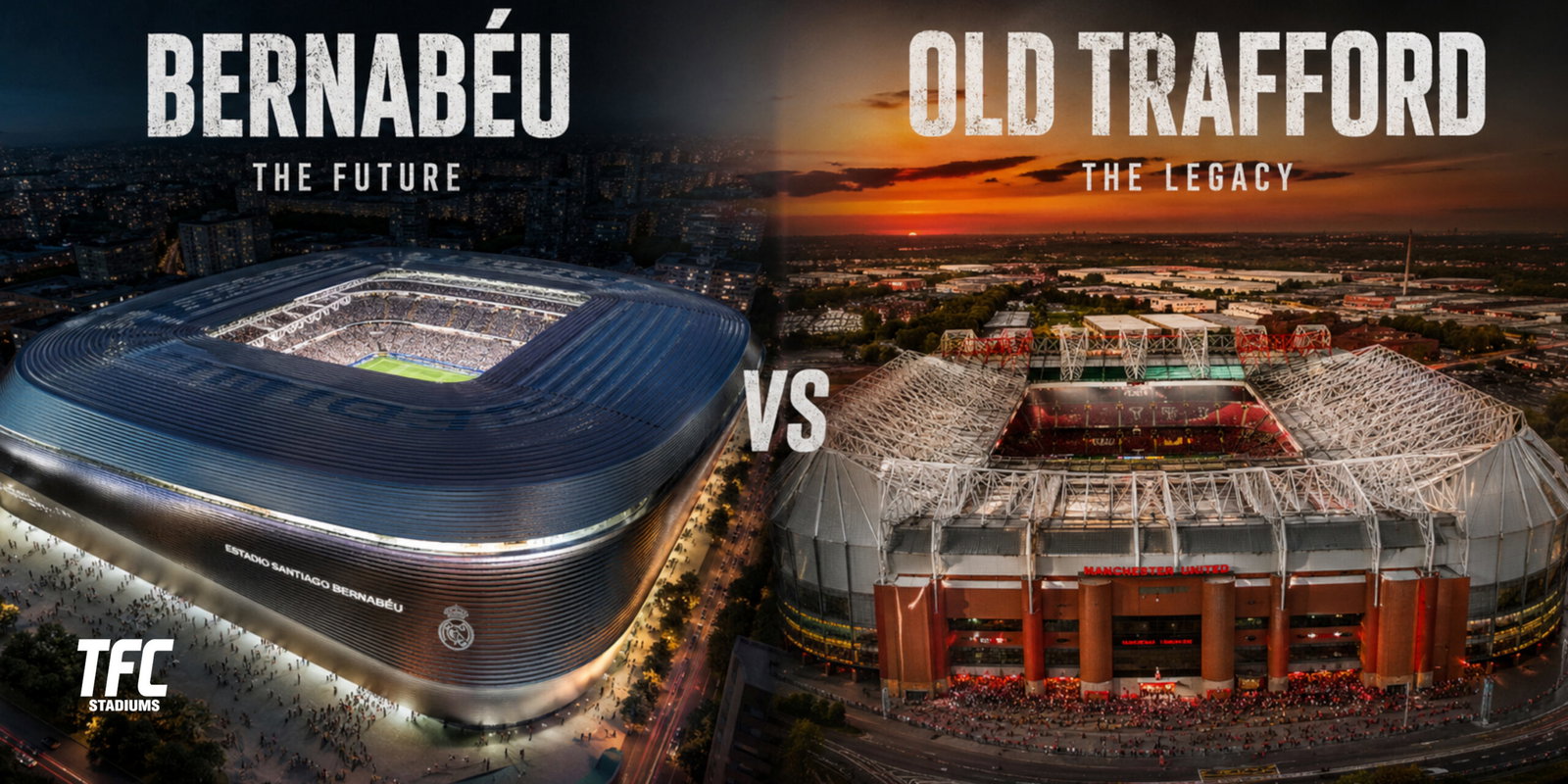
There are football stadiums, and then there are places that feel like they’ve watched the sport grow up.
The Santiago Bernabéu Stadium and Old Trafford sit comfortably in that second category. Both are loaded with history, expectation and just enough arrogance to make visiting teams uneasy before kick off.
Yet they are not twins. One has embraced the future with unapologetic ambition. The other still leans heavily on its past, sometimes to its own frustration. Comparing them reveals as much about their clubs as it does about the buildings themselves.
History and Identity
The Bernabéu opened in 1947, born out of Santiago Bernabéu’s vision of a club that would dominate Europe rather than simply compete in Spain. Expansion came quickly, and by the 1950s it was already hosting European Cup nights that felt larger than life.
Old Trafford is older, opening in 1910, though its story is interrupted by destruction during the Second World War. Rebuilt and reshaped, it became the symbolic home of Manchester United’s rise under Matt Busby and later Alex Ferguson.
The key difference lies in narrative. The Bernabéu reflects sustained dominance. Old Trafford reflects resilience and reinvention, sometimes messy, often emotional.
Capacity and Scale
Both stadiums sit among the largest in European football, though their approaches to scale differ.
Santiago Bernabéu
- Approximate capacity, 85,000 after renovation
- Designed for flexibility, including retractable pitch and roof
- Premium seating and hospitality heavily expanded
Old Trafford
- Capacity, just over 74,000
- Largest club stadium in England
- Expansion constrained by surrounding infrastructure, especially the railway line
The Bernabéu feels engineered for growth and spectacle. Old Trafford feels stretched to its limits, impressive but occasionally creaking.
Architecture and Design Philosophy
Madrid has gone all in on reinvention. The Bernabéu now looks like a statement piece, wrapped in a metallic skin that shifts with light and time of day. Inside, it is built for events beyond football, concerts, NFL games, even esports.
Old Trafford remains more traditional. Its asymmetrical stands and visible structure give it character, though not always elegance. The Stretford End still feels like the emotional core rather than an architectural showpiece.
One is trying to become the future of stadium design. The other is trying not to lose its soul while catching up.
Atmosphere and Matchday Experience
Atmosphere is where things get subjective, and occasionally heated.
The Bernabéu can feel controlled, almost expectant. The crowd demands excellence and reacts sharply to it. On major European nights, it transforms into something far more intense, a pressure cooker with a sense of inevitability.
Old Trafford has a different rhythm. At its best, particularly when the Stretford End is engaged, it carries a rolling, vocal energy that builds rather than explodes. At its worst, it can go quiet in ways that frustrate supporters.
In simple terms, Madrid’s crowd judges. Manchester’s crowd believes, sometimes against evidence.
Modernisation and Future Direction
This is where the gap becomes impossible to ignore.
Real Madrid have turned the Bernabéu into a multi purpose venue expected to generate year round revenue. The retractable pitch alone allows non football events without damaging the playing surface. It is a business move as much as an architectural one.
Old Trafford’s future remains uncertain. Talk of redevelopment or even a new stadium has been ongoing for years. Investment has not matched ambition, and it shows in areas like concourses, roofing leaks and general infrastructure wear.
One club has acted decisively. The other is still deciding.
Data Comparison Snapshot
| Feature | Santiago Bernabéu | Old Trafford |
|---|---|---|
| Opened | 1947 | 1910 |
| Capacity | ~85,000 | ~74,000 |
| Major Renovation | Completed 2020s | Partial, ongoing discussions |
| Roof | Retractable | Partial cover |
| Pitch System | Retractable | Fixed |
| Primary Use | Multi event venue | Football focused |
Cultural Impact
Both stadiums carry weight beyond football.
The Bernabéu is tied to the global brand of Real Madrid, a club that measures success in European Cups. It represents power, expectation and a certain cold confidence.
Old Trafford is tied to the identity of Manchester itself. It reflects working class roots, global popularity and the complicated legacy of a club that has seen both dominance and decline.
If Madrid feels like a throne, Old Trafford feels like a home that has seen better days but still refuses to be ignored.
Verdict
Choosing between them depends on what you value.
If you want cutting edge design, commercial ambition and a stadium built for the next fifty years, the Bernabéu is comfortably ahead.
If you want history you can feel in the concrete, imperfect but authentic, Old Trafford still has a pull that is hard to replicate.
One is evolving into something new. The other is holding onto something old. Both, in their own way, remain essential to football.
About the Author