Camp Nou before Messi arrived
Camp Nou was already a giant long before Lionel Messi took his first steps on the pitch. Opened in 1957, it was built for scale, authority, and spectacle. By the early 2000s it held just under 100,000 supporters and carried decades of European pedigree, from Cruyff’s Dream Team to Rivaldo’s overhead kicks.
What it lacked in the early 2000s was consistency. Barcelona were successful but uneven, brilliant one season and fragile the next. The stadium felt imposing, but not yet inevitable.
That changed very quickly.
A stadium shaped around one player
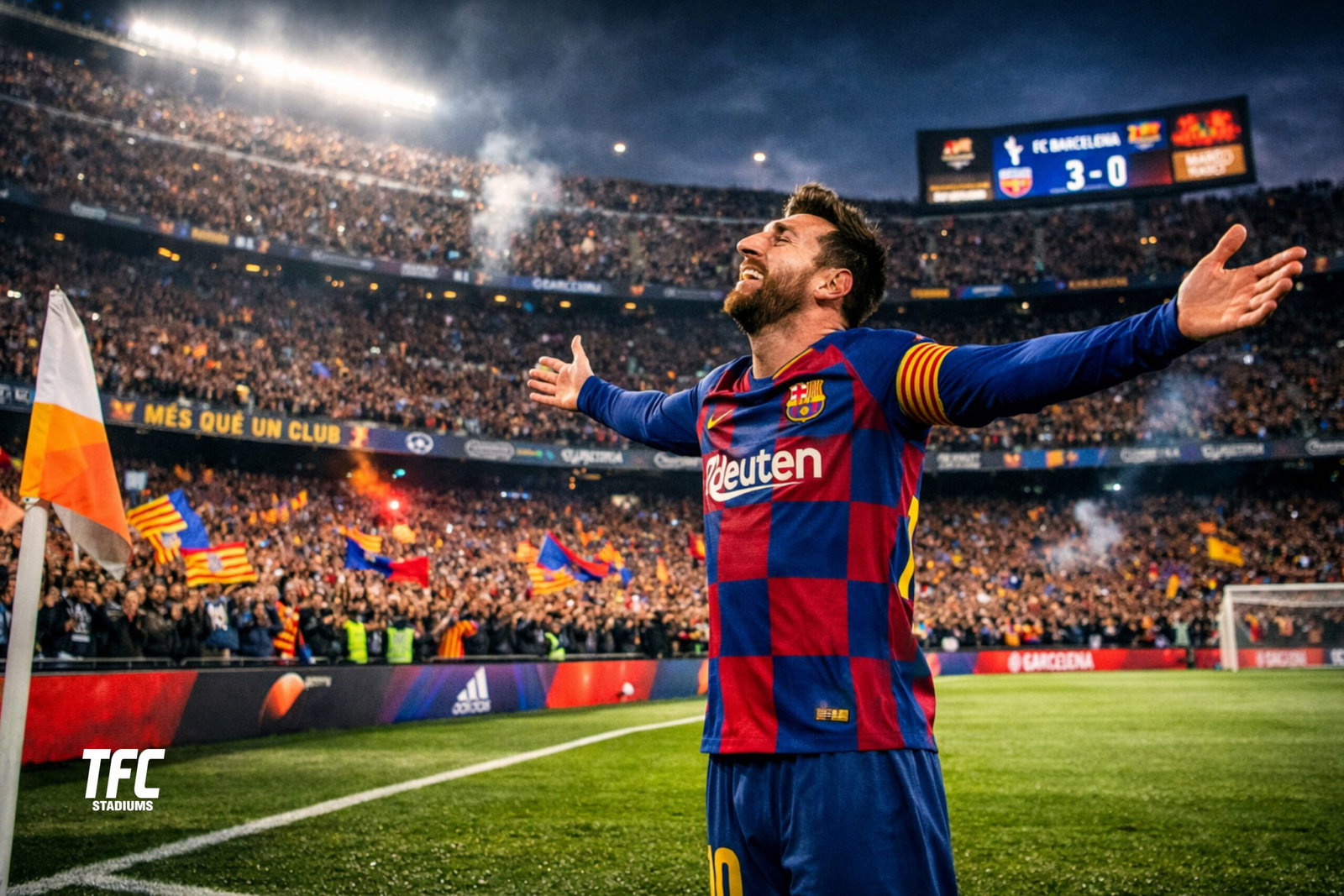
Messi made his senior debut at Camp Nou in October 2004. Over the next seventeen seasons, the ground became the setting for his peak years and his most ruthless football.
Key Camp Nou Messi numbers tell the story clearly:
• Home appearances for Barcelona, over 520
• Goals scored at Camp Nou, approximately 670 across all competitions
• Hat tricks at the stadium, more than 30
• Seasons with 30 or more home goals, 10
• Home goals per game average, roughly 1.3
Camp Nou was not just where Messi played most often. It was where he played best. The pitch dimensions suited his movement, the crowd understood his pauses, and opponents arrived already half beaten.
Big nights and bigger numbers
If league matches turned Camp Nou into a weekly points factory, European nights turned it into a theatre.
Between 2009 and 2019, Barcelona won roughly 72 percent of their Champions League home matches at Camp Nou. During that period:
• Average home goals per Champions League game, 2.6
• Home defeats in Europe across ten seasons, fewer than 15
• Clean sheets at home in Europe, over 40
Matches like Barcelona 4 Arsenal 1, Barcelona 5 Bayer Leverkusen 0, and Barcelona 3 Bayern Munich 0 were not exceptions. They were patterns.
Messi scored more Champions League goals at Camp Nou than any player has scored at a single stadium in the competition’s history.
That is not romance. That is math.
El Clásico, with an audience
Camp Nou hosted more than 25 El Clásicos during Messi’s senior career. Against Real Madrid at home, Messi delivered:
• 15 goals
• 8 assists
• Multiple match winning performances
• Several moments that ended careers or started memes
Barcelona lost some Clásicos at home, but the emotional balance tilted heavily in their favour. When Messi scored at Camp Nou against Madrid, the stadium did not erupt instantly. There was often a half second of silence, as if everyone needed to confirm what they had just seen.
Then it landed.
The crowd factor
Camp Nou during the Messi era averaged between 85,000 and 92,000 spectators per match across competitions. High profile league games and European knockouts regularly pushed past 95,000.
More important than raw attendance was rhythm. The crowd learned Messi’s game. They did not panic when he slowed. They did not demand crosses when he carried the ball inside. Camp Nou crowds were patient, and that patience fed his style.
Opponents noticed it too. Many managers spoke openly about Camp Nou feeling quieter than other grounds, but heavier. The pressure was not noise. It was inevitability.
Trophies lifted at home
Messi’s Barcelona won 10 La Liga titles, 4 Champions Leagues, and 7 Copa del Rey trophies during his first team career.
At Camp Nou, supporters watched:
• Multiple league title celebrations
• Three Champions League semi final triumphs
• Domestic trebles in 2009 and 2015
• Record breaking seasons in goals and points
Camp Nou did not host every final, but it hosted the process. Week after week, it supplied the wins that made those trophies possible.
When the magic faded
The later Messi years showed a subtle shift. Barcelona still dominated possession, but European collapses away from home exposed how much Camp Nou had been carrying the team.
From 2017 onward, the contrast became stark:
• Near perfect home performances
• Repeated heavy defeats away in Europe
• Increasing reliance on Messi to rescue games
Camp Nou remained strong, but it could no longer disguise structural problems. When Messi left in 2021, the stadium felt suddenly large and oddly quiet.
That absence said everything.
Camp Nou’s legacy in the Messi era
Some stadiums host legends. Camp Nou and Messi formed something closer to a partnership.
The data backs it up. The trophies confirm it. The memories do the rest.
When future renovations are finished and new generations fill the seats, Camp Nou will still be Camp Nou. But the version shaped between 2004 and 2021 stands apart. A stadium where one player turned home advantage into something approaching certainty.
Football rarely offers that kind of alignment again.
About the Author