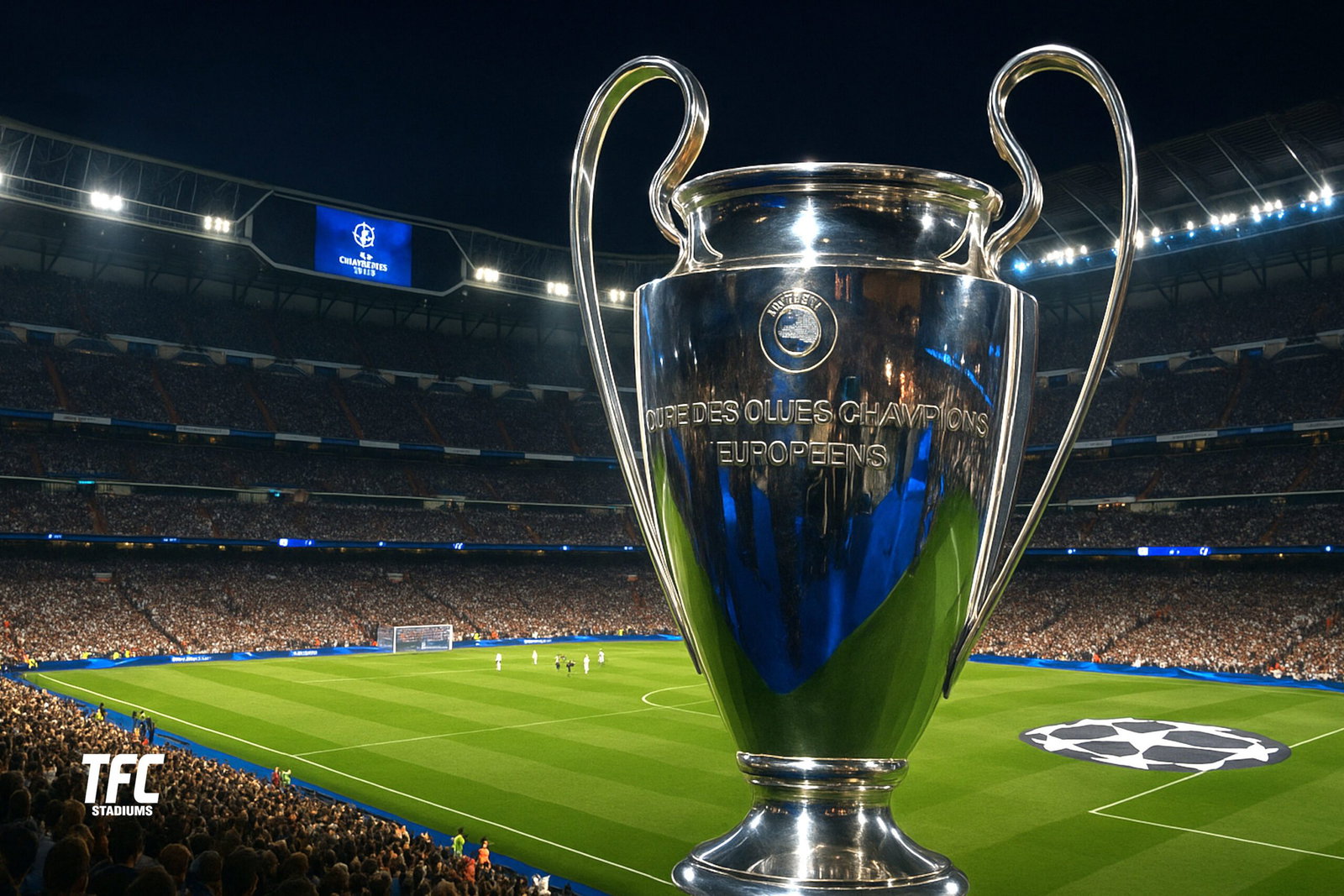
Few stadiums in the world have hosted as many defining moments in European football as the Santiago Bernabéu. Home to Real Madrid, the club that built its reputation on continental dominance, this stadium has witnessed four European Cup and Champions League finals. Each one tells a story not just of triumph and heartbreak, but of eras, legends, and shifting power in world football.
1957 – Real Madrid vs Fiorentina (2–0)
The Bernabéu’s first final was a celebration of its own. Real Madrid, chasing a second consecutive European Cup, defeated Fiorentina before a raucous home crowd of over 120,000. Alfredo Di Stéfano and Paco Gento scored the goals that sealed Madrid’s supremacy in the competition they would come to define.
It was more than a victory. It was the match that cemented the Bernabéu as the heart of European football’s golden age.
1969 – Milan vs Ajax (4–1)
By the late 1960s, European football was changing, and this final marked a turning point. Milan, led by Pierino Prati’s stunning hat-trick, outclassed a young Ajax side featuring a certain Johan Cruyff. It was a clash of eras: the old tactical rigidity of Italy’s catenaccio system against the rising tide of Dutch Total Football.
The Bernabéu that night was a theatre of evolution, hosting the dawn of a new football philosophy that would soon dominate Europe.
1980 – Nottingham Forest vs Hamburg (1–0)
In one of football’s most curious dynasties, Nottingham Forest lifted their second straight European Cup under the mercurial Brian Clough. Against Hamburg, John Robertson’s precise strike was enough to seal victory.
For Clough’s modest English side, to win twice on the grandest stage at the Bernabéu was a defiance of football hierarchy itself. For the neutral, it was proof that the Bernabéu could elevate underdogs as easily as it celebrated giants.
2010 – Inter Milan vs Bayern Munich (2–0)
After thirty years, the Bernabéu returned to the European spotlight. José Mourinho’s Inter Milan, playing with tactical perfection, outmanoeuvred Bayern Munich. Diego Milito scored both goals in a masterclass of composure and efficiency.
It was more than just a win; it was Mourinho’s crowning moment before his own move to Madrid. For Inter, it was the night of the treble. For the Bernabéu, it was another chapter of destiny written under its lights.
The Bernabéu Legacy in Europe
The Santiago Bernabéu’s relationship with the European Cup is symbiotic. It is not merely a host venue but a symbol of what the competition represents: ambition, drama, and continental prestige.
Every final held there has carried its own weight in football history, from Di Stéfano’s supremacy to Mourinho’s tactical artistry. And with the stadium’s modern renovation nearing completion, few doubt it will host more nights like these.
Why the Bernabéu Matters
- Location: Central Madrid, steeped in history and accessibility.
- Atmosphere: A fusion of Spanish passion and European grandeur.
- Pedigree: Home to the most successful club in the competition’s history.
- Legacy: Each final has mirrored a turning point in football’s evolution.
Looking Ahead
As UEFA rotates its final venues across Europe, the renovated Santiago Bernabéu stands ready for its next act. With a retractable roof, cutting-edge lighting, and upgraded seating, it’s now as futuristic as it is iconic.
About the Author