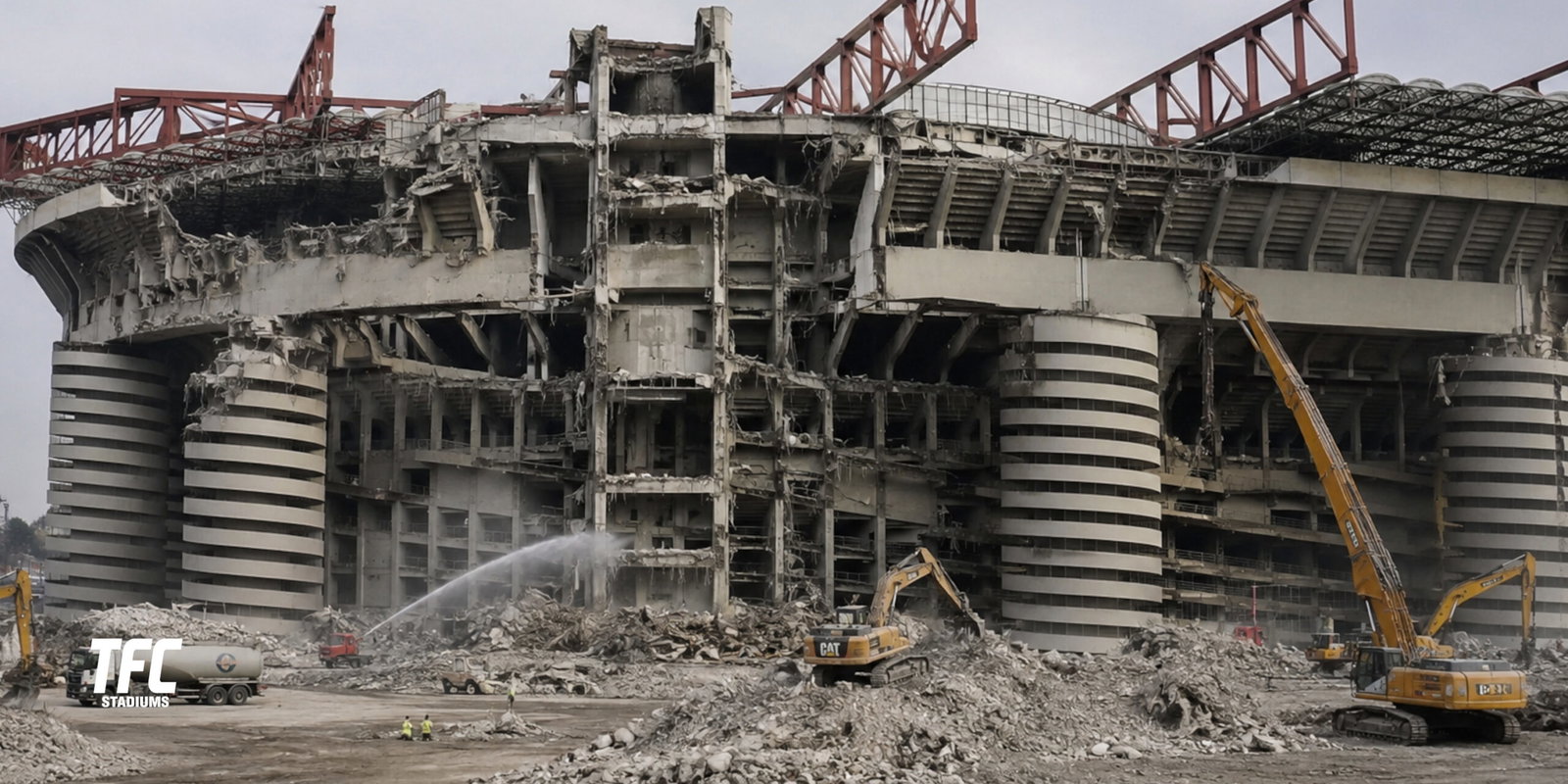
For many football supporters, San Siro is far more than concrete, steel and seats. It is one of the few stadiums that genuinely feels larger than the clubs who play there. AC Milan and Inter have won European Cups beneath its floodlights, generations of supporters have climbed its famous spiral towers, and visiting fans have often walked away believing they had experienced one of football’s great theatres.
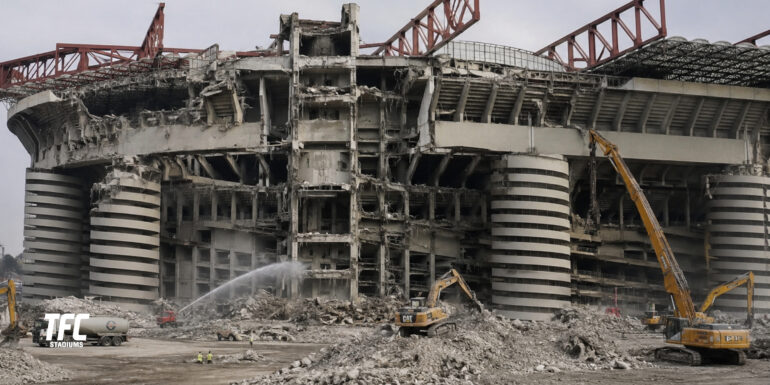
That is exactly why the proposal to demolish San Siro has become one of the most emotional stadium debates anywhere in the world.
Supporters, architects, politicians and historians continue to argue over whether replacing the stadium represents necessary progress or an irreversible mistake. Both sides have convincing arguments, making this one of modern football’s most fascinating disputes.
Why Is Demolition Even Being Considered?
At first glance, demolishing San Siro seems almost unthinkable.
The stadium still attracts huge crowds, regularly hosts Champions League football and remains one of Europe’s most recognisable sporting venues.
The problem lies beneath the atmosphere.
Originally opened in 1926, San Siro has undergone several major redevelopments, most notably ahead of Italia ’90 when its famous cylindrical towers and new roof were added. Those renovations extended its lifespan but also created a complex structure that is increasingly expensive to maintain.
Modern football places very different demands on stadiums.
Today’s clubs generate significant revenue through:
- Premium hospitality
- Corporate lounges
- Retail outlets
- Year round entertainment
- Concerts
- Museums
- Digital infrastructure
San Siro performs well in several of these areas, but not at the level achieved by Europe’s newest venues.
For clubs competing financially against Real Madrid, Bayern Munich, Tottenham Hotspur and others with modern stadiums, every commercial opportunity matters.
The Financial Argument
The strongest case for demolition is economic.
Modern stadiums are no longer simply places to watch football.
They are business districts operating throughout the week.
A new purpose-built stadium could potentially generate hundreds of millions of euros in additional income over the coming decades through improved hospitality, sponsorship opportunities and commercial developments surrounding the site.
Estimated advantages include:
| Current Challenge | Potential Benefit of a New Stadium |
|---|---|
| Limited hospitality areas | Significantly more premium seating |
| Older infrastructure | Lower maintenance costs |
| Shared operating constraints | Purpose-built commercial facilities |
| Less flexible event scheduling | Increased non-football revenue |
| Higher energy consumption | Modern sustainability standards |
This additional income could be reinvested into player recruitment, academies and club infrastructure.
From a purely financial perspective, building new often appears easier than renovating nearly a century of construction.
Why Many Fans Want It Saved
Football rarely runs on spreadsheets.
Emotion matters.
For many supporters, San Siro cannot simply be recreated elsewhere.
I’ve visited modern stadiums that offer flawless facilities, wider concourses and better food. They’re impressive. Then you arrive at San Siro and remember why football became an obsession in the first place.
The walk through the surrounding streets.
The first glimpse of those giant towers.
The climb through the spirals.
The overwhelming wall of noise when you finally emerge into the stands.
None of those experiences can simply be copied into a brand new building.
Supporters argue that football increasingly risks becoming sanitised.
San Siro still feels wonderfully unpredictable.
A Stadium That Helped Shape Football History
Few stadiums possess a résumé comparable to San Siro.
It has hosted:
- European Cup and Champions League finals
- World Cup matches
- European Championship matches
- Milan derbies
- Countless Serie A title deciders
- Legendary concerts
- International fixtures
Football history is layered into almost every section of the ground.
The memories include Marco van Basten, Paolo Maldini, Franco Baresi, Ronaldo Nazário, Javier Zanetti, Kaká, Andrea Pirlo, Andriy Shevchenko and countless other legends.
Every generation has added another chapter.
Demolition would erase the physical setting where many of those moments happened.
Could Renovation Work Instead?
This remains one of the central questions.
Several architectural studies have examined ways of modernising San Siro while preserving much of its historic identity.
Possible improvements include:
- New hospitality areas
- Improved accessibility
- Better circulation
- Expanded commercial facilities
- Modern sustainability upgrades
- Improved transport integration
The challenge is cost.
Renovating a stadium that remains in regular use is technically complicated.
Construction would likely take years.
Capacity could be reduced during works.
Unexpected structural issues often emerge once renovation begins.
In some cases, refurbishment costs approach those of entirely new construction while still leaving compromises.
The Heritage Debate
San Siro occupies an unusual position in architectural history.
Although it has changed dramatically since 1926, elements of the stadium have become recognised examples of twentieth century sports architecture.
Its iconic towers and suspended roof are instantly recognisable around the world.
Heritage campaigners argue that demolishing such a globally significant venue would represent a cultural loss extending far beyond football.
Many European cities protect historic theatres, railway stations and civic buildings despite their limitations.
Their argument is simple.
If those buildings deserve preservation, why should football architecture be treated differently?
What Other Clubs Have Done
San Siro is not facing this dilemma alone.
European football has already produced several contrasting examples.
Arsenal left Highbury and moved to the Emirates Stadium, gaining vastly improved commercial opportunities but leaving behind one of England’s most beloved grounds.
Tottenham rebuilt on the same site, creating arguably Europe’s most advanced football stadium while maintaining geographic continuity with supporters.
Real Madrid chose a different route by extensively redeveloping the Santiago Bernabéu without abandoning its historic location.
Each approach involved compromises.
None pleased every supporter.
Environmental Questions
Modern stadium projects increasingly face environmental scrutiny.
Demolishing a vast concrete structure creates enormous quantities of waste and releases significant embodied carbon.
Supporters of renovation argue that preserving much of the existing structure is often more environmentally responsible.
Advocates for a new stadium respond that energy efficient design, renewable technologies and lower operating costs could offset some of those impacts over the building’s lifespan.
The environmental calculation is therefore far from straightforward.
The Political Challenge
The future of San Siro has never been solely about football.
Local government, heritage authorities, developers and residents all hold significant influence.
Planning regulations, preservation laws and political priorities have repeatedly slowed proposals.
Each new administration has viewed the project slightly differently.
That uncertainty has prolonged the debate for years.
For AC Milan and Inter, delays also create financial uncertainty as competing European clubs continue upgrading their own facilities.
What Fans Really Fear
The greatest fear is not simply losing an old stadium.
It is losing identity.
Many supporters worry that modern stadiums increasingly resemble luxury entertainment venues rather than football grounds.
Higher ticket prices.
More hospitality.
Corporate seating replacing traditional supporters.
The atmosphere changing little by little.
San Siro still feels like football belongs to the crowd.
That emotional connection explains why so many fans continue resisting demolition.
The Case for Starting Again
Supporters of demolition point to practical realities.
A new stadium could provide:
- Better sightlines
- More comfortable seating
- Improved accessibility
- Greater commercial revenue
- Enhanced sustainability
- Better matchday services
- Modern broadcast facilities
- Improved security systems
Most importantly, it could strengthen the long term financial competitiveness of both Milan clubs.
Football is increasingly driven by revenue.
Ignoring that reality carries risks of its own.
What Makes This Debate Different?
Many famous stadiums have disappeared.
Highbury.
White Hart Lane.
The old Wembley.
None vanished without controversy.
San Siro feels different because it is not merely famous.
It has become one of football’s universal landmarks.
Supporters from every continent recognise it instantly.
It belongs as much to football history as it does to Milan.
That makes the decision feel bigger than a local redevelopment project.
Takeaway
As a football supporter, my heart wants San Siro to survive.
There is something wonderfully imperfect about it. The concrete has aged. The facilities show their years. The concourses can feel crowded. Yet the stadium possesses a character that almost every modern arena spends millions trying to imitate.
My head, however, understands why the clubs continue pushing for change.
Elite football has become an economic competition as much as a sporting one. If AC Milan and Inter are to remain among Europe’s financial heavyweights, they need facilities capable of matching their ambitions.
Perhaps that is why this debate has lasted so long.
Neither side is obviously wrong.
One argument values memory, identity and architectural heritage.
The other focuses on sustainability, commercial reality and securing the future of two historic clubs.
Whatever ultimately happens, football will lose something when San Siro’s story reaches its final chapter. The hope, shared by supporters across the world, is that whatever replaces or preserves it carries forward even a fraction of the magic that has echoed beneath those famous towers for nearly a century.
About the Author