The Basics at a Glance
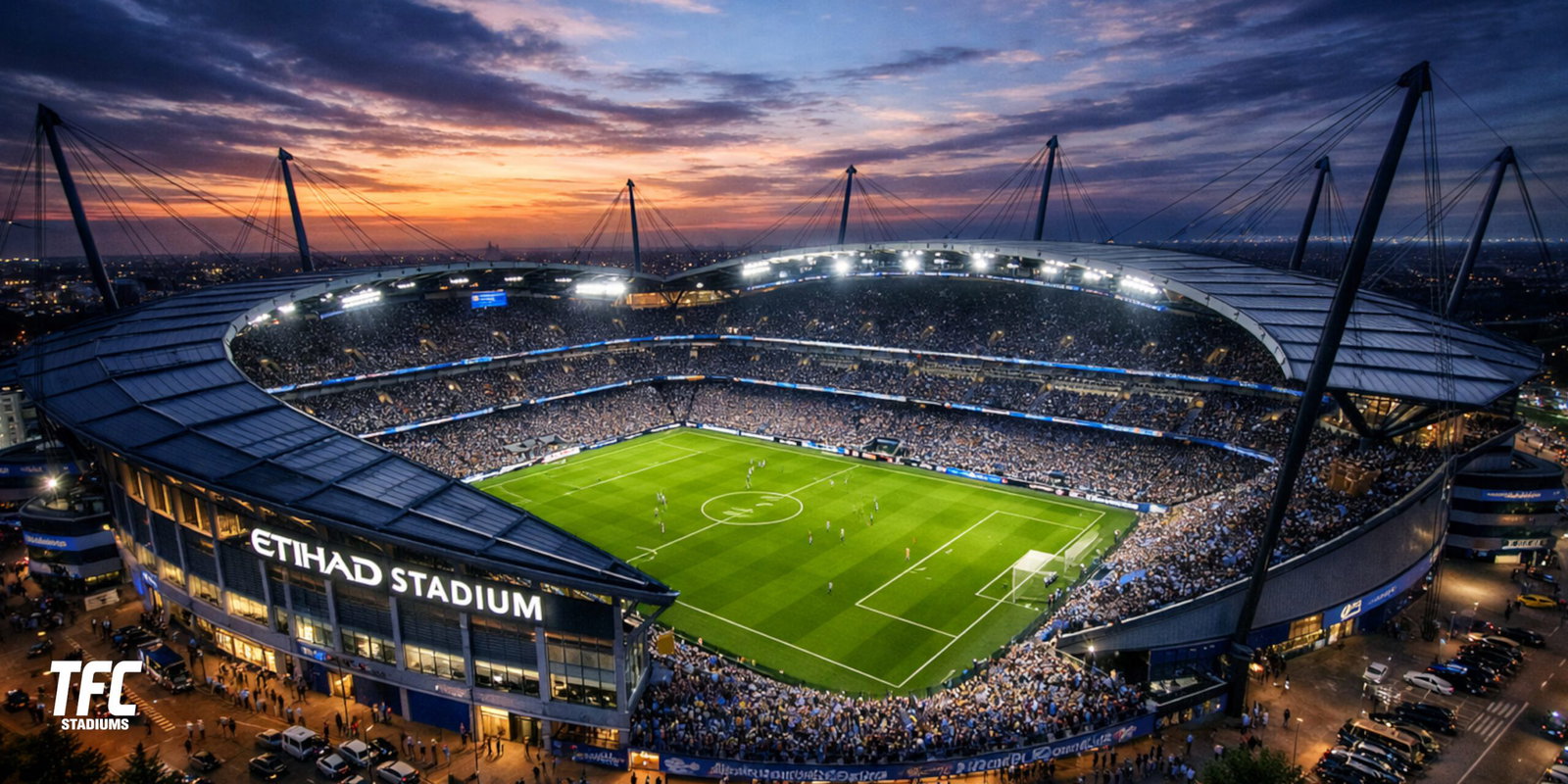
Etihad Stadium, officially known as the City of Manchester Stadium, sits in East Manchester and serves as the home of Manchester City F.C..
| Category | Detail |
|---|---|
| Opened | 2002 |
| Original Purpose | 2002 Commonwealth Games |
| Football Tenant Since | 2003 |
| Current Capacity | Approx. 53,400 |
| Record Attendance | 54,693 |
| Location | East Manchester, England |
| Owner | Manchester City Council |
| Naming Rights | Etihad Airways |
It looks sleek and modern today, but its origins are more athletic track than Champions League night.
Built for the Commonwealth Games, Not Football
The stadium was originally constructed for the 2002 Commonwealth Games, complete with an athletics track.
After the Games, it underwent a major conversion to become a football-only stadium. The track was removed, the pitch lowered, and seating brought closer to the action. That decision changed the atmosphere entirely. Instead of a multi-purpose arena, City gained a compact and intimidating ground.
A stadium that began life hosting sprinters now hosts Erling Haaland.
The Pitch Was Literally Lowered
When Manchester City moved from Maine Road in 2003, the stadium had to feel like a football home rather than a converted athletics bowl.
Engineers excavated the playing surface to create a steeper seating bowl. This allowed additional rows of seating closer to the pitch.
| Conversion Element | Impact |
|---|---|
| Pitch lowered by | Approx. 2 metres |
| Additional seating added | Around 6,000 |
| Athletics track removed | Yes |
| Seating proximity improved | Significantly |
The result is one of the better sightline experiences in the Premier League.
The Roof Design Is Structurally Ambitious
The stadium’s sweeping roof is supported by a cable-stayed system attached to twelve external masts. It gives the ground a distinctive silhouette on the Manchester skyline.
From above, it resembles a shallow bowl wrapped in steel cables. From inside, it feels open yet acoustically contained.
It is modern without feeling cold. That balance is not easy to achieve.
It Has Expanded More Than Once
Capacity has steadily increased as Manchester City’s fortunes have grown.
In 2015 and 2016, a major expansion added a third tier to the South Stand. More recently, the North Stand expansion has pushed the capacity beyond 53,000, with plans aiming toward approximately 60,000 in the coming years.
| Year | Development | New Capacity |
|---|---|---|
| 2003 | Football conversion | 47,000 approx |
| 2015 | South Stand expansion | 55,000 approx |
| 2023 onward | North Stand redevelopment | 53,000 plus, rising |
Success on the pitch tends to demand more seats off it.
It Sits at the Heart of a Regeneration Project
The stadium was central to the regeneration of East Manchester. What was once industrial land became a growing sports and commercial district.
The surrounding Etihad Campus includes training facilities, the City Football Academy, and community pitches.
This is not just a stadium. It is an ecosystem built around a football club with global ambitions.
It Has Hosted More Than Football
Although football dominates, the stadium has welcomed major events across sports and entertainment.
Notable events include:
- 2002 Commonwealth Games
- England internationals
- Rugby League fixtures
- Large-scale concerts
Artists such as Oasis and Take That have filled the stands. The acoustics hold up surprisingly well for a football ground.
The Record Attendance Is Not What You Might Expect
The stadium’s record attendance stands at 54,693, achieved during a Manchester City versus Leicester City match in 2016.
It is not a European final or derby. It was a league match during the title-winning season under Pep Guardiola.
That says something about the club’s growth. The demand is now consistent, not occasional.
It Is One of the Most Technologically Advanced Stadiums in England
The Etihad Stadium integrates modern connectivity and fan infrastructure that supports:
- High-capacity Wi-Fi networks
- Digital ticketing systems
- Advanced security and crowd flow technology
- LED lighting upgrades
Manchester City’s ownership group has invested heavily in both aesthetics and infrastructure. The club’s ambitions are not subtle.
The Naming Rights Reflect Global Strategy
Since 2011, the stadium has been known as the Etihad Stadium following a sponsorship agreement with Etihad Airways.
The deal extended beyond naming rights and included investment in surrounding facilities. It marked a turning point in how the club positioned itself commercially.
Some fans still call it the City of Manchester Stadium. Old habits linger. Branding, however, moves forward.
It Replaced Maine Road, But It Changed the Club’s Identity
Maine Road was tight, raw, and unpredictable. The Etihad Stadium is modern, polished, and expansive.
The move symbolised more than relocation. It represented a shift in ambition.
Manchester City went from a historic English club with passionate local support to a global powerhouse competing for Premier League and Champions League titles almost every season.
Stadiums shape identity. This one helped shape an era.
TFC Takeaway
The Etihad Stadium is not the oldest ground in England. It does not carry the century-old mystique of certain rivals. What it does carry is momentum.
It began as a Commonwealth Games venue and became the home of one of Europe’s most dominant football sides. That transformation mirrors the club itself.
Not bad for a stadium that once had a running track.
About the Author