For much of its life, Anoeta Stadium was one of Spanish football’s most frustrating paradoxes. It belonged to one of Spain’s most admired clubs, produced generations of exceptional players and regularly hosted European nights, yet the stadium itself often felt strangely detached from the action.
The culprit was not the football. It was the athletics track.
Supporters of Real Sociedad spent more than two decades watching their team from distances that sometimes made the players resemble expensive action figures. Visiting fans rarely complained. Home supporters certainly did.
Today, the stadium tells a completely different story.
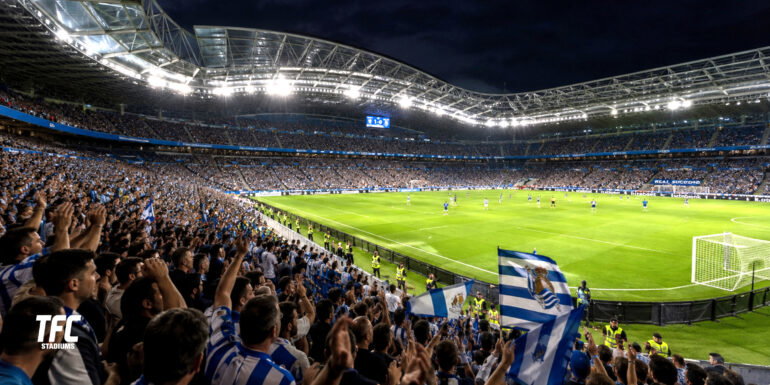
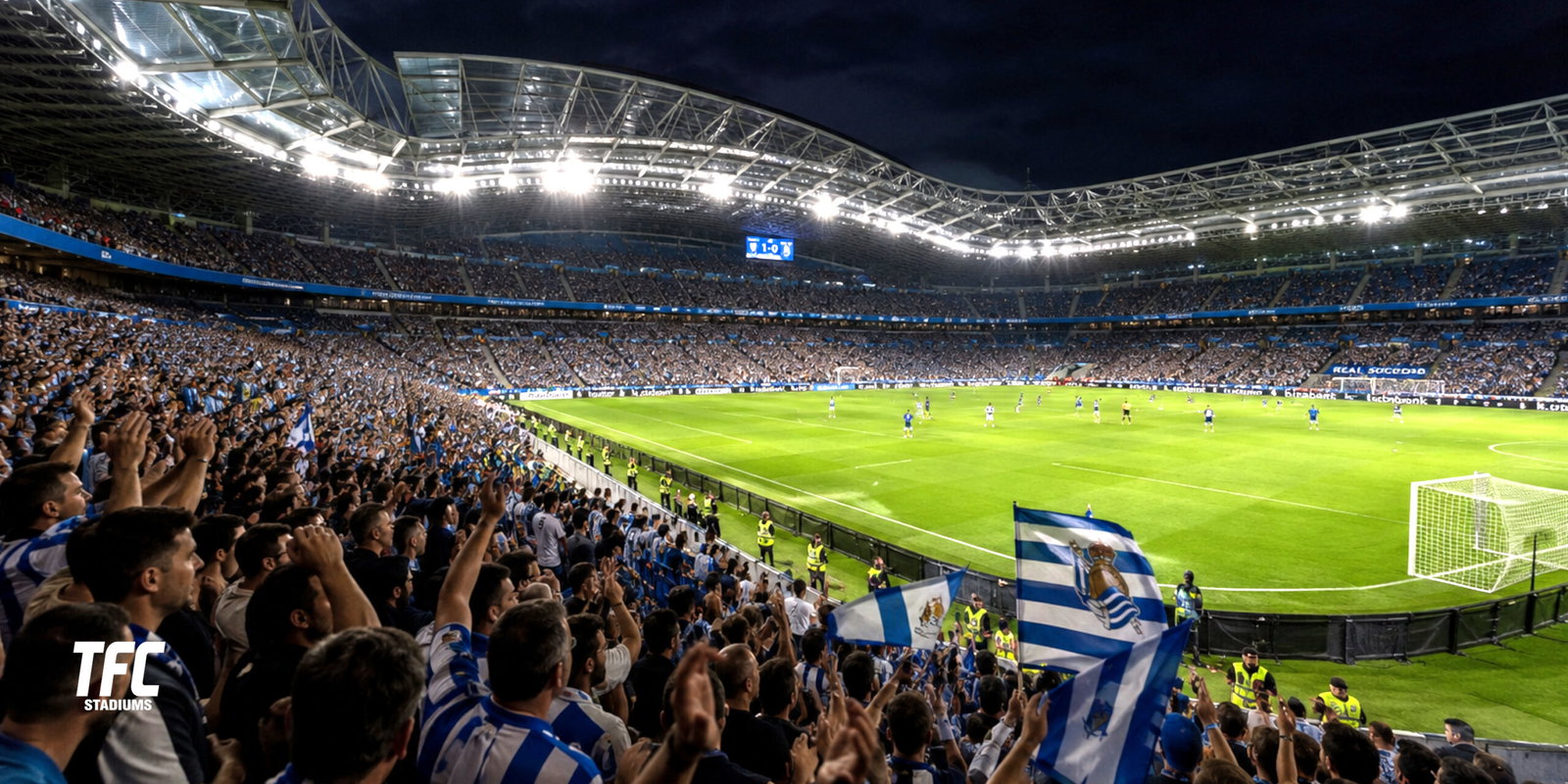
Known commercially as Reale Arena, the former Anoeta has transformed into one of Spain’s finest modern football grounds. The atmosphere is louder, the sightlines are excellent and the stadium has finally become worthy of one of La Liga’s most respected clubs.
Its journey has been anything but straightforward.
The Need for a New Stadium
Before Anoeta, Real Sociedad played at the historic Atocha Stadium, one of Spanish football’s great traditional grounds.
Opened in 1913, Atocha developed a reputation for being intimidating. The stands pressed tightly against the pitch, supporters were almost on top of the players and the atmosphere became legendary throughout Spanish football.
Unfortunately, romance rarely solves practical problems.
By the late twentieth century Atocha had become increasingly outdated.
Problems included:
- Limited capacity
- Restricted expansion opportunities
- Ageing infrastructure
- Poor commercial facilities
- Safety standards that no longer matched modern expectations
Rather than attempt an almost impossible redevelopment, the decision was made to build an entirely new stadium.
Construction of Anoeta
Construction began during the early 1990s in San Sebastián, or Donostia in Basque.
Anoeta officially opened in August 1993.
The project cost approximately €47 million, a substantial investment for the time, and was intended as a multi-purpose sports venue rather than a football-specific stadium.
Key facts included:
| Feature | Original Specification |
|---|---|
| Opening | 1993 |
| Original Capacity | Around 32,000 |
| Main Tenant | Real Sociedad |
| Surface | Natural grass |
| Design | Multi-purpose stadium with athletics track |
At the time, the design reflected stadium thinking across Europe.
The Olympic movement was hugely influential, and many cities preferred venues capable of hosting athletics, concerts and football rather than specialist football grounds.
It seemed sensible.
Football supporters soon disagreed.
The Athletics Track Problem
The defining feature of old Anoeta was the blue athletics track surrounding the pitch.
It looked attractive from above.
It was far less enjoyable from Row 25.
The gap between supporters and the action significantly reduced atmosphere compared with Atocha. Chants lost some of their intensity before reaching the players and television broadcasts often made the stadium appear quieter than it really was.
Psychology plays a remarkable role in football.
Research into crowd influence consistently shows that proximity between fans and players increases perceived pressure on officials and visiting teams. While atmosphere depends on supporters rather than concrete, the design of a stadium can amplify or reduce crowd noise.
Anoeta often muted what should have been one of Spain’s most passionate football audiences.
A New Home for Real Sociedad
Despite criticism, Anoeta quickly became home to some outstanding Real Sociedad teams.
Throughout the late 1990s and early 2000s, the stadium welcomed stars including:
- Xabi Alonso
- Nihat Kahveci
- Darko Kovačević
- Valeriy Karpin
- Antoine Griezmann
- Carlos Vela
- Mikel Oyarzabal
The club challenged for the La Liga title in the 2002 to 03 season, finishing runners-up behind Real Madrid.
Although supporters still missed the intimacy of Atocha, Anoeta witnessed plenty of memorable nights.
European football returned regularly, helping establish the stadium as one of northern Spain’s major sporting venues.
More Than Football
Anoeta was always designed to accommodate more than football.
Over the years it has hosted:
- International rugby matches
- Concerts by major international artists
- Athletic competitions
- Cultural events
- Community celebrations
Its flexible design allowed San Sebastián to stage events that would have been impossible at the old Atocha ground.
That versatility justified much of the original investment, even if football fans remained unconvinced.
The Great Transformation
Eventually the obvious solution became unavoidable.
Remove the athletics track.
Following years of planning and debate, redevelopment began in 2017.
The project fundamentally reshaped the stadium rather than replacing it.
Major improvements included:
- Complete removal of the athletics track
- New lower seating sections
- Spectators moved dramatically closer to the pitch
- Expanded hospitality facilities
- Improved accessibility
- Modern concourses
- Enhanced lighting
- Upgraded player and media facilities
Perhaps most importantly, the stadium finally looked and sounded like a football ground.
Supporters immediately noticed the difference.
Noise bounced around the enclosed bowl rather than disappearing across an empty running track.
Players frequently commented on the improved atmosphere, while television viewers could finally appreciate the intensity generated by Real Sociedad supporters.
Capacity Through the Years
Like many modern stadiums, capacity has changed following redevelopment.
| Period | Capacity |
|---|---|
| 1993 Opening | Approximately 32,000 |
| During Redevelopment | Reduced temporarily |
| Current Stadium | Around 39,500 |
The increase came despite bringing supporters closer to the pitch, demonstrating how efficiently the redesign used available space.
It remains one of Spain’s larger football stadiums outside Madrid, Barcelona and Seville.
Becoming Reale Arena
In 2019, Real Sociedad signed a naming rights agreement with insurer Reale Seguros.
The stadium officially became Reale Arena.
Among supporters, however, the original name remains remarkably resilient.
Many still refer to it simply as Anoeta.
Football supporters are creatures of habit. Rename a stadium and many will politely ignore you for the next thirty years.
European Football Returns
The redeveloped stadium arrived at an ideal moment for the club.
Real Sociedad established themselves as regular contenders for European qualification under successive managers, combining academy graduates with intelligent recruitment.
The improved stadium became an important asset.
Higher attendances, increased hospitality revenue and better commercial opportunities strengthened the club’s finances while creating a more intimidating home environment.
In modern football, stadiums are no longer simply places to watch matches. They are year-round business assets.
Anoeta’s redevelopment reflected that reality perfectly.
Architecture and Design
The current stadium combines practicality with understated elegance.
Unlike many recently constructed arenas, it avoids dramatic architectural gimmicks.
Instead, the focus is on supporter experience.
Strengths include:
- Excellent sightlines
- Continuous seating bowl
- Steep lower tiers
- High-quality roofing for improved acoustics
- Modern hospitality spaces
- Efficient circulation around the concourses
The clean design also complements San Sebastián’s reputation for refined architecture without competing with the city’s famous coastline and historic centre.
Anoeta by the Numbers
| Statistic | Figure |
|---|---|
| Opened | 1993 |
| Major Redevelopment | 2017 to 2019 |
| Current Capacity | Around 39,500 |
| Home Club | Real Sociedad |
| City | San Sebastián, Basque Country |
| Original Stadium Replaced | Atocha Stadium |
| Athletics Track | Removed during redevelopment |
The Stadium’s Place in Spanish Football
Anoeta’s history mirrors wider trends across European football.
Many stadiums built during the late twentieth century prioritised flexibility over atmosphere.
Years later, clubs across Europe reached the same conclusion.
Football supporters want to feel close to the action.
Germany embraced football-specific stadiums earlier than most, England accelerated after the Taylor Report, while Spain gradually modernised many of its older grounds during the twenty-first century.
Real Sociedad’s redevelopment fits neatly into that evolution.
Rather than abandoning the stadium, the club adapted it for the modern game.
The result feels like an entirely different venue.
Legacy
Anoeta has lived two very different lives.
The first was a practical, versatile sports stadium that never quite captured the emotion of the club it served.
The second has become one of Spain’s finest football arenas, combining modern facilities with the intensity that Real Sociedad supporters had long wanted.
That transformation has strengthened both the club and the matchday experience.
Sometimes the biggest improvement is surprisingly simple.
Move the fans closer to the football.
It took more than twenty years to reach that conclusion, but few supporters would argue the wait was not worthwhile.
About the Author