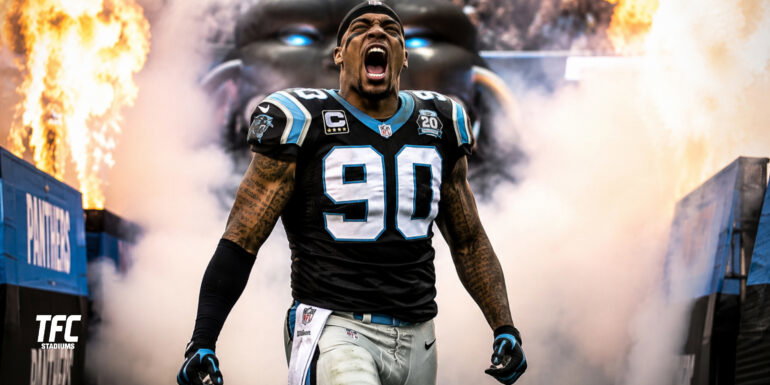
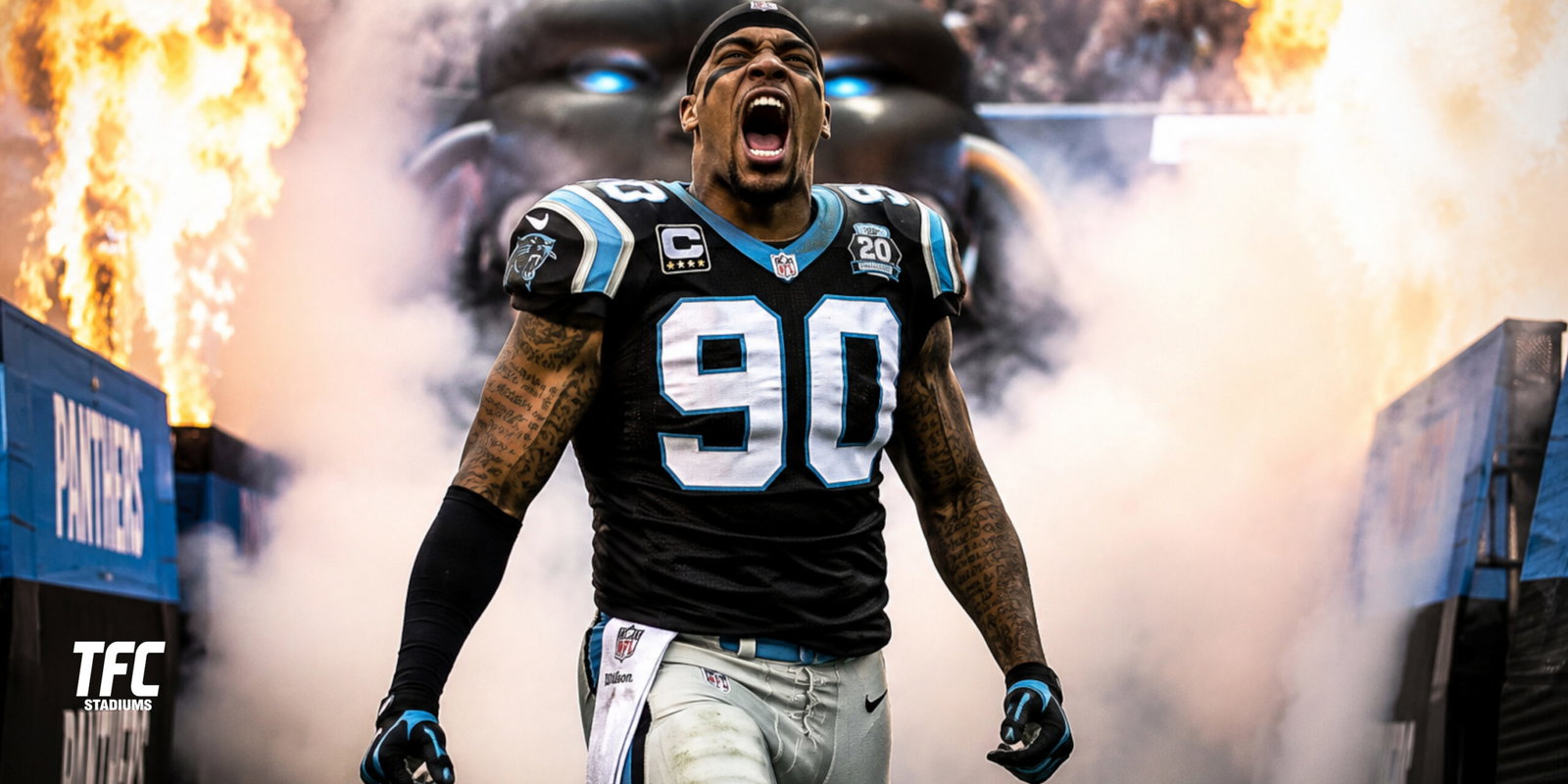
Mention Bank of America Stadium to Carolina Panthers fans and the conversation rarely stays away from No. 90 for very long. His combination of speed, power and athleticism turned Sundays into a fairly miserable experience for opposing quarterbacks, while Panthers supporters enjoyed the sort of defensive dominance that every franchise spends decades trying to find.
The NFL has seen plenty of elite pass rushers. Few combined size, intelligence and sheer versatility quite like Peppers. Standing 6-foot-7 and weighing around 295 pounds, he looked like someone who had accidentally wandered onto the field from an NBA practice, then proceeded to sack the quarterback anyway.
More than twenty years after his debut, his fingerprints remain all over Carolina football.
The Beginning of a Franchise Icon
When the Carolina Panthers selected Julius Peppers with the second overall pick in the 2002 NFL Draft, expectations were already enormous.
The former University of North Carolina star had excelled in both football and basketball. That rare athletic background helped create one of the most complete defensive players of his generation.
His rookie season immediately justified the hype.
He finished with:
| Statistic | 2002 Season |
|---|---|
| Sacks | 12 |
| Forced Fumbles | 5 |
| Interceptions | 1 |
| Defensive Rookie of the Year | Yes |
It became obvious almost immediately that Carolina had landed a cornerstone player rather than simply another talented edge rusher.
Bank of America Stadium Became His Hunting Ground
Every great stadium develops its own folklore.
Lambeau has its Frozen Tundra.
Arrowhead has deafening crowd noise.
Charlotte had Julius Peppers closing in on another quarterback.
Home games developed a familiar rhythm. The Panthers’ defence forced third-and-long, the crowd rose to its feet, offensive tackles glanced nervously across the line of scrimmage, and Peppers exploded off the edge with frightening speed.
He never relied solely on brute strength.
His success came from:
- Outstanding first-step acceleration
- Exceptional reach
- Refined hand technique
- Patience reading offensive formations
- The ability to line up almost anywhere across the defensive front
Even when he did not record a sack, he disrupted passing lanes, hurried throws and altered entire offensive game plans.
Those contributions rarely appear fully in a stat sheet.
The Numbers Behind the Legacy
Peppers retired with statistics that place him among the greatest defensive players in NFL history.
Career highlights include:
| Career Achievement | Total |
|---|---|
| Career sacks | 159.5 |
| Panthers franchise sacks | 97 |
| Forced fumbles | 52 |
| Interceptions | 11 |
| Defensive touchdowns | 4 |
| Pro Bowls | 9 |
| First-Team All-Pro selections | 3 |
His 97 sacks remain one of the defining franchise records.
Perhaps even more impressive was his consistency.
Across seventeen NFL seasons, Peppers produced double-digit sacks ten times. That level of sustained excellence is remarkably rare, particularly for defensive linemen who endure constant double teams.
More Than Just Sacks
One of the biggest misconceptions surrounding Peppers is that he was simply a pass-rushing specialist.
That hardly tells the full story.
His height allowed him to bat passes at the line of scrimmage with remarkable regularity.
His basketball background gave him unusual agility when changing direction.
He could chase running backs in open space.
He occasionally dropped into coverage and even intercepted passes.
Watching him play often felt slightly unfair. Offensive coordinators would solve one problem only to discover he had another way of ruining the afternoon.
The 2003 Super Bowl Run
The Panthers’ remarkable journey to Super Bowl XXXVIII remains one of the defining periods in franchise history.
Although quarterback Jake Delhomme and wide receiver Steve Smith generated many of the headlines, Carolina’s defence powered much of the team’s success.
Peppers emerged as its centrepiece.
Throughout the season and playoffs, Bank of America Stadium became one of the NFL’s toughest places to visit.
The Panthers fed off an aggressive defensive identity built around relentless pressure and physical football.
That style perfectly matched the city itself.
Hard-working, blue-collar and quietly confident.
Leaving and Returning
NFL careers rarely follow a perfectly straight path.
Peppers left Carolina in 2010, signing with the Chicago Bears before later joining the Green Bay Packers.
Many fans wondered whether his best years had passed.
Instead, he continued producing at an elite level well into his thirties.
When he returned to Carolina in 2017, it felt less like a free-agent signing and more like a family reunion.
Older?
Certainly.
Slower?
A little.
Dangerous?
Absolutely.
His leadership became just as valuable as his production, helping mentor younger defensive players while continuing to make game-changing plays.
Comparing Peppers with the NFL’s Great Pass Rushers
Peppers belongs comfortably in discussions alongside the greatest defensive ends the league has ever seen.
| Player | Career Sacks |
|---|---|
| Bruce Smith | 200 |
| Reggie White | 198 |
| Kevin Greene | 160 |
| Julius Peppers | 159.5 |
| DeMarcus Ware | 138.5 |
Statistics never tell the whole story, but this company certainly says plenty.
Peppers reached these numbers during an era increasingly designed to help quarterbacks.
Rule changes favoured passing offences, making elite defensive production harder than ever.
The Charlotte Connection
Unlike some star players who become temporary residents, Peppers developed a genuine connection with North Carolina.
He had already become a local sporting hero during his college career before ever wearing Panthers colours.
That local identity strengthened his relationship with fans.
Children growing up in Charlotte during the 2000s often wore No. 90 jerseys instead of chasing the latest offensive superstar.
Defence can sell jerseys too, provided the defender looks capable of folding an offensive tackle in half.
Hall of Fame Recognition
Peppers’ induction into the Pro Football Hall of Fame confirmed what Panthers fans had known for years.
He was not merely a great Carolina player.
He was one of the defining defensive players of his generation.
His career blended longevity, athletic excellence and consistency in a way few players have managed.
The honour also reinforced Bank of America Stadium’s place in NFL history as the home of one of football’s greatest defensive careers.
How Fans Remember Him
Ask Panthers supporters about Julius Peppers and the stories usually begin before the statistics.
They remember:
- The roar before obvious passing downs.
- Offensive tackles desperately grabbing at air.
- Quarterbacks scrambling into mistakes.
- Huge momentum-changing sacks.
- His calm personality that contrasted with the chaos he created on the field.
Some legends rely on nostalgia.
Peppers does not need much help from memory.
The film still looks impressive.
His Lasting Influence on the Panthers
Every franchise has players who establish its identity.
For Carolina, Julius Peppers helped define what elite defensive football looked like.
Future pass rushers arriving in Charlotte inevitably face comparisons with him. That is hardly surprising.
He set the standard for professionalism, preparation and production.
Even today, whenever a Panthers defender records multiple sacks at Bank of America Stadium, someone in the crowd inevitably says the same thing.
“That looked a little like Julius.”
Few compliments carry more weight.
Takeaway
Bank of America Stadium has hosted thrilling victories, heartbreaking defeats and countless memorable moments since opening in 1996. Through all those seasons, one player consistently stood above the rest on defence.
Julius Peppers combined extraordinary athletic ability with technical excellence and remarkable longevity. He terrorised quarterbacks for nearly two decades, became the face of Panthers football across multiple generations and left behind records that continue to shape the franchise.
Every stadium has its defining figures. Some score touchdowns. Some throw impossible passes. Julius Peppers did something arguably more satisfying. He made quarterbacks question whether dropping back was really such a good idea in the first place.
Long after new stars emerge in Charlotte, No. 90 will remain one of the first names that comes to mind whenever fans think about greatness at Bank of America Stadium.
About the Author