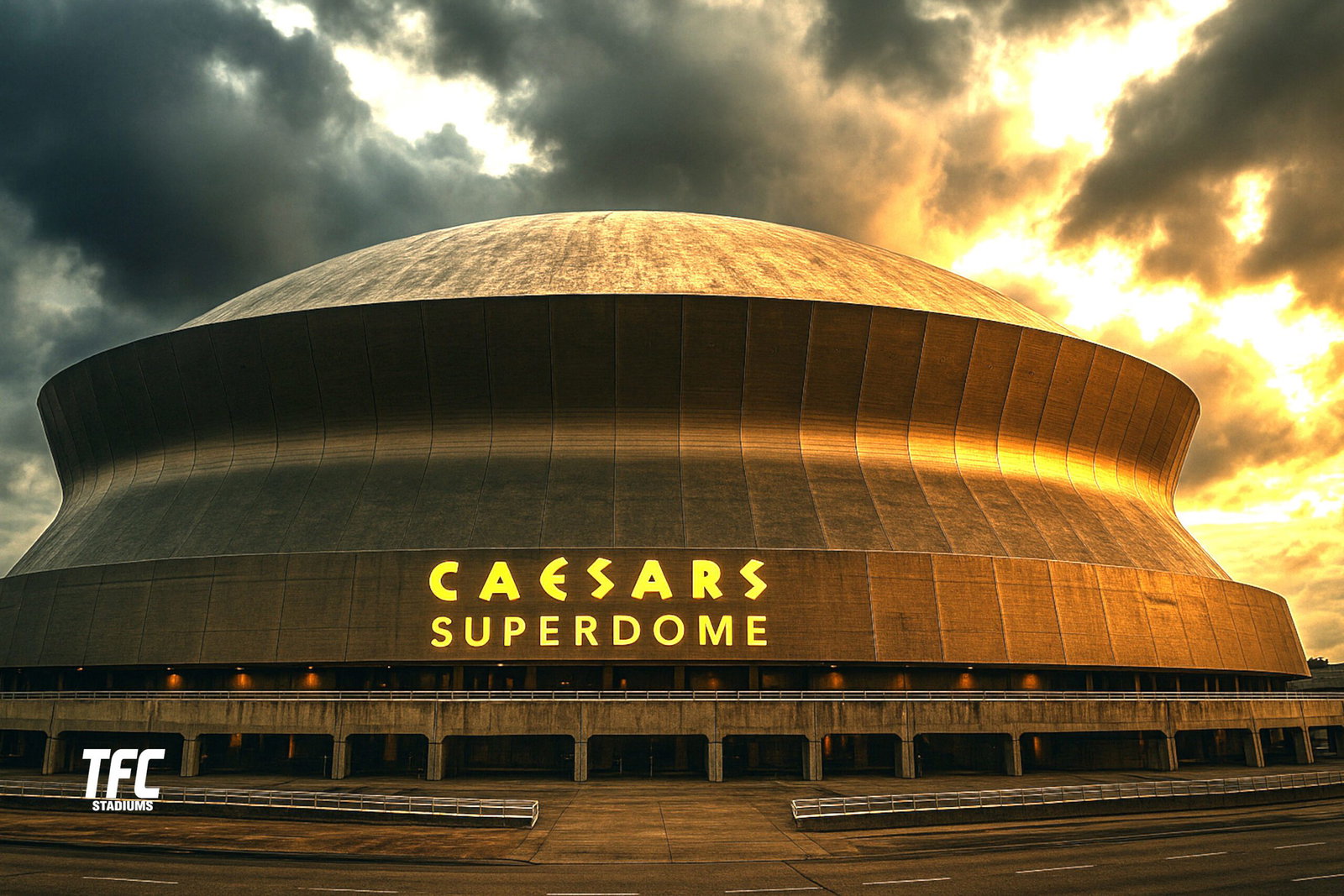
The Superdome does not whisper its importance. It sits in New Orleans like a concrete mic drop, daring every newer stadium to try and top it. Flashier venues have come and gone, roofs have slid and folded and opened on cue, yet the Superdome remains the benchmark for what a true fixed dome can be.
Built long before architects decided every roof needed to move, this place went big and stayed put. That stubborn confidence is part of its charm.
What Makes the Superdome the Largest Fixed Dome
The Caesars Superdome earns its claim through sheer scale. Its roof spans roughly 680 feet in diameter, a figure that still holds up decades later. There are larger enclosed volumes in the world, but when the conversation narrows to a single, non retractable dome covering an entire stadium bowl, the Superdome remains the standard reference point.
The structure covers more than thirteen acres and rises high enough to make quarterbacks feel like they are throwing into low orbit. The roof is self supporting, with no interior columns blocking sightlines. That decision alone explains why the building feels cavernous even when it is half full.
This was not about elegance. It was about doing something massive and making it work.
Engineering Confidence from a Different Era
The Superdome was completed in the mid 1970s, which matters. This was a time when stadiums were built to intimidate rather than charm. Engineers opted for a steel and concrete shell capable of withstanding hurricane level winds, because New Orleans demands that kind of respect.
The fixed roof was a gamble at the time. Air conditioning a space this large was no small task, and neither was keeping it structurally sound in a city built below sea level. The result was a building that feels over engineered in the best possible way, like it was designed by people who did not trust nature one inch.
That mindset paid off more than once.
The Superdome as a Cultural Anchor
Calling the Superdome just a sports venue misses the point. This building has hosted Super Bowls, Final Fours, WrestleMania, and concerts that rattled the rafters. It has also played a far heavier role in the city’s story.
After Hurricane Katrina, the Superdome became a refuge. That chapter is complicated and uncomfortable, but it cemented the stadium’s place in New Orleans history far beyond football. Few venues anywhere can claim that level of civic relevance.
On Sundays, though, it returns to its natural state. Loud, hostile, and unapologetically tilted in favour of the Saints.
How It Stacks Up Against Modern Domes
Modern stadiums love flexibility. Retractable roofs, translucent panels, and architectural curves designed for drone shots now dominate the market. The Superdome does none of that.
Instead, it offers consistency. Weather never changes the game. Noise stays trapped inside. Sightlines remain brutally honest. Visiting teams know exactly what they are getting, and they usually do not enjoy it.
While newer domes may look sleeker, few match the Superdome’s ability to feel overwhelming. It is not pretty. It is effective. There is a difference.
Why the Superdome Still Matters
The Superdome endures because it represents a philosophy that stadium design has largely moved away from. Bigger was better. Fixed meant final. Once it was built, there was no need to apologise for it.
For all the talk of innovation, many newer venues still chase the atmosphere this building produces naturally. The noise. The scale. The sense that the structure itself is part of the home advantage.
That is a hard thing to engineer after the fact.
Final Word from Rick Dalton
I have spent years watching teams spend billions trying to outsmart gravity, weather, and common sense. Meanwhile, the Superdome just sits there, doing exactly what it was built to do.
It does not open. It does not flex. It does not pretend to be subtle. It looms, it traps sound, and it dares you to beat the home team anyway.
That is not nostalgia. That is dominance poured in concrete.
About the Author