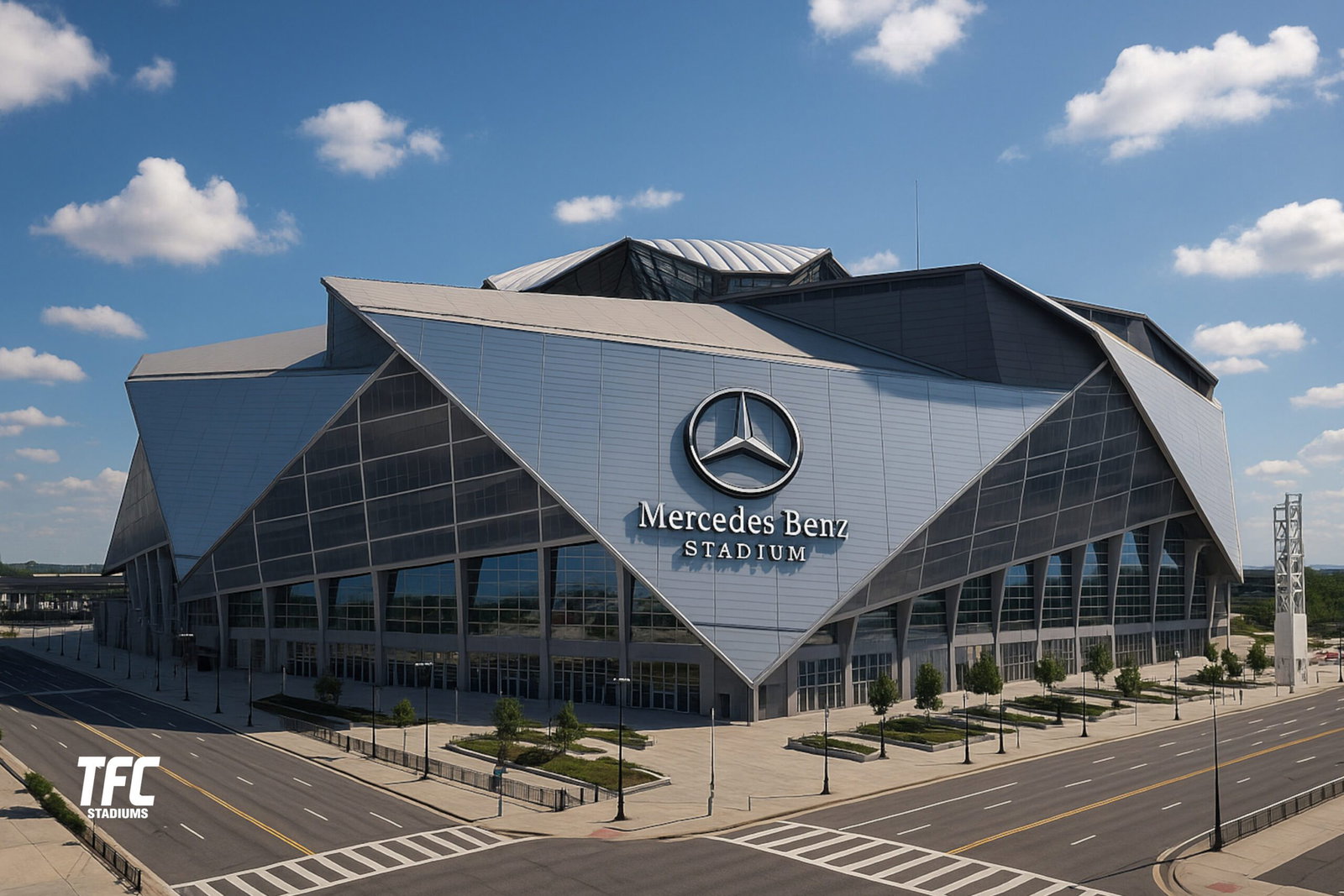
Opened in 2017 as the home of the Atlanta Falcons and Atlanta United FC, Mercedes-Benz Stadium has rapidly become one of the most talked-about venues in modern sport. It blends advanced engineering with fan-first design principles and sets new standards in sustainability, flexibility, and scale.
The Retractable Roof
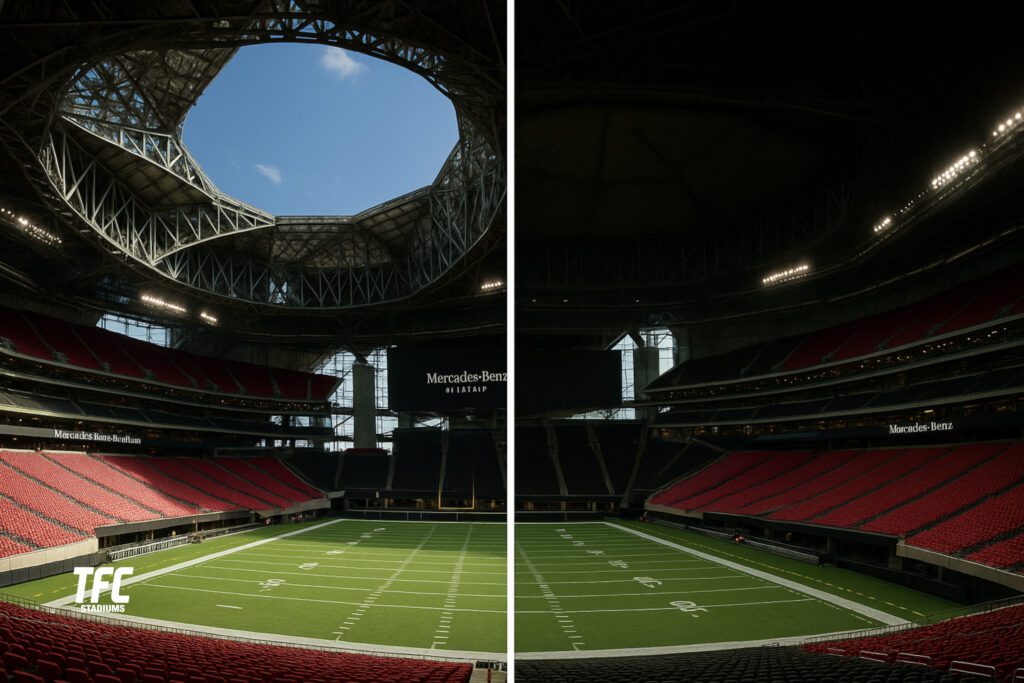
The stadium’s eight-panel retractable roof is its most striking feature. Inspired by the oculus of the Roman Pantheon, it opens and closes like a camera lens, requiring precise coordination from 1,600 motors. Unlike traditional sliding-panel systems, this one rotates and stacks inward in a circular pattern, allowing the venue to transition from an enclosed dome to an open-air stadium in about 12 minutes.
The roof’s engineering complexity lies in its dual-track rail system and the need to synchronise each petal’s movement down to the millimetre. The process was initially slow and experimental, but refinements have made it more reliable over time.
Halo Video Board
Suspended from the roof is a 360-degree “halo” video board measuring 63,000 square feet. At the time of construction, it was the largest of its kind in the world. The screen’s curved, continuous design ensures visibility from every seat in the stadium, eliminating the need for conventional corner or centre-hung scoreboards.
The board not only displays real-time gameplay, statistics, and replays, but also integrates social media feeds, fan cams, and concert visuals. Its massive size and position add to the architectural symmetry of the space without dominating it.
Sustainability and LEED Platinum Certification

Mercedes-Benz Stadium was the first professional sports stadium in the United States to receive LEED Platinum certification, the highest sustainability rating awarded by the U.S. Green Building Council.
Key features include:
- 4,000 solar panels capable of offsetting power usage for ten Falcons games annually.
- A stormwater management system that captures and reuses over 2 million gallons of water.
- Water-efficient plumbing fixtures that reduce usage by 47% compared to a typical stadium.
- LED lighting systems and automated energy controls that minimise consumption.
These elements are not bolt-ons but integral to the design, showing that environmental responsibility can be achieved at scale without compromising functionality.
Fan Experience and Accessibility
The stadium was designed with the fan experience as a core principle. Concourse layouts are wide and open, offering clear views of the field from food vendors and walkways. Ticketing and security lines are handled efficiently with digital-first systems, while Wi-Fi and mobile app integrations support mobile ticketing, food ordering, and instant seat upgrades.
Perhaps most revolutionary is the pricing model for concessions. Mercedes-Benz Stadium pioneered fan-friendly pricing with £1.50 hot dogs, £2 soft drinks with free refills, and similarly priced items across the board. This approach has reshaped expectations across the NFL and MLS, prompting other venues to follow suit.
Versatility for Events
Mercedes-Benz Stadium is not limited to football and soccer. Its field and seating configurations can be adapted for concerts, college championships, esports tournaments, and more. This modularity was part of the initial planning, allowing quick turnovers and minimal downtime between major events.
The field level, for instance, can shift from artificial turf to a temporary stage floor. Additional lower-bowl seating can be removed or expanded as needed, while lighting and acoustics have been tailored to match both sports and entertainment requirements.
Engineering Beyond the Structure
Beyond the roof and screen, the stadium’s construction included advanced materials and techniques. The massive steel trusses used to support the roof structure were pre-fabricated off-site, trucked in, and lifted using one of the largest cranes in North America. The exterior of the building features ETFE, a lightweight, transparent polymer that lets in natural light while protecting against heat and UV.
Load-bearing concrete was mixed with local aggregate to reduce environmental impact and speed up construction. From foundation to finish, the engineering challenge was not just about innovation, but about executing that innovation at a commercial scale.
Legacy and Influence
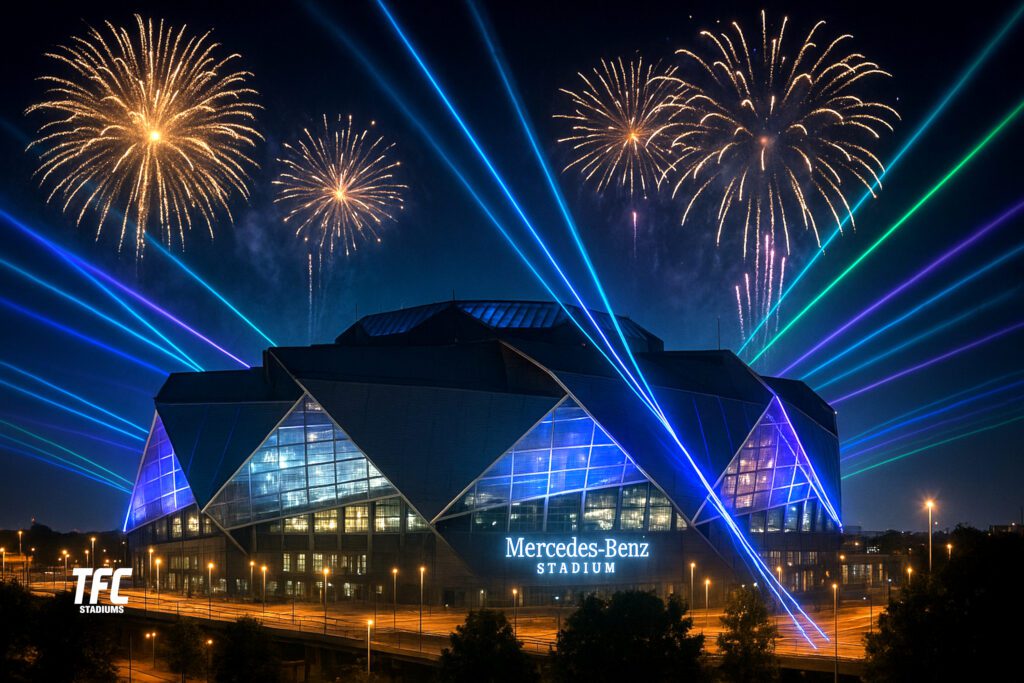
Mercedes-Benz Stadium has set a precedent. Its influence can be seen in the design of newer stadiums such as Allegiant Stadium in Las Vegas and SoFi Stadium in Los Angeles. Both have borrowed elements of fan-friendly pricing, visual openness, and retractable technology. The Atlanta venue has proven that an arena can be visually dramatic, operationally sound, and financially responsible.
It also acts as a civic centre, hosting community events, job fairs, and public health drives, further embedding it in the identity of the city.
Conclusion
Mercedes-Benz Stadium is not just a showcase of modern architecture. It is a functional, sustainable, and fan-focused venue that redefines what a stadium can be. Through clever design and engineering, it merges form and purpose without compromise.
About the Author